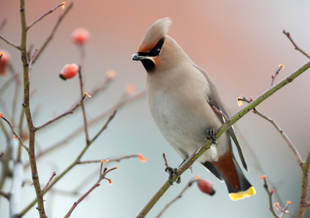
 Finally I could hear the birds, and those were not the voices of cedar waxwings. The birds were Bohemian waxwings! We have lived at this location for going on 22 years, and this is the first time I have seen Bohemian waxwings here. I had previously seen them in Ontario and Quebec, Canada in autumn and in the northern Lower Peninsula during winter, but for this was the first time I had seen them south of the Gaylord area. They are generally a bird of the far northern forests.
I needed a break anyway, so I set the wheelbarrow down and watched the birds as they all swooped down to cranberry bushes and began to feed. After a few minutes they all picked up and flew around, landing once again in the box elder, now almost over my head. As I picked up the handles on the wheelbarrow and started again toward the house, the birds didn’t go anywhere. They just let me trundle on by. That is another difference between Bohemian waxwings and cedar waxwings – my experience has been that Bohemian waxwings are substantially less skittish than cedar waxwings. Later, from the house, I could see them back in the cranberry bushes feeding on berries again.
The birds hung around for about three weeks. I saw as few as about 15 and as many as 48 together at one time. I am still amazed that they came this far south, but I discovered there were several locations across southern and mid-Michigan where Bohemian waxwings were reported this winter. I presume that either they experienced particularly good nest success this year, resulting in more of them seeking winter food and pushing farther south in that search, or that food is scarce in their usual northern haunts. Either way, I was very pleased to see them.
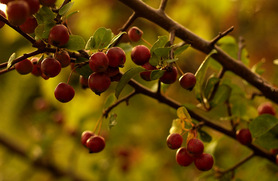
If you would like to provide natural food during winter for birds like waxwings, bluebirds and robins, you might consider planting high bush cranberries, Sargent’s crabapples or Siberian crabapples. These shrubs and small trees produce fruit that stays on through the winter and is available to wildlife when most fruits are gone. I have found that creatures eat the crabapples first, and they eat the high bush cranberries when things get tough. You might also be interested to know that I have never had a problem with deer munching high bush cranberry bushes, but they will eat both the Sargent’s crabapple bushes and Siberian crabapple trees. Siberian crabapples eventually grow out of the reach of deer and become small trees, but I have Sargent’s crabapples that are over 20 years old and none of them is more than 7 feet tall so they remain within reach of deer.
Learn more about the Bohemian waxwing.
How can you help wildlife in Michigan?
There are several easy ways you can help conserve wildlife and their habitats in Michigan:
With increased funding to the Nongame Wildlife Fund, we can boost our efforts to conserve and manage Michigan’s wildlife. Join us in protecting the natural, wild and wonderful things that make MiNature.
|