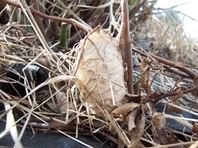
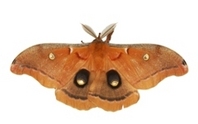
 This time I had discovered the cocoon of one of the giant silkworm moths, this particular one containing the metamorphosing caterpillar of an Antheraea polyphemus moth. I knew that in the spring a gorgeous, fawn-colored moth with big, dark blue eyespots on its hindwings would emerge from this cocoon, and even if I didn’t get to see the creature then, I certainly didn’t want to squash it now. The cocoon is still there as I write this (see the photo that accompanies this article). Chances of me actually seeing the moth when it emerges are very slim, but that is okay.
Of the three cocoon types that I mentioned above, the polyphemus has been the rarest find for me. I have only found about five in my lifetime. I believe all the others I found were in clumps of willow or gray dogwood shrubs.
The other “little brown paper sacks” I mentioned above are the cocoons of Hyalophora cecropia – the triangular-shaped cocoon and largest of the three moths, having exotically beautiful red and white coloration over a background of brown – and the Callosamia promethea which is the smallest of the three but still a very large moth with dark chocolate-colored wings edged in tan. It seems somehow appropriate for such exotic-appearing moths to have exotic names. They are pronounced see-crow-pee-ah, pro-me-thee-ah and polly-fee-mus. The cecropia can have a wing spread as wide as nearly 7 inches, which is gargantuan for a North American moth.
Watch closely this winter and you may find a cocoon of one of these species. You just never know what awaits you on a trip to forest or field!
How can you help support wildlife conservation in Michigan?
Join us in protecting all the natural, wild and wonderful things that make MiNature.
Thanks to Doug Reeves for the photo of the polyphemus cocoon. The polyphemus moth photo is credited to: Myers, Phil. Polyphemus moth. 2006. University of Michigan Museum of Zoology; The Animal Diversity Web (online). Accessed at http://animaldiversity.org. 1/17/13
|