|
By MARCEE WARDELL, communications specialist,
Fisheries Division
Michigan Department of Natural Resources
It was the best of times; it was the worst of times … For lake whitefish and cisco (often called lake herring), Charles Dickens’ famous opening line has a striking resonance.
Cisco and whitefish are native to Michigan’s Great Lakes and are both members of the Coregonus genus. They’re so similar that, early in life, they’re visually indistinguishable from each other (not unlike the lookalikes in the Dickens novel), and can only be identified using genetic analysis.
Despite the apparent similarities between these two species, in Lake Michigan, their paths have been different.
Lake whitefish declines occurred in the 1940s, the result of sea lamprey invasions, extensive fishing, and environmental degradation from logging and booming industrialization in the region. Cisco population declines occurred even earlier in the 19th and 20th centuries.
Successful sea lamprey control and reductions in commercial harvest led to recovery of lake whitefish populations, which supported profitable commercial fisheries throughout much of the 1970s, 80s and 90s.
Cisco did not experience such a recovery, and until recently, few positive signs were observed. Despite the success of sea lamprey control efforts, other ecological problems and invasive species continue to change factors influencing the success or failure of these fish.
The underlying mechanisms driving the recent recovery of cisco and demise of lake whitefish have yet to be identified.
Recent research conducted by Central Michigan University, the Michigan Department of Natural Resources, tribal organizations and others is helping to define mechanisms that explain differences in early life survival between the two species.
Interesting distinctions include faster metabolism, stronger responses to predators and even a difference in how wide the fish open their mouths (yes, really!).
“Why do we have two such similar things doing different things?”
Jory Jonas is a fisheries research biologist for the DNR whose work is focused on native species restoration and fish population dynamics in the Great Lakes, particularly Lake Michigan.
Much of her work over the last 30 years has been on lake trout, a native species also affected by sea lamprey, overharvest and changes to the food web due to invasive species.
|
During this work on lake trout, she noticed something that caught her attention: More cisco were appearing in recreational fisheries and sampling nets. Jonas noted that this stood out, as cisco had been nearly extirpated (made locally extinct) in the lower Great Lakes, and observations had been rare in Lake Michigan.
“I remember back in the late 80s, being in Green Bay on a sampling crew, and we caught a cisco,” she said. “We had to send it to Ann Arbor to a specialist to confirm it. We were so excited that we’d actually found one, that we’d caught a cisco.”
Reports of cisco in Lake Michigan continued to increase, with anglers, commercial fishers and other scientists reporting higher and more frequent observations.
A group of researchers from the DNR (including Jonas and current Fisheries Division Chief Randy Claramunt), Little Traverse Bay Bands of Odawa Indians, The Nature Conservancy and other organizations examined this change in a study, published in 2018, finding that cisco populations were, in fact, expanding in Lake Michigan.
The researchers identified 2011 as a turning point, when the number of cisco in the lake began to notably increase.
The timeframe corresponded with the greatest ecosystem shifts associated with zebra and quagga mussel (collectively known as dreissenid mussels) invasions, which dramatically altered the food web and shifted the flow of energy in the lake.
The carrying capacity for other species was lowered, because so much of the food energy was now going into these mussels.
Why this energetic shift would have a different effect on one species of coregonid than the other was a mystery.
“So, I’m thinking, as a researcher, ‘why do we have two things, cisco and lake whitefish — that are so similar most people can’t tell them apart — doing different things?” Jonas said.
She started reaching out to other agencies, tribal governments and university partners to put together research projects to look into this difference, and funding was secured from the Great Lakes Fishery Trust (via Central Michigan University) to support the work.
Earlier research had already determined that some of the issues affecting lake whitefish occurred early in life. Other work showed that the newly successful cisco were behaving differently: They were eating other fish.
|

Cisco typically eat plankton and invertebrates, tiny things in the water column, but some of the Lake Michigan cisco were now found with round goby and alewife in their stomachs.
The place to start the investigation was at the beginning — looking at the early life of cisco and whitefish. The team hoped to find the point in the life history of these species where their life trajectories began to diverge and identify what specifically caused that divergence.
To find the mechanism, the team saw the need for a combination of laboratory work, where all the variables could be controlled and isolated, and correlative evidence from data collected in the lakes.
What is the mechanism?
Kelly Hoyer completed her PhD, entitled “Factors Which Affect Growth and Survival of Larval and Juvenile Lake Whitefish (Coregonus clupeaformis) and Cisco (C. artedi) in the Upper Great Lakes,” at Central Michigan University (advised by Dr. Scott McNaught).
Hoyer’s work involved studying cisco and lake whitefish under laboratory conditions, evaluating their metabolic rates, feeding behaviors and reactions to predators.
“I realized pretty early on that there wasn’t a lot of species-specific data on these fish, especially for things like metabolism,” Hoyer said.
With the aim of eventually creating a more comprehensive model that would compare the growth of the two species, she designed her studies to address important gaps in knowledge for later work to build on.
Crucially, these studies involved comparison of cisco and whitefish of the exact same age and life stage; in the wild, whitefish often hatch earlier than cisco.
Much previous research on early life stages of these species compared them at the same point in time, when whitefish are older than cisco, rather than at the same age, which may have obscured important differences between the fish.
Feeding
In one study, Hoyer looked at feeding behaviors of juvenile lake whitefish and cisco, which measured the amount of prey they can capture within a given timeframe and how long it takes them to eat a single prey item. She also measured the mouth gape (how wide the mouth opens) for each species as they grew.
|
The mouth gape of lake whitefish was initially larger than that of cisco — until the later juvenile stage, when the gape size of cisco surpassed that of lake whitefish. The gape size transition likely enhanced the ability of cisco to prey on larger, more abundant prey.
During this stage, cisco were better at consuming copepods — small crustaceans that are abundant throughout the Great Lakes. Lake whitefish had better success eating smaller zooplankton, such as cladocerans (often called water fleas). These tiny — often microscopic — marine animals are less prevalent in present-day (post-dreissenid mussel) Lake Michigan than copepods.
To recap, as cisco grow into late juvenile stage, they can open their mouths wider, and that means they can eat bigger food, which happens to also be more available. These fish need sufficient food to grow larger (so they’re less likely to be eaten by other fish) and mature into adult fish that can reproduce.
Metabolism
Not only does it matter what the fish eat and how available that food is to them, it also matters how quickly their metabolism works to turn that food into energy.
In another experiment, Hoyer and the team measured metabolism (oxygen consumption) of larval and early juvenile lake whitefish and cisco. Larval cisco had higher metabolic rates than lake whitefish.
When lots of food is available to the larval cisco, this may result in higher growth rates and faster swimming speeds to search for prey and escape predators relative to lake whitefish.
Predator response
For the third study, Hoyer, Jonas, and their partners looked at how cisco and whitefish responded to predators, specifically rainbow smelt and round goby.
The round goby is a non-native species in the Great Lakes and is considered invasive. They were first discovered in Michigan waters in 1990 and were introduced to the Great Lakes from international ships’ ballast water discharge.
Goby prey on other fish, including young whitefish and cisco, but also serve as a food resource for older fish.
In experiments where cisco and lake whitefish were placed in tanks with the predators and observed, round goby had more success preying upon juvenile whitefish than cisco.
Why? Cisco had a stronger anti-predator response – they grouped together in tight groups rather than dispersing as lake whitefish did.
|

What happens going forward?
For Hoyer and Jonas, these findings represent a significant step toward understanding why the two species experienced such different outcomes in recent decades.
“This work shows that the different recruitment trajectories are probably not happening at the larval stage but the juvenile stage,” said Hoyer, though there are developmental factors that take effect before the juvenile stage, like differences in metabolism, that could make a difference there.
Knowing this, future research can look into juvenile-stage whitefish and cisco in greater depth.
The subtle difference in mouth gape has huge ramifications for the ability of these fish to survive, and perhaps thrive, under current conditions in Lake Michigan.
Because of their smaller mouth gape at the critical later juvenile stage, lake whitefish are less efficient in feeding on accessible food than are cisco, which can eat the larger, more abundant copepods.
“The biggest smoking gun out of all of this is the lack of cladocera. That’s what’s really hurting whitefish,” Jonas said. “This is a big unlock. If you understand the mechanism, you understand whether you can intervene to change its course.”
What that intervention might entail will be the subject of future research and management discussions.
Hoyer is continuing her work with coregonids in a postdoctoral position with the University of Michigan. She is currently studying preserved, archived fish samples to investigate fish diet differences that started with the dreissenid mussel establishment in the Great Lakes.
More field work on juvenile cisco and macroinvertebrates is needed, to establish effective mechanisms to manage stocks in the face of ecosystem change. Work to address the quagga mussel invasion, which shifted the food web and caused this lack of cladocerans, is being attempted through a variety of means.
In the meantime, other efforts to support declining whitefish populations continue to increase in priority. Lake whitefish is an important species culturally and culinarily, and it is a mainstay of Great Lakes commercial fishing economies, making it a focus of preservation and restoration efforts.
The work to understand and restore cisco and lake whitefish in Lake Michigan, and all of Michigan’s Great Lakes, will continue. Research like this helps us to better understand the fish and their relationship to the environment and can contribute to better management solutions and outcomes.
In this tale of two fish, the narrative is complex, with troubled waters and some success.
Future directions are unknowable, but perhaps we can yet hope to see the return of stable fisheries supported by resilient ecosystem functions.
For more information on Michigan’s fabulous fisheries and fishing, visit Michigan.gov/Fishing.
Check out previous Showcasing the DNR stories at Michigan.gov/DNRStories. To subscribe to upcoming Showcasing articles, sign up for free email delivery at Michigan.gov/DNREmail.
|
Note to editors: Contact: John Pepin, Showcasing the DNR series editor, 906-226-1352. Accompanying photos and a text-only version of this story are available below for download. Caption information follows. Credit Michigan Department of Natural Resources, unless otherwise noted.
Text-only version of this story.
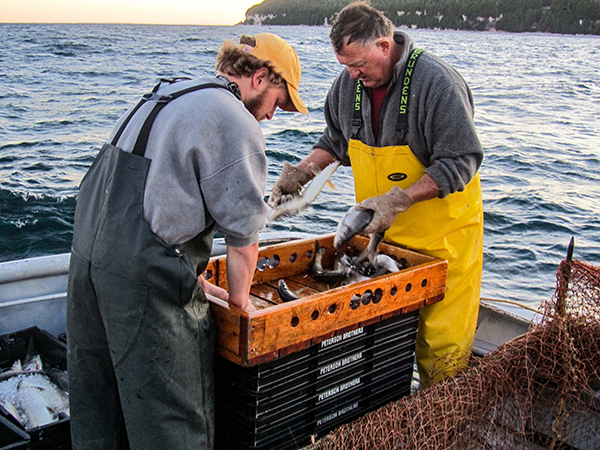
Cisco-1: Lake whitefish are a mainstay of Great Lakes commercial fishing economies.
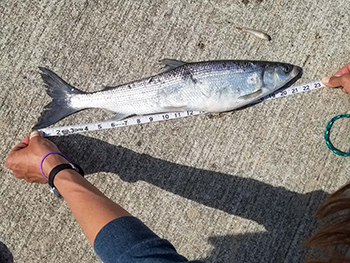
Cisco-2: An angler measures a coregonid.
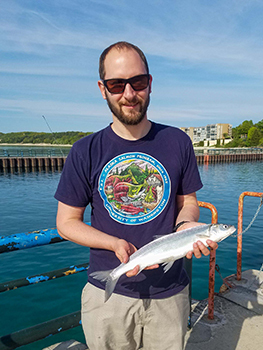
Cisco-3: An angler holding a coregonid caught on Lake Michigan.
Cisco-4: Anglers with their Lake Michigan catch.
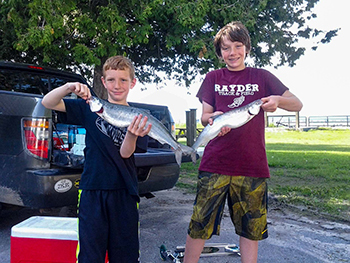
Cisco-5: Two young anglers hold cisco caught on Lake Michigan.
Cisco-6: A survey net and lake whitefish being pulled aboard the SV Steelhead, the former Lake Michigan research vessel.
|