The fight to save Michigan's bats
By ANDY HENION
Communications representative, Wildlife Division
Michigan Department of Natural Resources
Think bats are spooky? Let’s dispel some myths right off the, ah, bat.
Bats do not want to touch human hair. They are not blind. Less than 1% of bats carry rabies. And, no, bats do not suck blood (at least the bats living in Michigan).
Here’s the real scary part about bats: Their numbers were decimated by a fungal disease called white-nose syndrome more than a decade ago and, despite researchers’ ongoing efforts, have not yet recovered.
That’s frightening because bats play an important role in our world. An average bat eats more than 3,000 bugs a night – from mosquitoes to moths to soft-shelled beetles, according to the U.S. Fish and Wildlife Service.
By consuming massive amounts of crop pests, bats save farmers as much as $23 billion annually in crop damage and pesticide expenses, the U.S. Geological Survey estimates. Bats also benefit the lumber industry by killing destructive forest pests, while nectar-feeding bats play a vital role as plant and crop pollinators.
A 2024 study published in Science found that, when bats die, farmers use more pesticides and infant deaths rise. According to the University of Chicago-led study, when bat populations crashed due to white-nose syndrome, farmers compensated by increasing insecticide use by 31%. This change corresponded with a nearly 8% rise in infant mortality rates in affected U.S. counties.
“We can’t overestimate the importance of bats to our ecosystem,” said John DePue, a wildlife biologist and bat specialist for the Michigan Department of Natural Resources. “But due to white-nose syndrome, we’ve lost about 90% of our bats since it was first discovered in 2014.”
|
White-nose syndrome, which ranks among the most devastating wildlife diseases in recent history, is caused by a fungus in hibernating bats that leaves a white growth on their muzzles, ears and wings. Infected bats prematurely awaken from hibernation, rapidly deplete their fat reserves and are unable to survive winter. They often exhibit unusual behavior, such as flying during daylight or gathering outside caves, in cold weather.
DePue has created a report documenting the efforts by the DNR and its research partners to monitor Michigan’s bat population and combat white-nose syndrome over the past year. The report comes as bats take center stage during Halloween time and Bat Week (Oct. 24-31), an international celebration to raise awareness about the need for bat conservation.
Fungal disease takes its toll
In October, swarms of bats descend into abandoned mines in the Upper Peninsula to hibernate for the winter.
But those swarms are only a fraction of what they used to be.
Before white-nose syndrome hit, DePue and his fellow researchers would venture into the caves every year and document an average of nearly 2,000 hibernating bats per site, with some caves housing tens of thousands of bats.
|
But since 2015, researchers have documented fewer than 800 bats per cave annually. During the 2025-26 winter season, they surveyed 24 sites and documented 510 bats per cave, according to the new report.
“Before the disease caused such big declines, we’d have individual sites with 50,000 bats,” DePue said. “Now, the upper end is more like 1,000, 2,000, maybe 3,000 bats. We don’t have those big sites anymore.”
Michigan has nine species of bats, including four that hibernate in abandoned mines across the U.P. Of those four hibernating species, two of them – the little brown bat and the northern long-eared bat – were hit the hardest by white-nose syndrome.
Litle brown bats, North America’s most abundant bat species, experienced a population decline of about 85% due to the disease. DePue said it appears the little brown bat population is finally stabilizing, albeit at very low levels, and even ticking up in some site surveys.
That’s not the case for the northern long-eared bat. While it used to account for about 15% of Michigan’s bats, the species now accounts for less than 1% of the state’s bat population. The deadly effects of white-nose syndrome literally put the once-thriving northern long-eared bat on the federal endangered species list.
“I do have a real concern for northern long-eared bats, as their populations do not appear to be recovering,” DePue said. His team documented only one northern long-eared bat during the 2025-26 cave survey.
|

And then there’s the mystery of Tippy Dam in the Lower Peninsula’s Manistee County. Somehow, a huge colony of bats – mostly little brown bats – has hibernated on the concrete walls inside the hydroelectric dam for more than a decade without succumbing to white-nose syndrome.
An Eastern Michigan University survey of Tippy Dam in early 2026 documented a vibrant population of about 26,500 bats.
EMU researchers have confirmed the fungus exists in Tippy Dam and are attempting to determine why the bats are faring better than their U.P. counterparts. The researchers are studying factors including temperature, humidity, genetics and the makeup of the dam itself.
The answers could ultimately help in the larger effort to save bats from the deadly fungus that causes white-nose syndrome.
Fighting for bats
The DNR is teaming with universities, federal agencies, tribal groups, mine owners and conservation organizations on multiple efforts to mitigate further loss to the bat population.
|
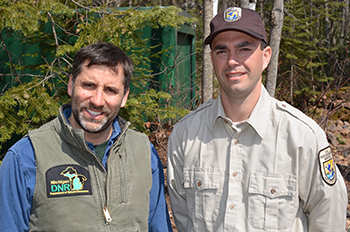
Projects range from the installation of gates at mines to keep people from disturbing hibernating bats to the use of ultraviolet light in hopes of killing the fungus that causes white-nose syndrome.
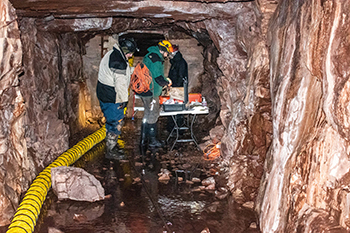
DePue is leading a research project with Michigan Technological University to ventilate the abandoned Carp Lake Mine in the Porcupine Mountains to lower the mine’s temperature by a few degrees. A cooler mine means less fungus and possibly better bat survival rates.
The project, which began in 2019 and is funded by federal and private grants, is showing signs of success. Researchers have effectively lowered the mine’s temperature with venting and propane-powered fans, and bats are hibernating in the artificially cooled area.
But can the project improve bats’ long-term survival rate?
DePue believes it can.
“I am optimistic that if we cool it, they will come,” he said.
On the flip side, DePue and his team a couple years ago decided to insulate another abandoned mine with heavy-duty foam to block the freezing wind and hopefully attract the first hibernating bats. Getting the hibernating temperature just right is tricky: too warm and the bats can get fungal disease; too cold and frostbite can set in.
The insulated cave seems to be working. Two years ago, DePue spotted the first two bats – both big brown bats – hibernating in the mine. Last year, there were five big brown bats hibernating.
|
“It will be interesting to see if little brown bats show up too,” DePue said. “They just need to find it.”
Big brown bats are very abundant in Michigan, particularly in the southern part of the state and in urban and suburban areas. And while big brown bats can get white-nose syndrome, these larger bats are surviving the disease at much higher rates than little brown bats and northern long-eared bats.
Be a bat ambassador
So, what can you do to help bats survive and thrive?
Stay out of caves and mines where bats are hibernating in winter. If a bat is disturbed during hibernation, it may become active and use up its fat reserves, leading to starvation.
On your own property, you can create a bat garden free of pesticides and herbicides, according to Bat Conservation International. Planting native vegetation creates roosting habitat and gives diverse insects a place to grow into the perfect meal for bats.
You can also give bats a helping hand by putting up a bat house. Bat houses are a bit complicated and frustrating to get right, but good construction and placement will allow you to observe bats and grow your understanding of these fascinating animals.
Another option is helping out with bat monitoring efforts. In 2025, the DNR and Michigan Natural Features Inventory introduced the Michigan Bat Roost Monitoring Program to help bridge gaps in our understanding of bats.
In the first year, community scientists reported nearly 150 summer bat roosts or emergence counts. Emergence counts involve sitting near a roost in the evening and counting the number of bats as they emerge. This allows researchers to estimate the number of bats using a roost and help them to understand fluctuations in bat populations over time.
“We had a successful first year with the Bat Roost Monitoring Program and look forward to even more participation from community scientists in the years to come,” DePue said.
Finally, we can simply educate ourselves and our neighbors about bats to build a better understanding and acceptance of these misunderstood animals. For many of us, that means overcoming a fear of bats based on those pesky old myths.
|
That bat flying crazily over your head in the evening? It sees just fine and is perfectly capable of avoiding your hair. Instead of freaking out, you could thank the bat for preventing another mosquito bite.
Aren’t bats just flying mice? Nope. Bats belong to a completely different order (Chiroptera) than mice (Rodentia). Unlike mice, which can produce 100 babies or more per year, most bats give birth to single pups only once a year.
But bats want to suck my blood! Out of the 1,400-plus bat species, only three species of vampire bats feed on blood. Those bats opt for livestock, wild animals and birds, not humans. Oh, and they’re restricted to tropical climates, far, far away from Michigan.
“So be a bat ambassador and spread the word,” the U.S. Fish and Wildlife Service encourages. “Bats get a bad rap, and we need your help to dispel bat myths and help people learn the truth about these fascinating and beneficial animals.”
Learn more about Michigan’s bats at Michigan.gov/Bats.
|
Check out previous Showcasing the DNR stories in our archive at Michigan.gov/DNRStories. To subscribe to upcoming Showcasing articles, sign up for free email delivery at Michigan.gov/DNREmail.
Note to editors: Contact: John Pepin, Showcasing the DNR series editor, 906-226-1352. Accompanying photos and a text-only version of this story are available below for download. Caption information follows. Credit Michigan Department of Natural Resources, unless otherwise noted.
Text-only version of this story.
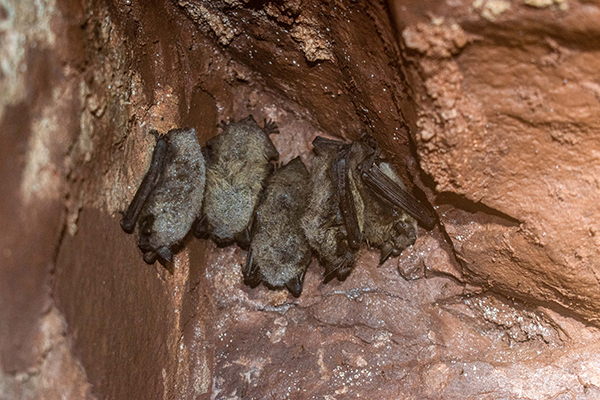
Bat-1 and Bat-2: Little brown bats spending the winter in the Little Carp Mine in the Porcupine Mountains in Ontonagon County.
Bat-3: A hose extends back into the Carp Lake Mine to carry cold air from the outside.
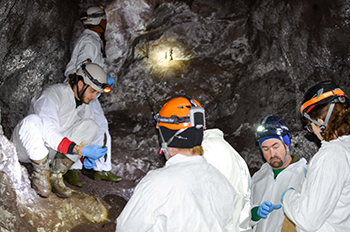
Bat-4: Workers are shown inside the Carp Lake Mine at the Porcupine Mountains in Ontonagon County.
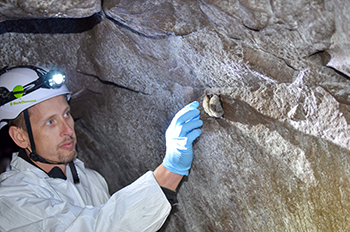
Bat-5: Maartin Vonhof, a professor of biological sciences at Western Michigan University, gets ready to pull a little brown bat off a mine shaft wall in Ontonagon County.
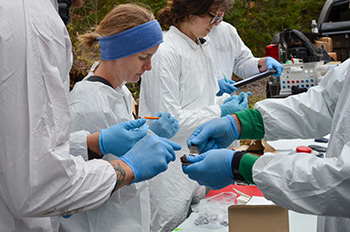
Bat-6: Researchers retrieve bats from a cave near Mass City in Ontonagon County. The bats were treated with chitosan to combat white nose syndrome.
Bat-7 and Bat-10: Little brown bats are treated with chitosan outside a cave near Mass City in Ontonagon County to combat white nose syndrome.
Bat-8: Michigan Department of Natural Resources wildlife biologist John DePue, left, and Rich Geboy, Midwest regional white-nose syndrome coordinator for the U.S. Fish and Wildlife Service, pose for a photograph outside the Adventure Mine in Ontonagon County.
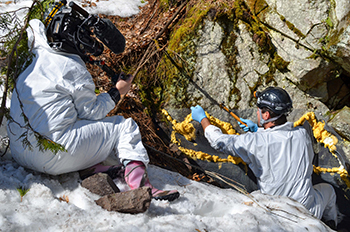
Bat-9: A film crew from HBO's "Vice News" films as Tim Carter of Ball State University works to reopen a mine shaft in spring in Ontonagon County in 2017.
Bat-11: Little brown bats on a wall inside a bat hibernaculum at the Tippy Dam in Manistee County.
Bat-12: From left, Michigan Department of Natural Resources wildlife biologists Bill Scullon and John DePue prepare to enter a mine in the western Upper Peninsula.
|