|
If you’ve been craving some fresh fall air, an adventure with family or just a chance to connect with the places that make Michigan special, we invite you to step outside with us during Michigan Trails Week, Sept. 19-26.
Michigan’s trails system is as diverse as the state itself. Whether it’s a meandering walk with your dog, a trail ride with friends or a paddle along one of our scenic rivers that you're seeking, we have a trail waiting for you.
Michigan’s trails are about more than just getting from one place to another. Our trails support healthier lifestyles and stronger communities and represent a significant part of Michigan’s $15.1 billion outdoor recreation economy.
With over 13,700 miles of state-designated trails, Michigan is home to some of the best year-round hiking in the nation. The Michigan Department of Natural Resources' trails system is always growing and improving, too; since 2013, the DNR has:
- Created 1,000 miles of state-designated trails.
- Added 220 miles of permanent snowmobile trail easements in the Upper Peninsula.
- Invested $273 million in our state's parks and recreation system through Gov. Gretchen Whitmer’s Building Michigan Together Plan.
This trails investment isn’t just about adding miles to the map; it’s also about helping communities make those miles useful for generations to come. That work is happening throughout the state, with Michigan State University students, local leaders and the DNR working together to identify opportunities, address challenges and plan for the future of Michigan’s trail systems.
|
“Trails are important because they bring people together by creating shared spaces,” said Tim Novak, DNR state trails coordinator. “They help people meet others in their community and build a sense of connection.”
This work would not be possible without the partnership of local municipalities, conservation districts, regional land conservancies and nonprofit organizations like the Michigan Trails & Greenways Alliance.
"As a mom of three young children, I get to see trails and greenways through their eyes and know that the work we’re doing today is protecting them for future generations," said Andrea LaFontaine, Michigan Trails & Greenways Alliance executive director. "Seeing kids, parents and grandparents enjoying trails together reminds me why this work matters. My hope is that giving my kids that connection to the outdoors now will help create the next generation of trail advocates."
|
Imagine being able to experience Michigan from the forests of the western Upper Peninsula to the skyscrapers of Detroit; not from behind a windshield, but on a welcoming trail where you set the pace.
Now at over 70% completion, Michigan’s Iron Belle Trail offers incredible lengths of connectivity while working toward that reality.
At over 2,000 miles, the Iron Belle Trail links more than half of Michigan’s counties. The trail includes two routes: a biking route that travels along the eastern side of the state, and a hiking route that traverses the western side and utilizes the North Country Scenic Trail, a 4,800-mile trail that stretches across eight states, from North Dakota to Vermont.
“When I think about a trail connecting our entire state, I think about the positive experiences that will happen within each of those miles,” said Lee Maynard, the DNR’s nonmotorized trail grant coordinator. “From through-hikers accomplishing a once-in-a-lifetime goal to dog walkers and commuters using smaller segments routinely, the Iron Belle Trail is already improving the quality of life for so many people.”
|
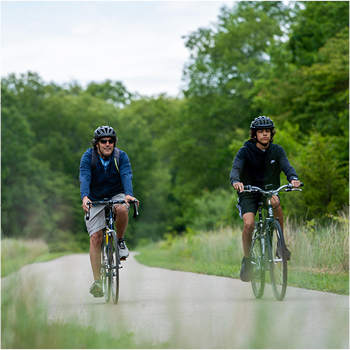
Creating a trail of this scale takes time and teamwork, and the DNR is working with local partners to fill the remaining gaps. Since 2012, the DNR has identified $10 million in internal and external Iron Belle grants to support this effort. Completing the trail is about more than connecting its physical gaps: It is also about connecting the people and communities along its route.
“When I look at what we have accomplished so far with the Iron Belle Trail, I see diversity and inclusivity for trail users — through both hiking and biking opportunities and by experiencing the many different communities and regions this trail travels through," Maynard said. "It truly is an opportunity to connect with something far greater than ourselves."
|
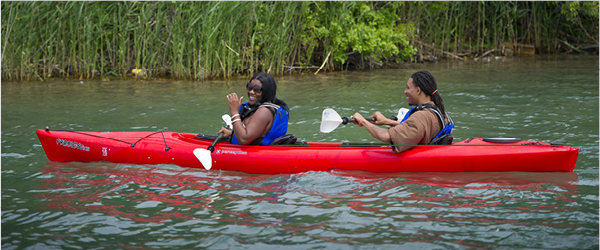 Not only does Michigan’s trails network extend from one end of the state to the other, but it also goes beyond where the pavement ends. Our water trails — Michigan is home to nine state-designated inland water trails and has more than 3,000 miles of rivers and lakes — connect visiting paddlers to historical, natural and cultural destinations that make great places to stop, rest and explore.
"A common reaction for first-time paddlers is how beautiful the river looks even though they may have visited the area many times from shore," said David Merk, the DNR's nonmotorized trails specialist. "Being on the water gives you a whole new perspective on a place."
More than just recreational opportunities, these water trails also attract visitors who support local economies throughout the state with stops at nearby restaurants, hotels, outfitters and other businesses.
"From paddling over a shipwreck and imagining the history beneath you, to feeling the excitement of a large fish swimming right underneath your kayak or quietly drifting past a deer standing along the riverbank, each moment on the water is amazing," Merk said.
When you’re out enjoying Michigan’s trails, practicing good trail etiquette helps to keep these places enjoyable and safe for everyone.
- Stay on marked trails, follow posted closures and pack out what you bring in.
- Be aware of other trail users and communicate when passing, remembering that different activities have different yielding expectations.
- If you bring your pet, keep your furry friend on a 6-foot leash, clean up their business and watch for wildlife.
- Help prevent the spread of invasive species by cleaning off your gear after each adventure.
- If you’re visiting a state park, recreation area or trail access point, remember that a Recreation Passport is required for vehicle entry and helps fund maintenance of trails, parks, campgrounds and other outdoor recreation facilities.
|
Whether you’re a trails newbie or a veteran explorer, here are some ways to enjoy, support and advocate for Michigan’s trails during Trails Week and beyond:
|
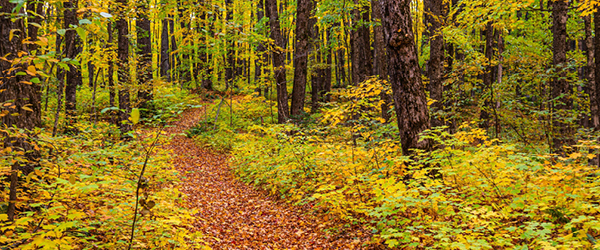 A walk around the corner, a horseback ride with friends, an off-road vehicle trip or an ambitious bike tour, Michigan’s trails offer more than a way to get somewhere. They give us places to explore and different ways to experience the communities we call home.
Discover your next adventure at Michigan.gov/DNRTrails. (And it's not too early to start planning a snowmobile weekend!)
Questions? Contact Tim Novak at 517-388-8347.
Note to editors: Accompanying photos are available below for download. Caption information follows. Photos courtesy of the Michigan DNR unless noted otherwise.
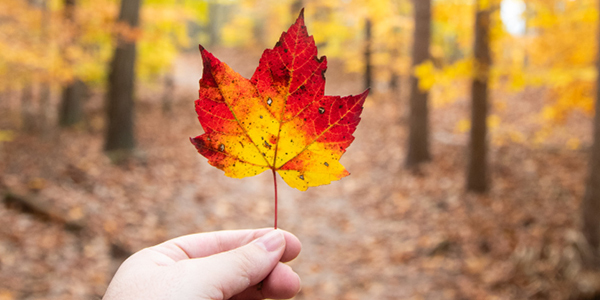
Leaf: A red and yellow maple leaf discovered at Hoffmaster State Park. Photo credit: Blair Celano, in cooperation with the Michigan Department of Natural Resources.
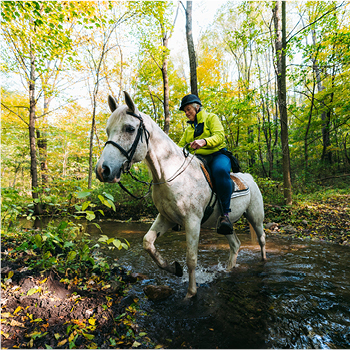
Horseback riding: A rider enjoying the equine trail at Fort Custer State Recreation Area in Kalamazoo County. Michigan is a great place to go horseback riding, with more than 1,000 miles of trails to choose from.
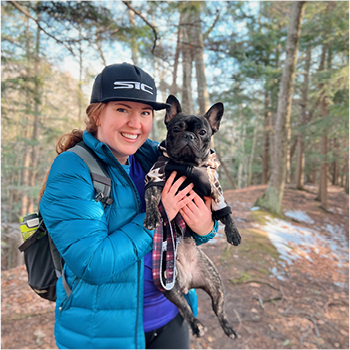
Hiking with pets: A young woman holds up her dog while hiking at Ludington State Park. Photo credit: Sarahbeth Ramsey, in cooperation with the Michigan Department of Natural Resources.
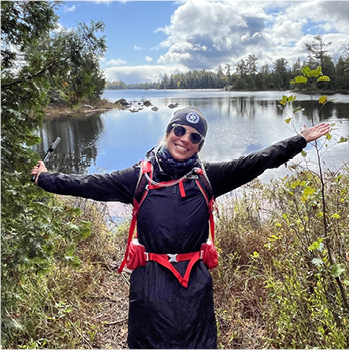
Craig Lake: A woman hikes at Craig Lake State Park, the most remote park in Michigan’s state parks system. Located in Baraga and Marquette counties, the park is home to hike-in backcountry campsites and many miles of trail, including the North Country Trail, six lakes and a variety of wildlife.
Biking: Biking is a popular way for Michiganders to enjoy the outdoors. According to a recent survey from the Michigan Department of Natural Resources, nearly half (47%) of Michigan residents use bicycles for recreation on paved streets, paths or sidewalks, and about one in four (26%) bike on unpaved trails or paths. Photo credit: Tyler Leipprandt and Michigan Sky Media LLC, in cooperation with the Michigan Department of Natural Resources.
Paddling: One out of every four Michiganders recreates by spending time paddling. Michigan offers thousands of miles of paddling opportunities on the Great Lakes and on Michigan's inland lakes and rivers.
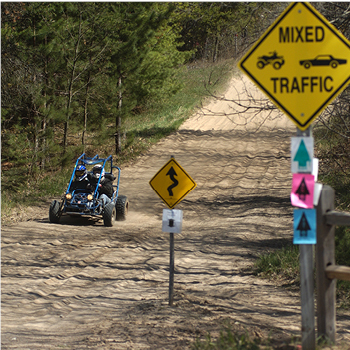
ORV: In addition to ORV routes and trails, Michigan has a number of ORV scramble areas, each one offering unique and exciting ORV riding opportunities for riders of all abilities and experience levels.
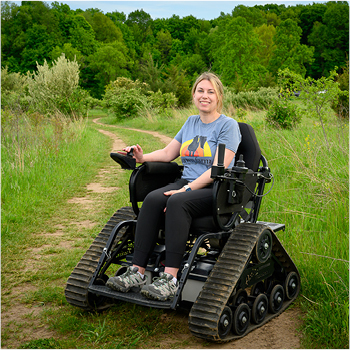
Track chair: From color blind scenic viewers to accessible kayak launches and track chairs, the Michigan Department of Natural Resources offers a wide range of ways for people of all ability levels to enjoy the outdoors.
Twin Lakes: Twin Lakes State Park is located in Michigan’s Copper Country, about 26 miles from Houghton. The park is one of just a few state parks that allow the operation of an ORV between the campground and nearby ORV trails. Photo credit: Samantha Hageman Gaina, in cooperation with the Michigan Department of Natural Resources.
|