After 11 years, Good Neighbor Authority ‘wildly successful’ in Michigan
DNR partners with U.S. Forest Service to manage federal land
By ANDY HENION
Communications representative, Wildlife Division
Michigan Department of Natural Resources
Michigan has become a national leader in implementing the Good Neighbor Authority, a congressionally authorized program to co-manage federal land that brings millions of dollars into the state through timber sales, supports jobs and protects wildlife.
Since joining the program in 2015, the Michigan Department of Natural Resources has teamed with the U.S. Forest Service to manage nearly 50,000 acres within Michigan’s three national forests: Huron-Manistee in the Lower Peninsula and Ottawa and Hiawatha in the Upper Peninsula.
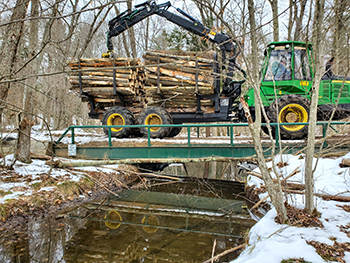
The DNR cuts and sells timber from federal land, then manages the acreage through reforestation or creating and maintaining new types of habitats. This, in turn, can benefit hunters, hikers, wildlife watchers and other visitors to Michigan’s national forests.
Despite having a mere fraction of the federal land compared to Western states like California and Idaho, Michigan operates the country’s most prolific Good Neighbor Authority program.
“The collaboration between the U.S. Forest Service and the Michigan DNR is the single biggest reason Michigan boasts the largest and most productive GNA program in the United States,” said Brooke Owens, a Michigan-based authorities coordinator for the Forest Service.
“Historically, state and federal agencies operated within strict, isolated boundaries. This partnership deliberately broke down those traditional bureaucratic silos, replacing an 'us vs. them' mindset with a shared culture of mutual respect.”
Restoration projects have included creating savanna habitat for species such as wild turkey, white-tailed deer and Karner blue butterflies; enhancing jack-pine landscape for the Kirtland’s warbler songbird; plugging abandoned oil wells and cleaning up tons of discarded junk from national forests.
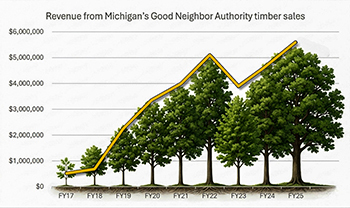
Timber revenue through the program has skyrocketed – from about $500,000 in 2017 to more than $5 million in 2025. Under the GNA agreement, the DNR retains control of all revenue collected from timber harvests and funnels it directly back into reforestation and habitat work.
|
“I would say the Good Neighbor Authority in Michigan has been wildly successful,” said Derek Cross, a DNR forester who coordinates the program statewide. “Through the GNA, we’re partnering with the Forest Service to sustainably manage and restore the forests of Michigan for the people of Michigan.”
Steady growth
No single agency has the staff or funding to manage the nearly 200 million acres of U.S. Forest Service land. The Good Neighbor Authority lets states act as agents of the Forest Service to expedite reforestation and habitat management and reduce wildfires across state and federal boundaries.
Created in 2001 as a pilot partnership between the Forest Service and Colorado, the GNA program was made permanent and opened to all states in 2014. Michigan joined the following year, signing an agreement with the Forest Service in October 2015 and starting work in 2016.
Program officials said the early years were somewhat challenging, with a different DNR forester coordinating work in each of Michigan’s three federal forests in addition to their other duties. After several years, the DNR went with a single, dedicated coordinator –Cross – which streamlined operations and helped fuel growth.
A manager for habitat improvement projects, DNR wildlife biologist Bob Sanders, was hired in 2022. Today, DNR wildlife technician Andrew Kaiser and DNR fire officers in the Upper and Lower peninsulas assist Sanders in habitat restoration work.
Michigan has steadily increased the amount of federal land it manages annually – from about 1,000 acres during the first year of the program to 12,000 acres this year. Still, that represents less than a half a percent of the total acreage comprising the Huron-Manistee, Ottawa and Hiawatha national forests.
|
Michigan has about 2.9 million acres of Forest Service land, which is the most of any Midwestern state and ranks 13th nationally. Yet that federal footprint pales in comparison to Western states like Alaska, California and Idaho, which each have more than 20 million acres of Forest Service land.
Despite that discrepancy, Michigan’s GNA program leads all states in both timber harvest sales and the amount of habitat improvement projects, Owens said.
“The Good Neighbor Authority has profoundly expanded land management in Michigan since its inception in 2015,” she said. “The true strength of the program lies in its ability to create a localized, self-sustaining financial cycle that enhances traditional federal forest management.”
The partnership has generated about $42 million in revenue from GNA timber sales.
“Every dollar stays right here in Michigan, supporting local loggers and mills while funding vital ecosystem restoration – from revitalizing oak-pine barrens to protecting critical wildlife habitats,” Owens said.
‘Hidden gem’
On an overcast day in mid-June, Sanders and Cross of the DNR and Owens of the Forest Service ventured deep into the Huron-Manistee National Forest to examine the results of habitat improvement work.
Their first stop: an area called Turkeyville, in West Michigan’s Newaygo County. Here, in 2022, the DNR harvested 80 acres of timber with plans to convert it to savanna-type habitat to host various wildlife species, including the endangered Karner blue butterfly.
|
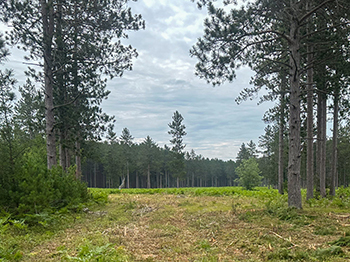
Savanna grasslands play a vital role in helping improve water and air quality and supporting wildlife. But this habitat – historically maintained by wildfire that keeps out encroaching forest – has disappeared throughout much of the country due to agriculture, urban sprawl and advances in fire suppression.
In Turkeyville, the DNR created pockets of savanna oak barrens in 2023 by harvesting trees, removing the stumps and planting a seed mix of grasses and flowering North American-native plants such as sundial lupine, black-eyed Susan and wild bergamot.
Maintaining this habitat in the years to come, Sanders said, will likely involve thinning out trees that sprout up and prescribed burning to set back forest succession.
Wildlife species that thrive on savanna oak barrens include the red fox, eastern box turtle, white-tailed deer and eastern bluebird.
In 2025, just two years after the savanna planting, program officials were excited to learn that a new resident – the Karner blue butterfly – was documented throughout the area.
North of Turkeyville, near Caberfae Peaks in Wexford County, the Good Neighbor Authority team in 2025 created another type of habitat on about 5 acres within the Huron-Manistee. They thinned the forest, leaving timber on the ground for wildlife foraging, and dug out a low-lying area for a pond that filled in naturally. The pond is now about 6 feet deep.
|
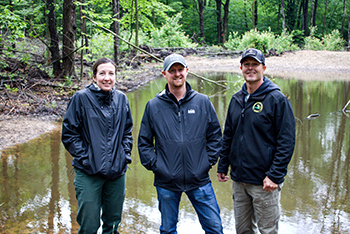
“This treatment created a whole bunch of downed woody debris that wildlife, such as the American marten, use for foraging,” Sanders said. “We established an early successional habitat that’s favorable to wildlife like grouse, snowshoe hare and white-tailed deer. And the pond was dug to bring in reptiles like salamanders and turtles. Deer and bear use the water, too, of course.”
All told, the Michigan GNA program has more than 80 habitat improvement projects lined up for fiscal year 2027, which starts Oct. 1. Sanders sees the program as a “hidden gem” that benefits wildlife and national forest visitors alike.
A total of about 4 million people visit Michigan’s three national forests each year.
“Wildlife knows no boundaries, whether it’s state land or federal land,” Sanders said. “We’re doing all this great habitat work on public land that’s open to hunting, that’s open to fishing and open to recreation.”
Power of partnerships
Michigan’s GNA program is a boon for various contractors, including logging companies, habitat-improvement specialists, forestry consultants and archeological surveyors.
Cross said the DNR partners with universities, tribal communities, other state departments and nonprofits to help co-manage federal land. These efforts include:
- Collaborating with Grand Valley State University and the Little River Band of Ottawa Indians to monitor how timber harvest affects the American marten in the Huron-Manistee.
- Partnering with county road commissions to maintain roads through the forests. The DNR has repaired and rebuilt more than 50 miles of roads within the national forests.
- Helping the Michigan Natural Features Inventory monitor sensitive plants and animals, including terrestrial turtles, Massasauga rattlesnakes, Karner blue butterflies, raptors and a long list of vulnerable plants.
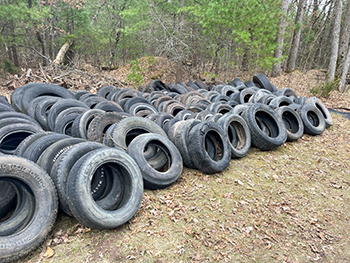
- Participating every year in the Adopt-a Forest Program by cleaning up the Huron-Manistee. In 2025, the DNR and volunteers helped remove 11 tons – more than 22,000 pounds – of discarded junk from the forest, including dozens of car tires and even an old boat.
- Funding part of the salary of a Michigan coordinator position for the American Bird Conservancy.
|
“Numerous partnerships have made the restoration activities undertaken through this program possible,” Cross said. “As the Good Neighbor Authority continues to grow in Michigan, the expertise these groups provide will be essential in continuing the restoration efforts on Michigan’s national forests.”
Looking ahead
Every year for the past several years, the DNR has harvested a combined total of about 70 million board feet of timber from Michigan’s three national forests.
A board foot equals the volume of a piece of wood measuring 1 foot long, 1 foot wide and 1 inch thick. Put into perspective, 70 million board feet equates to about 13 million 2x4s at 8 feet long – enough to build about 50,000 houses at 2,000 square feet each.
Cross said plans are to increase harvest production to about 90 million board feet per year and expand habitat improvement work. Program officials are discussing how to add extra capacity with limited staff.
Scaling up lumber volumes at the three national forests, Owens added, will allow Michigan’s GNA program to help meet the goals of a 2025 presidential executive order to expand timber production.
Additionally, the Michigan GNA team is in the beginning stages of incorporating the federal EXPLORE Act into the program, which will increase recreation services at the three national forests.
“We’re now entering our second decade of partnership, and Michigan’s GNA program is no longer just an experiment – it has become a vital pillar of our state’s timber economy and land management strategy,” Owens said. “Today, GNA serves as an indispensable extension of how the Forest Service manages federal land across Michigan.”
Find out more about the Good Neighbor Authority in Michigan.
Check out a previous Showcasing the DNR story on the Good Neighbor Authority from 2016.
|
Check out previous Showcasing the DNR stories in our archive at Michigan.gov/DNRStories. To subscribe to upcoming Showcasing articles, sign up for free email delivery at Michigan.gov/DNREmail.
Note to editors: Contact: John Pepin, Showcasing the DNR series editor, 906-226-1352. Accompanying photos and a text-only version of this story are available below for download. Caption information follows. Credit Michigan Department of Natural Resources, unless otherwise noted.
Text-only version of this story.
Discarded boat: Volunteers remove a discarded boat from the Huron-Manistee National Forest in 2025 as part of the Michigan Department of Natural Resources’ cleanup efforts through the Good Neighbor Authority program. (Photo courtesy of the Gambler 500 adventure and stewardship club.)
Discarded mattress: Volunteers load a discarded mattress into a dumpster in 2026 as part of the Michigan Department of Natural Resources’ cleanup efforts in the Huron-Manistee National Forest. (Photo courtesy of the Gambler 500 adventure and stewardship club.)
Discarded tires: Dozens of discarded tires collected from the Huron-Manistee National Forest in 2025 as part of the Michigan Department of Natural Resources’ cleanup efforts through the Good Neighbor Authority program. (Photo courtesy of U.S. Forest Service.)
GNA_cleanup: John Randle, formerly of the Michigan Department of Natural Resources, helps clean up the Huron-Manistee National Forest through the Good Neighbor Authority program.
GNA_Grasslands: The Michigan Department of Natural Resources partners with the Michigan Natural Features Inventory to study habitat within the Huron-Manistee National Forest, including this oak/pine barren. The habitat, which supports wood turtles and box turtles, is influenced by drought and periodic fire. (Photo courtesy of Michigan Natural Features Inventory.)
GNA_Hiawatha: Through the Good Neighbor Authority program, the Michigan Department of Natural Resources in 2025 created a 200-acre, savanna-type habitat in the Hiawatha National Forest in Michigan’s Upper Peninsula.
GNA_Michigan revenue: Revenue growth from Michigan’s Good Neighbor Authority program has increased more than 900% since the program began a decade ago. All the money stays in Michigan for reforestation and habitat improvement.
GNA_pond: In 2025, Michigan’s Good Neighbor Authority team created a 5-acre habitat within the Huron-Manistee National Forest in Wexford County that’s suitable for a variety of animals including ruffed grouse, snowshoe hare and amphibians. The timber stand was thinned, and a low-lying area was dug out for a pond that is now about 6 feet deep.
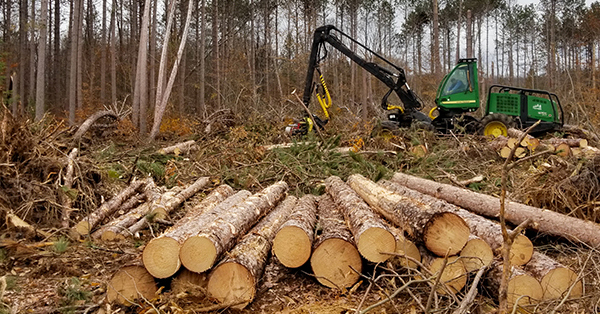
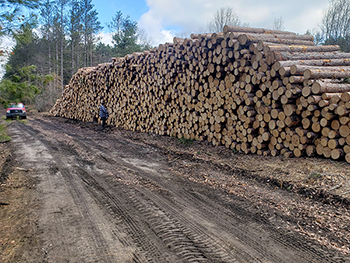
GNA_timber harvest: The Michigan Department of Natural Resources salvages red pine from the Huron-Manistee National Forest in 2019 after a severe windstorm damaged timber across Wexford, Lake and Newaygo counties.
GNA_timber haul: The Michigan Department of Natural Resources hauls away a load of red pine for sale through the Good Neighbor Authority program. The timber was harvested in the Huron-Manistee National Forest in Newaygo County.
GNA_field: The Michigan Department of Natural Resources partners with the Michigan Natural Features Inventory to study habitat within the Huron-Manistee National Forest, including this wet-mesic sand prairie. This habitat, which supports massasauga rattlesnakes, is influenced by fluctuating water tables, droughty sands and periodic fire. (Photo courtesy of Michigan Natural Features Inventory.)
GNA_timber pile: The Michigan Department of Natural Resources salvages red pine from Lake County in the Huron-Manistee National Forest after a severe 2019 windstorm.
Owens, Cross, Sanders: From left, Brooke Owens of the U.S. Forest Service and Derek Cross and Robert Sanders of the Michigan Department of Natural Resources work together to manage Michigan’s Good Neighbor Authority program. They’re shown in front of a pond habitat created in the Huron-Manistee National Forest.
|