New 1,100-foot accessible boardwalk opens at Tahquamenon Falls State Park
By HEATHER JOHNSON DUROCHER
Writer, Michigan Department of Natural Resources
For some visitors to Tahquamenon Falls State Park, the main attraction at Michigan’s second-largest state park has always remained out of reach.
For those using wheelchairs, experiencing the iconic, 200-foot-wide, amber-hued Upper Falls up close was impossible. What stood in the way was a 94-step staircase that led park visitors to a viewing platform.
“We heard time and time again from people that because of accessibility, they had never been to the brink, had never been able to feel that spray hit their face or smell the river,” said Kevin Dennis, park manager at Tahquamenon Falls State Park in the Upper Peninsula’s Luce and Chippewa counties.
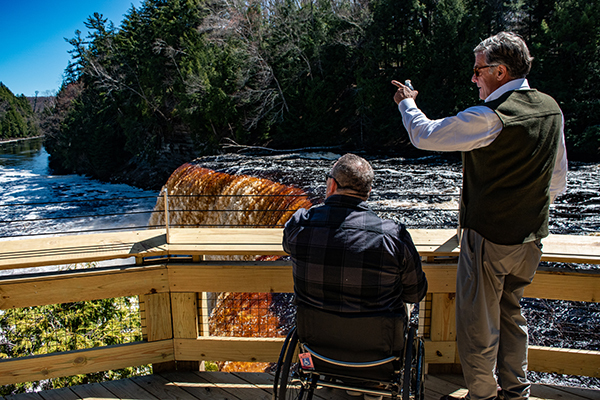
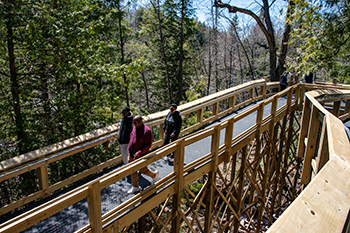
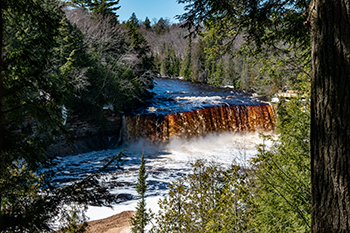
That has now changed with the long-awaited official opening last Thursday of a new 1,100-foot, fully accessible boardwalk that replaces the aging staircase. The new feature will offer all visitors close-up, panoramic views of the Tahquamenon River as it rushes over the edge and drops about 50 feet.
“It’s really exciting to be able to open it to the public,” said Dennis of the renovation project that took nearly two years. “The public has been so patient during these past few years of hard work by a lot of people to bring this project to life. It feels great to see it finished, and most importantly, it feels good to watch as people use the new boardwalk."
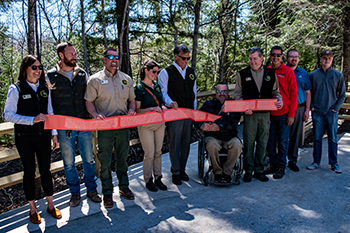
Last week, Michigan Department of Natural Resources Director Scott Bowen and other DNR staff and community members helped celebrate the new accessway to the Upper Tahquamenon Falls during a ribbon-cutting ceremony at the state park.
“Access to public lands for everyone is a priority for the Michigan Department of Natural Resources, and Tahquamenon Falls is a prime example,” Bowen said during the ceremony. “Today, we celebrate the opening of this beautiful boardwalk, the latest feature furthering our legacy of partnership, collaboration and public access, not only here at Tahquamenon Falls but across our great state.”
Fully accessible waterfall viewing
The new boardwalk to the Upper Falls is the latest effort at Tahquamenon Falls to make the state park accessible for all.
|
“With the Lower Falls boardwalk extension and island bridge project completed in 2021, and this new walkway at the Upper Falls brink, both the Lower Falls and Upper Falls are fully accessible for our visitors,” said Kristen Kosick, chief of the DNR Parks and Recreation Division, during the ribbon-cutting ceremony. “We’re here to celebrate one of our signature state park projects that really demonstrates our mission – preserving natural resources while also providing access to recreation.”
The new boardwalk offers views of old-growth forest as it winds its way toward the brink. Five switchback landings will offer interpretive displays, benches and never-before-seen views of the river and the falls.
The walk or roll to the Upper Falls using the new boardwalk will be longer for visitors compared to the days of the lengthy and steep staircase – it could be up to a half hour longer, depending upon stops along the way – but the journey will be easier. Visitors also can use one of the park’s available wheelchairs or track chairs, Dennis said.
“We have had, and will continue to have, several wheelchairs available for visitors to check out for free in our interpretive area – we call it the ‘fact shack’ near the Upper Falls parking lot – and we also have two track chairs, one at the Upper Falls and one at the Lower Falls, that visitors may use,” he said.
|
‘There are no words’
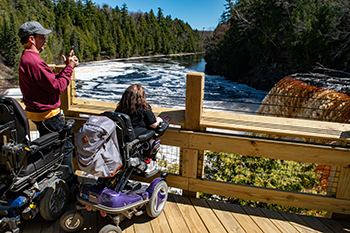
Missy Davert, 62, was a child the last time she saw the Upper Falls up close.
“I was here as a little girl,” said Davert, who uses a wheelchair. “My dad had me in a backpack on his back.”
But until Thursday, she hadn’t been on the platform overlooking the Upper Falls in 50 years, she said.
“I thought I’d never come back down here again,” she said while sitting at the brink next to her husband Ken Davert, who also uses a wheelchair. “This is one of my most favorite places in the world. This feels like heaven. I’m just so grateful. There are no words.”
Missy and Ken Davert were among several wheelchair users who attended the ribbon-cutting and experienced the new accessible boardwalk for the first time.
Bryan Wilkinson, co-chairman of the DNR's Accessibility Advisory Council, was a featured speaker at the ceremony and was invited to cut the ribbon. He shared his own personal Tahquamenon Falls story and a passion for helping make the outdoors accessible to all.
In 2004, after hearing that the park had just opened a paved path to the Upper Falls, he rushed to visit the attraction with his then-girlfriend/now wife Breanne. Unfortunately, he was disappointed to find he could only go so far along the path toward the Upper Falls – to the top of the staircase – because he uses a wheelchair.
|
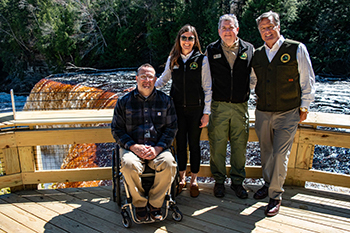
“I looked at her and said, ‘I guess go check it out, I’ll see you in 20 minutes,’” he recalled.
On Thursday, the 45-year-old father of two from Brighton was excited to be able to reach the Upper Falls brink for the first time.
“Today I get to go the rest of the way,” he said. “It’s going to be awesome.”
Wilkinson also is eager for other park visitors to have this experience.
“Accessibility is super important, and I hope the DNR continues to keep this drumbeat going,” he said. “I look forward to the hundreds of thousands, the millions of people who are going to get to experience this.”
A monumental project
The DNR worked with design consultant OHM Advisors in Hancock and construction company ASI Environmental in Ludington to complete the approximately $1.6 million project.
“The goal was to design and construct an accessible ramp system traversing an erodible slope covered in dense forest and a delicate understory with over 60 feet in elevation change from top to bottom,” Kosick said. “No machinery was allowed on the slope to complete excavation of 430 footings, helical installation, staircase demolition, steel beam transportation or concrete pouring.”
|
The total project cost was covered by $70,000 in DNR capital outlay dollars and just over $1.5 million in federal relief program funding as part of Gov. Gretchen Whitmer’s Building Michigan Together Plan.
That plan, signed into law in March 2022, included $250 million in federal relief program funding from the American Rescue Plan Act to help tackle the backlog of critical infrastructure needs in Michigan’s state parks system.
This historic investment – which has aided states in response to the COVID-19 pandemic – put in motion a targeted effort to repair, replace or modernize the core components of state parks and trails.
With an additional $23 million appropriated Aug. 1, 2023 for Belle Isle Park, including $10 million awarded to the Belle Isle Conservancy to tackle crucial HVAC upgrades, American Rescue Plan Act funding stands at $273 million for the state's parks and recreation system. A state parks and trail project dashboard tracks the DNR’s progress of these projects.
Tahquamenon Falls: An historic state park
In the mid-1930s, the only way for visitors to reach the Upper and Lower Tahquamenon Falls was by boat and foot. Back then, people were pushing for the area surrounding the falls to be made a state park to avoid despoiling the site with roads, logging and commercial development.
|
Through partnerships and collaborations, the state park was established in 1947. Today, it is Michigan’s second-largest state park at nearly 50,000 acres.
By the 1960s, M-123 had been constructed, which provided ample access to the Upper and Lower Falls, as well as the Tahquamenon River mouth. All three sites are part of the state park that provides access, camping, hiking, fishing and other recreation, as well as preservation of the attractions for the enjoyment of future generations.
The park, which stretches 13-plus miles in the U.P., attracts just over 500,000 day-use visitors each year. The park is home to multiple campgrounds, overnight lodging facilities, a boating access site, 35-plus miles of trails and multiple overlooks to the Upper and Lower Falls. The North Country National Scenic Trail travels 16 miles within the park and includes a route between the Upper and Lower falls.
The Upper Falls, a breathtaking waterfall over 200 feet wide, is one of the largest in the eastern United States. The river's amber hue is due to tannins from the surrounding cedar swamps. The falls' powerful force and the soft water create a distinctive foamy appearance. Just 4 miles downstream, the Lower Falls offers a series of smaller cascades around an island. You can explore both falls from the riverbank, the Ronald A. Olson Island Bridge or by renting a rowboat.
How to help
Many of the accessible features people enjoy in Michigan’s parks and public spaces are made possible through the generosity of DNR friends' groups, community partners and individual donors.
“Whether it’s a major project or small enhancement, every contribution helps expand access and create more inclusive donor experiences for everyone,” said Michelle O’Kelly, fund developer for the DNR Parks and Recreation Division. “No donation is too small, and we maintain a list of accessibility needs and projects for those interested in making an impact.”
Anyone interested in supporting accessible recreation opportunities can contact O’Kelly directly at OKellyM1@Michigan.gov or contribute by visiting the donate to Michigan state parks, trails and waterways webpage.
|
Check out previous Showcasing the DNR stories in our archive at Michigan.gov/DNRStories. To subscribe to upcoming Showcasing articles, sign up for free email delivery at Michigan.gov/DNREmail.
Note to editors: Contact: John Pepin, Showcasing the DNR series editor, 906-226-1352. Accompanying photos and a text-only version of this story are available below for download. Caption information follows. Credit Michigan Department of Natural Resources, unless otherwise noted.
Text-only version of this story.
TF-1: Track chairs, which provide more traction, and wheelchairs for visitor use are displayed at Tahquamenon Falls State Park.
TF-2: Park visitors enjoy the new 1,100-foot boardwalk to the brink of the Upper Tahquamenon Falls north of Newberry.
TF-3: Kevin Dennis, manager at Tahquamenon Falls State Park, speaks during the official opening ceremony last Thursday of the new accessible boardwalk at the park. Looking on as Dennis speaks are Michigan Department of Natural Resources Director Scott Bowen and DNR Parks and Recreation Division Chief Kristen Kosick.
TF-4: Michigan Department of Natural Resources Parks and Recreation Division Chief Kristen Kosick speaks Thursday at the official opening ceremony for the new accessible boardwalk at the Upper Tahquamenon Falls in Luce County.
TF-5: Bryan Wilkinson, co-chairman of the Michigan Department of Natural Resources Accessibility Advisory Council, cuts the ribbon Thursday officially opening the new accessible boardwalk at the Upper Tahquamenon Falls in Luce County.
TF-6: Bryan Wilkinson, co-chairman of the Michigan Department of Natural Resources Accessibility Advisory Council, looks downstream at the Upper Tahquamenon Falls viewing deck last Thursday with Michigan Department of Natural Resources Director Scott Bowen.
TF-7: Ken and Missy Davert were among several wheelchair users who attended the ribbon-cutting ceremony last Thursday and experienced the new accessible boardwalk for the first time.
TF-8: Event speakers Bryan Wilkinson, co-chairman of the Michigan Department of Natural Resources Accessibility Advisory Council, DNR Parks and Recreation Division Chief Kristen Kosick, Tahquamenon Falls State Park manager Kevin Dennis and DNR Director Scott Bowen pose for a photo on the new viewing deck at the Upper Tahquamenon Falls.
TF-9: A roaring Upper Tahquamenon Falls is shown in mid-April during high spring runoff at the state park in Luce County.
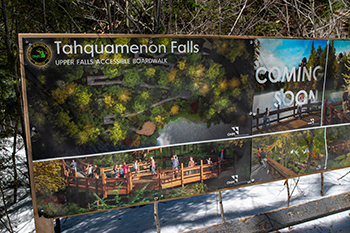
TF-10: A sign advertising the construction of the new accessible boardwalk at the Upper Tahquamenon Falls is shown.
|