Chevy Commons: An uncommonly revitalized green space in the heart of downtown Flint
By SARAH LAPSHAN
Senior Communications Advisor
Michigan Department of Natural Resources
“People told us we were crazy, that the site was beyond saving. It was truly a scar right in the center of Flint, but we believed it could be more.”
That’s Christina Kelly, director of community impact at the Genesee County Land Bank Authority, describing initial reactions some 20 years ago to a budding plan to reimagine Chevy in the Hole — the former site of a General Motors manufacturing complex — from a highly contaminated brownfield site along the Flint River into a thriving parks and outdoor recreation anchor.
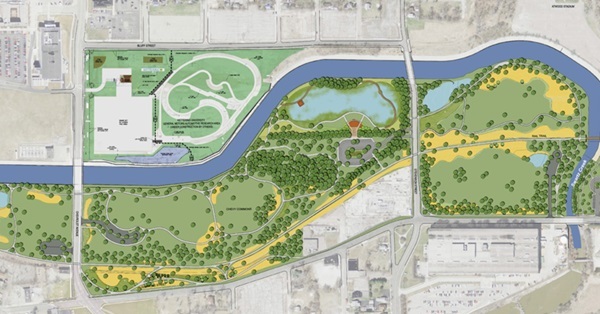
Chevy Commons is now a 60-acre park unit located on the river just a few blocks from downtown Flint, situated between Grand Traverse Street and Chevrolet Avenue, but the journey from abandoned brownfield site to premier park was anything but swift.
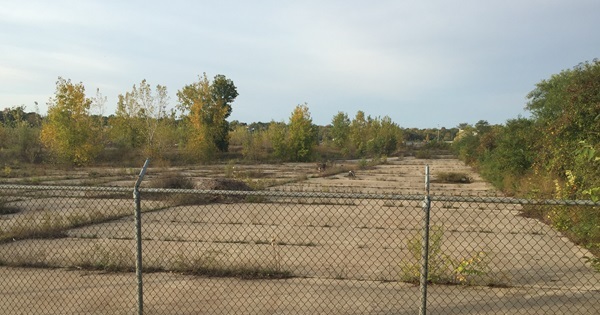
The site, which was established in the 1930s as one of General Motors’ four major production facilities in Flint, once featured 17 buildings and, at its peak, 8,000 workers. After plant closings and building demolition started in the 1990s, the concrete shop floor and asphalt remained in place to minimize the movement of residual contamination.
 “I started on this in 2004, when it was just a shop floor, when Dan Kildee pitched the idea of a revitalized green space along the river. The state park idea emerged out of the River District Plan by Sasaki and Associates in 2005,” Kelly said. “We moved forward, working with the city of Flint and Genesee County Parks, even without a commitment on design, to get the ball rolling. We didn’t know if it would work, if it was even feasible, but we knew it could be great.”
She said that despite some initial unease about whether the vision could be accomplished, there was strong local buy-in. The Mott Foundation funded the original plan, the River District Strategy, in 2005, and then came the creation of the Flint River Corridor Alliance, which met regularly around different projects. It was a lot of cleanup, a lot of planning — a cycle that continued for several years.
This brief Bright Side video, from the Community Economic Development Association of Michigan, highlights the rich history and sobering realities tied to tackling the remediation and development of such a large and complex property. The longer version digs even deeper.
“Once we got the brownfield and site turned into green space, the conversation was ‘let’s talk about turning this into a park,’” Kelly said. “The shop floor was a showcase Environmental Protection Agency project demonstrating what a transformed brownfield site could be. The EPA dollars were critical to understanding and resolving some of the most daunting challenges.”
 Progress continues
A $6,056,500 Michigan Natural Resources Trust Fund Grant in 2016 facilitated the city of Flint's acquisition of the land, which was then transferred to the Genesee County Parks and Recreation Commission for development into the beautiful park it is today. An additional nearly $1.2 million in Trust Fund grants in 2017-18 laid the foundation, farther down the river, for upcoming restoration of several of the “block” parks — Grand Fountain, Waterwall, Market Stall and Archimedes Screw — that make up the Riverbank Park along the river and complemented a larger $5 million grant from the National Park Service’s Outdoor Recreation Legacy Program.
Genesee County Parks Director Patrick Linihan said the Chevy Commons project was at that time the largest brownfield-to-public-resource transformation, requiring a strong core of local, county, state and federal agencies partnering with philanthropy to keep things on track and overcome the unique challenges of the former industrial site.
“Without that collaboration, the financial resources would have certainly been a nonstarter for the project,” he said.
Linihan said the redevelopment of Chevy Commons has already proven to be valuable as a community meeting place and as a welcoming space for passive recreation in the urban core. The developing play garden is expected to be a showpiece that draws people from outside the city and county, too.
“Thanks to the Charles Stewart Mott Foundation, the park will also be the hub of the ‘hub and spoke’ trail development in the works,” he said. “Everything will lead to Chevy Commons.”
The approximately 230-acre state park, located along a 3-mile stretch of the Flint River and a section of Swartz Creek (a tributary of the Flint River), will be Michigan’s 104th state park and Genesee County’s first. It will bring together local existing parks and natural areas, creating an outdoor experience of five park units and connector trails.
 While many of the park units are already open to the public, enhancements will be ongoing through 2027, when construction is expected to finish.
“It’s impossible to quantify the teamwork, the hours and the heart that have gone into making a state park in Flint a reality,” said Michigan Department of Natural Resources Director Scott Bowen. “Staff from across the DNR, especially from Grants Management and Parks and Recreation, have pulled out all the stops to keep this thing moving full speed ahead, working side by side with the city of Flint, Genesee County, the C.S. Mott Foundation and many other partners.
“It’s gratifying for everyone to see it all coming together!”
For more on Chevy Commons and the other four park units, the park footprint, the funding model, partnerships, park management and the construction schedule, visit the DNR’s Flint State Park page.
More on the Trust Fund
Renewals such as those taking place in Flint are what the Michigan Natural Resources Trust Fund is all about. Established in 1976 and enshrined for permanent protection in Michigan’s Constitution, the fund provides grants to state and local governments to purchase land for conservation or recreation, and for development of public outdoor recreation facilities.
The fund is financed through interest earnings on royalties from state-owned oil, gas and mineral leases and administered by the DNR.
In addition to those larger projects, the Trust Fund makes possible a variety of efforts to bring quality outdoor recreation opportunities to cities, townships and villages throughout Michigan: everything from pier harbor upgrades, shoreline beach expansion and trail connections to community skate parks, athletic fields and picnic pavilions.
Anniversary events April 14-15
As the Michigan Natural Resources Trust Fund celebrates 50 years of investing in communities, protecting natural resources and expanding access to outdoor recreation, leaders and partners will gather in Flint for on-the-ground fun and business Tuesday and Wednesday, April 14-15. It’s the first stop on the Trust Fund’s community tour and board meeting schedule, and an excellent opportunity to meet local partners and explore funded projects.
Tuesday’s “Feet on the Street” program includes a walking tour of Chevy Commons and a series of short presentations highlighting how Trust Fund investments continue to shape the landscape today. This is a free, public event, and all community members are welcome to attend any portion of the program.
On Wednesday, the Michigan Natural Resources Trust Fund Board meeting will take place at the Flint Farmers Market. It is a public meeting, open to everyone. Before the meeting, there will be an opportunity to connect over coffee and a slice of pie, followed by the official board meeting at 9 a.m., and an optional walking tour along the Flint River.
See the full schedule for both days.
Looking ahead in 2026, the Michigan Natural Resources Trust Fund Board will host similar community celebration/board meeting showcase events with stops in Detroit (June), Marquette (August) and Traverse City (September). All details, including specific locations and timing, will be announced as the dates draw closer.
|
 Change champion
Christina MacInness, chair of the Michigan Natural Resources Trust Fund Board, said Chevy Commons is living proof of how Trust Fund investments can catalyze a community to move from disinvestment to reinvestment by creating greater public access to nature, more expansive and accessible outdoor recreation opportunities and restored vital ecosystems.
“The impact of Trust Fund grants on Flint has been transformational because they were key to leveraging federal, state, local and philanthropic dollars to make the vision of a park revitalizing the Flint River Corridor a reality,” she said. “This project brings outdoor recreation directly into the city’s neighborhoods and downtown with safe, walkable, nonmotorized trails, river overlooks, fishing, kayaking, playgrounds, neighborhood parks and a connection to Michigan’s Iron Belle Trail.”
Through the last 50 years, the Trust Fund has awarded over $28.5 million for 80-plus projects and acquisitions in Genesee County. That funding is part of the nearly $1.4 billion granted in more than 3,000 allocations to state and local units of government across Michigan.
MacInnes said that as our climate changes and global freshwater resources become more precious, and as the benefits of access to nature — both in urban and rural settings — are better understood, Michigan’s natural resources will become even more highly valued and set our state apart.
“Access to nature and outdoor recreation becomes a huge quality of life factor,” she said. “That’s the reason my grandparents decided to make Michigan their home, why my parents made a similar decision 25 years later, and why my husband and I, 38 years after that, decided to move from California to Michigan, to make it our home and our mission.”
 Looking ahead
Over the next 50 years, MacInnes sees the Trust Fund continuing to help Michigan protect and steward the resources that define us, and to successfully adapt to changing needs: “It’s a source of stable, long-term funding that ensures public access, conservation, recreation and, in some cases, economic sustainability in the places we cherish.”
The Genesee County Land Bank Authority’s Christina Kelly agrees, noting that projects such as Chevy Commons would not be possible or sustainable at the local level in places like Flint without the Trust Fund.
“Looking back now, I’m thrilled. We were able to transport that old shop floor to a green space and incorporate it into a regional state park,” Kelly said. “It’s really the best possible outcome, and it was beyond our imagination.
“That old, forgotten site — that scar — is now a shining star, a clean slate, a natural asset to the Flint area. And the Michigan Natural Resources Trust Fund is the resource that makes Chevy Commons happen.”
Visit Michigan.gov/MNRTF to learn more about Trust Fund grant opportunities, eligibility and the application process, as well as the full scope of grant dollars that have supported development projects and land acquisitions in all of Michigan’s 83 counties.
This brief anniversary video highlights the Michigan Natural Resources Trust Fund’s history, ingenuity and impact.
Check out previous Showcasing the DNR stories in our archive at Michigan.gov/DNRStories. To subscribe to upcoming Showcasing articles, sign up for free email delivery at Michigan.gov/DNREmail.
Note to editors: Contact: John Pepin, Showcasing the DNR series editor, 906-226-1352. Accompanying photos and a text-only version of this story are available below for download. Caption information follows. All photos are courtesy of the Genesee County Land Bank Authority, except for the Michigan Natural Resources Trust Fund sign.
Text-only version of this story.
Central area: A view, facing west from Stevenson Street, of the central portion of Chevy Commons prior to capping the area with park space.
Concept: A rendering from the Flint Riverfront Restoration Plan for Chevy Commons; designs by Wade Trim and Rowe Professional Services.
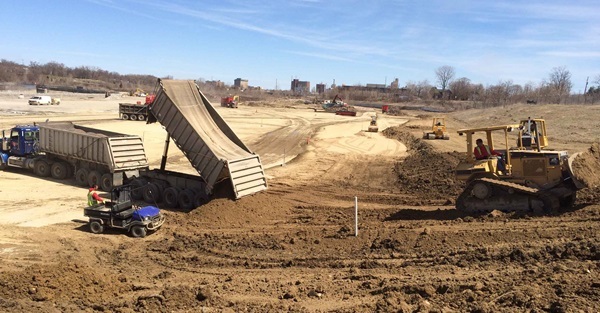
Soil: View of soil import and cap construction at the central portion of Chevy Commons site, east of Chevrolet Avenue and north of railroad tracks. Phase 1 construction, around 2015.
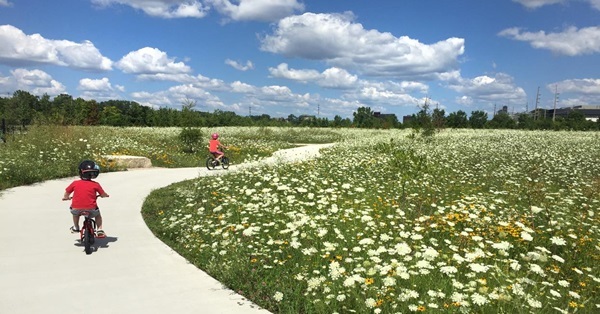
Trails: Phase 1 construction at Chevy Commons transformed the vacant industrial site into a low-maintenance public park with trails for pedestrians and bikers, as well as natural habitat for local species.
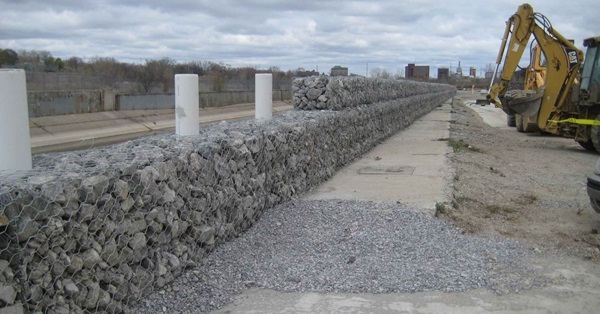
Baskets and fencing: View of construction work to place gabion baskets and fencing along the Flint River, just east of Chevrolet Avenue.
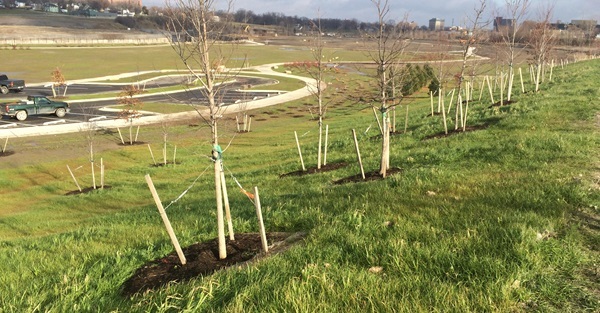
Trees: Building out the green space with the planting of more trees across the Chevy Commons site.
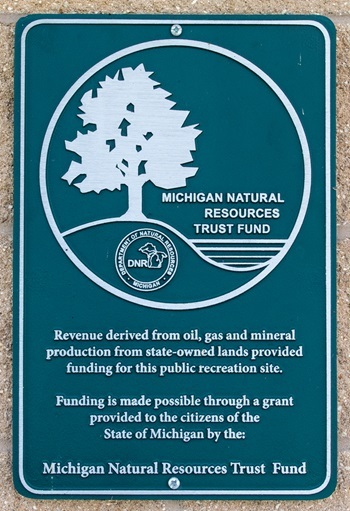
Trust Fund sign: The dark green Michigan Natural Resources Trust Fund sign that is posted at Trust Fund-supported sites and projects.
|