|
April 13, 2026
Contact: Addie Myers, 989-778-0389 or Jay Wesley, 616-490-5090
Lake Macatawa acoustic telemetry project shows surprising muskie movements
The Department of Natural Resources Fisheries Division has partnered with the Michigan Muskie Alliance, Great Lakes Acoustic Telemetry Observation System (GLATOS) and Grand Valley State University to track movement of muskellunge in Lake Macatawa (Ottawa County) with acoustic telemetry.
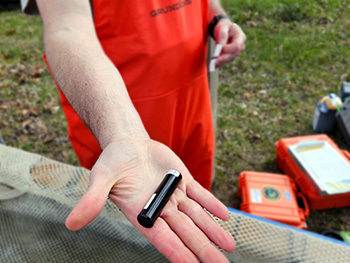
In April 2025, acoustic telemetry tags — provided by the Michigan Muskie Alliance — were implanted in 20 Great Lakes strain muskellunge from Lake Macatawa. These acoustic tags are about the size of an AA battery and have a life of approximately seven years. After tagging, the fish were returned to the lake.
Next, eight GLATOS receivers were placed in Lake Macatawa. This equipment and other receivers in the GLATOS network “listen” for signals from fish that have been implanted with acoustic transmitters. As of November 2025, there were over 69,000 detections of the 20 tagged muskie by GLATOS receivers.
|
Based on the data collected so far, these Great Lakes strain muskie appear to be traveling out of Lake Macatawa for at least part of the year. Some fish were tracked to Chicago, Grand Haven, Saugatuck and even Green Bay! If you catch a muskie, that fish may have been stocked hundreds of miles away.
The muskie will continue to roam Lake Macatawa and Lake Michigan and will be tracked for the next seven years. Annual updates will be provided at the Michigan Muskie Alliance banquet, and a final report will be written once the project is completed.
This muskie tagging research is one of many projects on which the DNR has partnered with the Michigan Muskie Alliance over the 25 years that organization has been in operation. The group has also provided forage for fish rearing and supported hatchery improvements and operations at Wolf Lake State Fish Hatchery — including donations for fish food and hatchery infrastructure needs, along with volunteer hours.
Partnerships with sportfishing groups have been essential for conducting this kind of local, species-specific research for which state, federal or grant funding is not available.
Learn more about Michigan Muskie Alliance projects at MichiganMuskieAlliance.org and how the DNR manages Michigan's muskellunge at Michigan.gov/Muskie.
|
Note to editors: Accompanying photos are available below for download. Caption information follows.
-
Acoustic tag: Acoustic transmitter tags, about the size of AA batteries and with a life of approximately seven years, were used in the Lake Macatawa muskellunge research.
-
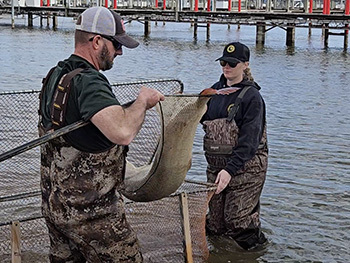
Muskie tagging: Michigan Department of Natural Resources fisheries biologists captured and implanted acoustic tags in 20 muskie from Lake Macatawa.
|