|
This quarterly newsletter from the Michigan Department of Natural Resources Forest Utilization and Marketing Program shares information on DNR programs, economic reports, industry news, professional development opportunities and more. If you know of an event or opportunity that may be of interest to our partners or if you have questions, contact timber sales and utilization specialist Matt Watkeys, or visit us on the web
Seasonal road restrictions are being applied across the state due to the spring weather.
To stay aware on the road weight restrictions and frost law enforcements, use the County Road Association of Michigan's app or website.
The 2026 Stewardship Forester is Paul Drysdale of Drysdale Forestry & Consulting in Cadillac. Paul was given the award in February to recognize his outstanding customer service to family forest landowners. The award recognizes Paul’s work on forest policy with partner organizations such as Association of Consulting Foresters, Society of American Foresters and Michigan Forest Products Council.
The Forest Stewardship Program is funded by the USDA Forest Service and administered in Michigan by the Department of Natural Resources. For more information, contact Mike Smalligan at SmalliganM@Michigan.gov or 517-449-5666.
The Timber Production Expansion Guaranteed Loan Program (TPEP), operated in partnership with the USDA Forest Service, provides financial support to qualified lenders whose loan applicants want to establish, reopen, expand, or improve a sawmill or other wood processing facility that processes ecosystem restoration byproducts from national forest land. You can find information about the loans and help for more complex projects online.
Subject to the availability of funds, the USDA Forest Service is making grant funding available through its Wood Innovations, Community Wood, and Wood Products Infrastructure Assistance grants to tribes and other entities.
The Forest Service is seeking proposals that support crucial links between resilient, healthy forests, strong rural economies and jobs in the forestry sector. The application period goes through April 22, 2026.
The Farm Bill, which covers an array of topics ranging from commodity pricing to forestry, is traditionally enacted every five years.
A few forestry highlights from the 2026 Farm Bill include:
- Amends the Cooperative Forestry Assistance Act to extend the $10 million authorization of appropriations for state Forest Action Plans and authorize funds to be used for their implementation. (Sec. 8101)
- Codifies the Reforestation, Nurseries, and Genetic Resources Program. (Sec. 8305)
- Requires the USDA Forest Service to suppress wildfires within 24 hours of detection, as seen in Senator McClintock’s (R-CA) H.R. 178. (sec. 8408)
- Amends the Good Neighbor Authority (GNA) to authorize special districts to retain revenue, allow new permanent road construction, and extend the GNA Revenue provision until 2030. (sec. 8412)
- Establishes a new “Deployment and Testbed Pilot Program for new and innovative wildfire prevention, detection, communication, and mitigation technologies” as seen in Senator Barrasso’s (R-WY) Wildfire Prevention Act of 2025 (S.140). (sec 8414)
- Reauthorizes the Wood Innovation Grant Program, reduces the non-federal match, and authorizes grants for hauling hazardous fuels reduction materials to locations that can use it. (sec. 8432)
Congress is working on a new Farm Bill, with a markup that was scheduled for March 3.
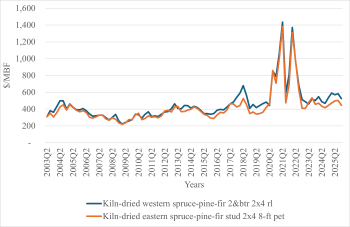
Detroit delivered lumber price series for kiln-dried western spruce-pine-fir (SPF) 2&Btr 2×4 and kiln-dried eastern spruce-pine-fir stud 2×4 shows three clear phases.
From roughly 2003 to 2019, prices remained relatively stable with moderate cyclical fluctuations, generally between about $250 and $500 per thousand board feet, reflecting typical housing market cycles and stable sawmill production. These SPF products represent a major share of structural softwood lumber used in U.S. residential construction. In the Lake States region, the eastern SPF market—largely supplied by species such as spruce, balsam fir, and other northern softwoods- plays a particularly important role in regional lumber production and pricing.
Beginning in 2020, prices rose sharply and peaked in 2021 due to COVID-19–related supply chain disruptions, temporary mill closures, transportation constraints, and a surge in housing construction and home renovation demand.
Prices declined after 2021 as mills resumed operations and supply chains stabilized, although market volatility remained higher than in the pre-2020 period as production and demand continued to adjust. For more information contact: Jagdish Poudel, DNR forest economist, poudelj@michigan.gov
|
In early 2026, Michigan DNR Marketing and Utilization Staff will start surveying primary sawmills for the purpose of the Timber Products Output (TPO) in partnership with the USDA Forest Service. The requested information will encompass calendar year 2025. This information helps to assess the amount of wood harvested from Michigan’s and US forestland, promote forest products, and evaluate trends in timber resources.
These surveys are used and reviewed by state and federal policy makers, as well as forest industry stakeholders. We will need your help to complete this task! When you receive your survey form, please provide as much information as possible about usage and production by your mill or energy facility during 2025.
All volume information will be held confidential and will only be used for statistical analysis and reports. No companies will be mentioned by name in any reports.
The TPO Interactive Reporting Tool allows visitors to view TPO data via an interactive experience. The TPO Interactive Tool includes estimates of timber products, logging residue, mill residue, residential fuelwood, and other removals based on the selected area. Users can click on the desired states or counties on the map to produce TPO data based on the geographic area and year of interest, and can be found here:
Timber Products Output Interactive Reporting Tool | US Forest Service Research and Development
Multiple short courses and Inspector training school classes are now available through the National Hardwood Academy. The calendar has classes listed through December 2026. Registration, class fees and other information can be found online.
Forest management input schedule: 2027 activities
EUDR 2026: Industry Perspectives on What Comes Next
Forest products you may not know: Siding from sustainable aspen forests | KAXE
Weyerhaeuser and Aymium Enter Agreement to Rapidly Scale Biocarbon Market - Dec 11, 2025
Volatile Prices and Falling Volumes Mark Lake States Timber Markets
What are the Prospects for Lumber Prices as Spring 2026 Approaches?
45Z Update: What You Need to Know
Ongoing: 2026 Michigan SFI Training Schedule
Ongoing: Forest Industry Safety and Training Alliance trainings
April 9-10: Michigan SAF Spring Meeting - Gaylord, Michigan.
April 15: 2026 Sustainable Forestry Conference - Florence, Wisconsin.
April 16-18: 2026 Timbermen's Convention - Boyne Falls, Michigan.
|