|
This quarterly newsletter from the Michigan Department of Natural Resources Forest Utilization and Marketing Program shares information on DNR programs, economic reports, industry news, professional development opportunities and more. If you know of an event or opportunity that may be of interest to our partners or if you have questions, contact timber sales and utilization specialist Matt Watkeys, or visit us on the web
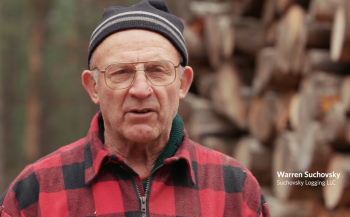
Warren Suchovsky passed away on November 14, 2025. He was very generous with his time serving on multiple Department of Natural Resources committees to provide thoughtful and constructive input. Warren chaired the Forest Stewardship Program advisory committee for its first ten years from 1990 to 2000 and was active on the committee for 30 years.
While it would prove impossible to list the achievements and accolades of Warren, here are a few; He was an avid reader and was very active in many organizations with his township, county, state and federal levels. He served on many boards and committees earning many merit and achievement awards with Farm Bureau, Michigan Association of Timbermen, Michigan Township Association, Soil Conservation District and many others. Warren further enjoyed woodworking, canoeing, skiing and hiking. He loved being out in the woods, whether it was working (cutting, skidding or planting trees), teaching, studying or recreating. Warren loved his family and enjoyed spending time with and doing/building things for them.
The full obituary can be found here: Obituary information for Warren H. Suchovsky.
Warren was influential and always involved. We hope you will enjoy this "Safe Crossings" video that includes Warren and is posted on the Michigan SAF YouTube page.
|
The Softwood Lumber Board is working to expand the softwood industry into different markets, such as multifamily and nonresidential construction. SLB has developed a strategic plan to continue the progress, addressing problems and challenges, leverage education and create a more focused strategy.
SLB is working on finding and capitalizing on opportunities for growth:
- Amplify and expand resources
- Accelerate code adoption
- Shape the next generation of specifiers
- Advance innovation and groundbreaking projects
- Deeper city level focus
DNR Forest Economist Jagdish Poudel recently performed a commodity imports and exports report, these were his findings:
Total foreign imports across 32 forest product sectors amount to $2.32 billion, while total exports total $956.2 million, resulting in a trade deficit of approximately $1.37 billion.
Among the 32 forest product sectors considered, six are net exporters and 25 are net importers. Institutional furniture emerges as the largest single category on both sides of trade, with $294.9 million in imports and $154.4 million in exports. The largest commodity trade deficit is observed in institutional furniture (-$140.4 million), followed by upholstered household furniture (-$135.1 million) and dimension lumber (-$126.3 million). Conversely, the largest surpluses are recorded in wood pulp (+$16.6 million), logs and roundwood (+$15.2 million) and paperboard from pulp (+$13.6 million).
The top three import categories: Institutional furniture ($294.9 million), dimension lumber ($197.1 million) and paper from pulp ($149.3 million): collectively account for about 27.6% of total imports, indicating a moderate level of concentration. On the export side, institutional furniture ($154.4 million), wood pulp ($116.2 million) and paperboard from pulp ($103.0 million) represent the top three lines, together comprising approximately 39.1% of total exports, reflecting a somewhat higher concentration than imports.
For questions or more information, please contact Jagdish Poudel: poudelj@michigan.gov
The lumber market today is different than it was a few years ago. The Wisconsin Department of Natural Resources has created a list of the major factors influencing timber demand.
The main ones highlighted in this article are:
- The housing market
- Substitute products (vinyl, plastic etc.)
- Location and timing (where trees grow and when they are cut)
- Pulp wood demand
- Transportation
- Tariffs
As quarter 4 comes to a close, it is important to look back and learn from what the market experienced. ResourceWise has compiled a list of insights from Q4 and going into 2026 during a webinar earlier this year.
Here are the most important insights from that webinar:
- Policy changes will reshape market dynamics.
- Demand for growth driven by higher mandates.
- Trade flows are shifting in North America.
- Pricing pressures reflect supply and policy tension.
Five years ago, Michigan DNR Forest Resources Division incorporated new technology and methodology for data collection, volume calculations and reporting of standing timber volumes across the nearly four million acres of state forest land.
“Our goal was to improve our consistency and accuracy of volume estimations across the state. A necessary part of the process has been reviewing the past five years of data comparing it to our previous data. We can now see particular parts of our timber cruise methods which need adjustments and fine tuning” said Brenda Haskill, unit manager for the Timber Sales and Utilization program area of FRD.
A team of five from FRD and one private sector wood procurement forester have been reviewing data, statistics and trends over the past five years. Starting Jan. 1, 2026, FRD field foresters will be implementing the changes approved by FRD managers.
All timber sale prospectuses will clearly specify the sales which have been cruised with these changes after Jan. 1.
For questions or more information, please contact Brenda Haskill: haskillb@michigan.gov.
The release of the new State Forest Management Plan (SFMP) will be delayed by at least a year due to the devastating ice storm in northern Michigan March 28-30. The historic storm coated trees with up to an inch or more of ice, causing widespread damage in the northeastern lower peninsula. Stands of all cover types were affected, with different levels of damage across just over 900,000 acres of state forest land. Damage is spread across five management areas: Avery Hills, Emmet Moraines, Huron Sandy Lake Plain, Presque Isle Lake and Till Planes and Wolverine Moraines. Three additional areas -- High Sand Plains, Camp Grayling and Kalkaska Sandy Moraines – were partially affected. Damage assessment of stands and existing treatments is underway, and salvage efforts have begun. Both are being tracked closely to gauge their impact on the SFMP. Before a revised SFMP is published, the SFMP planning team must complete a high-level assessment of damage and determine projected impacts from both salvage efforts and natural mortality in each cover type within each management area. Those disturbance impacts can then be represented in our SFMP model.
Our planning team will then need to re-run affected management areas and produce new harvest targets, wildlife habitat outputs, current and future age class distributions, volume estimations, etc. After those are incorporated into a revised SFMP, we will need to gather and incorporate external and internal comments, assess those comments and make changes as needed and submit the plan for final approval with ice damage accounted for. The projected final release date is June 2026.
If you have additional thoughts regarding what should be included in this process and the new plan, please contact Dan Heckman at heckmand@michigan.gov.
In early 2026, Michigan DNR Marketing and Utilization Staff will start the process of surveying Primary Sawmills in the State for the purpose of the Timber Products Output in partnership with the US Forest Service. The requested information will encompass the prior calendar year of 2025. This information helps to assess the amount of wood harvested from Michigan’s and our Nation’s forestland, promote forest products and evaluate trends in timber resources.
These surveys are also used and reviewed by state and federal policy makers, as well as forest industry stakeholders. We will need your help to complete this task! When you receive your survey form, please provide as much information as possible about usage and production by your mill or energy facility during the calendar year 2025.
All volume information will be held confidential and will only be used for statistical analysis and reports. No companies will be mentioned by name in any reports.
European Parliament Kicks EUDR Down the Road for 12 More Months | Wood Central
FLA Responds to EUDR Delay: A Necessary Pause on a Fundamentally Unworkable Regulation – Forest Landowners
Michigan and Wisconsin Timber Markets Continue to Show Resiliency in Challenging Times | GreenStone FCS
CN a 'strong fit' for lumber dealer's growth strategy, new upper Michigan plant - RailPrime | ProgressiveRailroading - Subscribe Today
Forest Industry Uncertainties Magnify the Strengths and Weaknesses of Local Timber Markets - Forisk
Rayonier And PotlatchDeltic Announce Massive Merger - Wood Business
Multiple dates: 2026 Michigan SFI Trainings (schedule) - Michigan.
Jan. 14-16: Lake States Lumber Association Winter Meeting - Green Bay, Wisconsin.
Jan. 20-22: Michigan Nursery Landscape Association Great Lakes Trade Expo - Grand Rapids, Michigan.
March 23-25: Lumber Grading Short Course - Grayling, Michigan.
April 9-10: Michigan SAF Spring Meeting (registration coming soon)- Gaylord, Michigan.
April 15: Sustainable Forestry Conference - Florence, Wisconsin
April 16-18: Timbermen's Convention - Boyne Falls, Michigan.
|