Hunters Feeding Michigan and how we can all help
By CARLY KALKAUSKI
Hunters Feeding Michigan student assistant
Michigan Department of Natural Resources
Hunger isn’t always obvious.
It can show up as the quiet gnaw in a child’s stomach before school, or in the concern of a parent while sitting at the kitchen table making the decision between paying for groceries or rent or the suffering of anyone lying in bed wishing dinner was able to stave off the ache of not enough.
This grim reality plagues over a million Michiganders.
Almost one in five children in Michigan struggle with hunger. It’s a problem that cuts across rural towns, urban neighborhoods and suburban streets.
One of the ways that the Michigan Department of Natural Resources is working to help address this problem is through a program called Hunters Feeding Michigan.
The program bridges the gap between hunters, who donate deer they harvest, and charities that can use deer meat, or venison, from those donations to help people in need.
Hunters Feeding Michigan follows a three-step process.
First, hunters use a license to harvest a deer and decide to donate the deer to the program to help their neighbors.
Second, they bring the deer to a participating processor, listed at Michigan.gov/HuntersFeedingMichigan, and the processor takes it from there – no processing fee to worry about.
Third, after the deer meat is processed into ground venison, the program’s partner, Food Bank Council of Michigan, uses the Feeding America network to distribute the venison to food banks, pantries, shelters, soup kitchens and other agencies across the state.
It’s a system that has helped bring in 2.8 million servings of clean protein to those in need since 2005, and that number is only getting bigger each year thanks to the support of donors. The program is primarily donation-funded in its current state, making it reliant on those who donate deer and money to function as it does.
|
If you’d like to support the program, visit the Hunters Feeding Michigan webpage and find out where you can either donate deer or donate funds, share the information with a hunter you know with an often-full freezer, or let friends and family know about the program.
After all, hunters have reported that increasing awareness about programs like Hunters Feeding Michigan would amplify program participation, so every bit of reach helps.
You can also support the program by buying Hunters Feeding Michigan products from Great Lakes Proud – including t-shirts, hats, a hoodie and a tumbler – and Deer Camp Coffee’s Donor Doe and Traditions coffees. A portion of the proceeds from these products benefits Hunters Feeding Michigan.
For those curious about exactly how the sausage is made (pardon the pun), read on.
Let me back-up to the beginning.
Hunters Feeding Michigan’s name may be new – the DNR adopted the name in the last year – but the program's existence is not.
Legislation was passed in 2005 requiring the DNR to start a wild game donation program. It was a bit of a slow start at first, with the program becoming fully operational in 2007, but now that Hunters Feeding Michigan has the Food Bank Council of Michigan as a partner, the program is quickly picking up steam.
Since Oct. 1, 2024, the program has processed almost 500,000 servings of venison. That’s about 18% of its lifetime donations in just the last year, showing its impact is only growing by the day.
The first, and arguably most important, piece of the puzzle?
Michigan deer hunters.
Many hunters see the program as one way they can connect with and contribute to their communities. Plus, hunters are the original conservationists – without them, it feels like the state would be more deer than people.
Hunting has been shown to increase a person’s love for the environment, respect for wildlife and a desire to protect nature, according to a 2024 study published in Nature Sustainability.
Adam Eller, owner of Carson Village Market and Village Market Deer Processing in Carson City, Michigan, walked me through what it’s like to participate in the program both as a hunter and the largest processor in the program.
Hunting, he said, is a family tradition, “all the way from (his) great-grandfather.”
Eller’s love for nature and his community was palpable as we talked.
I asked him what the program meant to him as a hunter, and he said, “Clean protein for families in need – that’s what I really like about it … As a conservationist, I really, really love that part of it because people can go, ‘hey, I see what they’re doing here.’”
|
Once hunters donate a deer they’ve harvested to the program, that’s where the processor – the next link that makes Hunters Feeding Michigan possible – comes in. Being able to donate deer and not having to pay for processing can inspire folks to harvest more deer.
Eller summed up what the program is all about perfectly when he said, “Donating takes care of two projects at once – helping people that are in need, and keeping our (deer) herd in check and healthy … It’s just a fantastic program.”
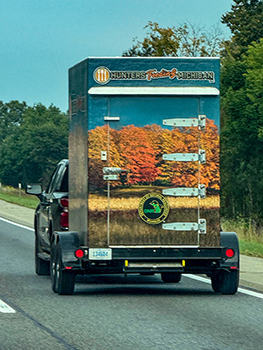
A recent addition to the program, refrigerated trailers deployed by Hunters Feeding Michigan, has changed the game for processors (again, sorry for the pun).
Now, instead of processors having to store excess venison within their own square footage, the program can provide extra space for donations.
Prior to the introduction of the refrigerated trailers, Eller would have to turn donations away due to issues with storage. He said having the refrigerated trailers feels like the next chapter for this program and that it’s the “biggest change” that’s happened in its history.
“If we go back to 2015, we did more donations last year than we did total deer in 2015,” he said. When I asked him about the numbers, he said that in 2015, they processed 436 total animals, with only a fraction of those being donations. In 2024, they processed over 500 donations alone.
For the customer, it’s a “five-minute process.”
They come in with their donation of game and the processor takes care of everything else from there. Once the donation has gone through processing, the venison is picked up by one of Food Bank Council of Michigan’s seven food banks.
From there, Food Bank Council of Michigan gets the venison to one of its agencies that helps feed those in need.
That’s the final link in the chain for Hunters Feeding Michigan.
The DNR’s partnership with Food Bank Council of Michigan, which started in 2024, has been a boon for both organizations. With the council’s ability to distribute to all 83 counties in Michigan through its unparalleled network of agencies, which includes food banks, pantries, shelters, soup kitchens and other charities that distribute food, the program is reaching more Michiganders than ever before.
Meanwhile, increased venison donations keep costs down for food banks.
|
According to Food Bank Council of Michigan’s agriculture business specialist, Garret Zuver, the organization spent an average of $3.70 per pound on proteins such as pork, sausage, turkey and beef products.
In the approximately eight-month span between Oct. 24, 2024, and June 20, 2025, Food Bank Council of Michigan purchased almost 4.5 million pounds of protein products. That means they spend over a million dollars per month on protein products.
This doesn’t include what the individual food banks may have purchased to try and keep up with the ever-increasing demand for food and especially protein. Every pound of venison donated through Hunters Feeding Michigan decreases that need to purchase protein and puts money back in the council’s budget to buy other essentials that its agencies need.
While venison donations are the core of what Hunters Feeding Michigan does, the program is continuing to expand its reach in helping those in need. This past summer, I had the pleasure of coordinating the inaugural Hunters Feeding Michigan nonperishable food drive.
For a week in July, people from across the state stopped into their local DNR customer service centers to donate food. There was even an internal food drive at the Deborah A. Stabenow building in Lansing, where many DNR staffers and their colleagues in other state agencies work.
By the end of that week, over 1,400 pounds of food were donated.
Deploying refrigerated trailers and hosting nonperishable food drives are just the beginning of Hunters Feeding Michigan’s current chapter.
At the end of the day, every effort to help those in need makes a difference. And the work that Hunters Feeding Michigan does is made possible by the support of individuals like yourself.
Head over to Michigan.gov/HuntersFeedingMichigan to learn more about donating your harvest or to make a monetary donation. Share this article with a friend. And this deer season, we’ll be doing what we can so no Michigander will have to worry about putting food on the table.
Check out previous Showcasing the DNR stories at Michigan.gov/DNRStories. To subscribe to upcoming Showcasing articles, sign up for free email delivery at Michigan.gov/DNREmail.
|
Note to editors: Contact: John Pepin, Showcasing the DNR series editor, 906-226-1352. Accompanying photos and a text-only version of this story are available below for download. Caption information follows. Credit Michigan Department of Natural Resources, unless otherwise noted.
Text-only version of this story.
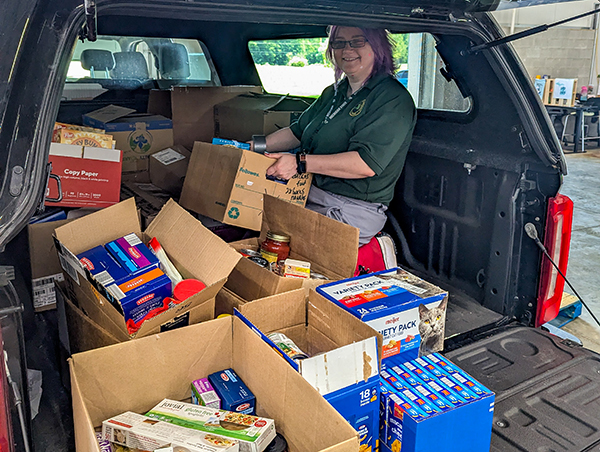
Author: Story author Carly Kalkauski, Hunters Feeding Michigan student assistant with the Michigan Department of Natural Resources, is shown sitting in the back of a vehicle with food drive donations.
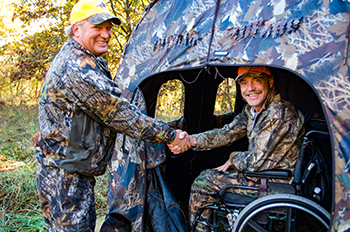
Hunters: Two hunters shake hands in the field. A growing number of hunters are donating to help Hunters Feeding Michigan.
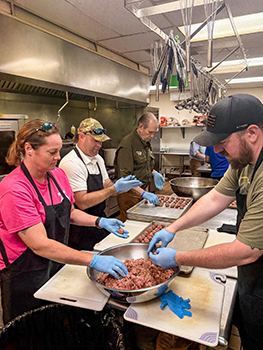
Meatballs: Hunters Feeding Michigan program specialist Joe Presgrove helps volunteers at Grace Centers of Hope prepare meatballs.
Trailer: A Hunters Feeding Michigan trailer is shown on the road.
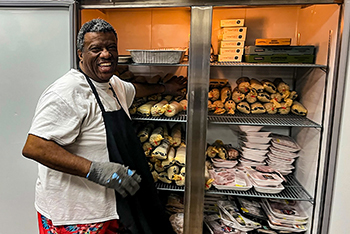
Volunteer: A volunteer at Grace Centers of Hope in Pontiac grabs some Hunters Feeding Michigan venison bags to prepare a meal.
|