|
The Michigan Department of Agriculture and Rural Development has confirmed new detections of invasive hemlock woolly adelgid in Manistee and Van Buren counties.
With these new detections, 11 Michigan counties have active hemlock woolly adelgid infestations:
- Allegan
- Antrim
- Benzie
- Manistee
- Mason
- Muskegon
- Oceana
- Ottawa
- Van Buren
- Washtenaw
|
Manistee County detection
Hemlock woolly adelgid was detected by the Mason Lake Conservation District on Feb. 3, 2025, during a routine survey. The U.S Department of Agriculture’s Animal and Plant Health Inspection Service confirmed the detection on Feb. 6, 2025. Working closely with MDARD and other partners, the conservation district conducted surveys near the northern edge of infestation. The detection is about 0.5 miles north of the Mason and Manistee county line near Lake Michigan.
Van Buren County detection
On March 3, 2025, forest health technicians from the Michigan Department of Natural Resources' Parks and Recreation Division detected two hemlock trees infested with hemlock woolly adelgid in Van Buren State Park. Samples collected from the infested trees were confirmed as positive by USDA APHIS on March 4, 2025. Technicians are in the process of determining the full extent of the infestation and plan to treat the infested trees this summer. Park visitors are advised to stay on designated trails to limit the risk of spreading hemlock woolly adelgid. The trees were previously surveyed in late November 2024, with no ovisacs detected at that time.
Hemlock woolly adelgid identification
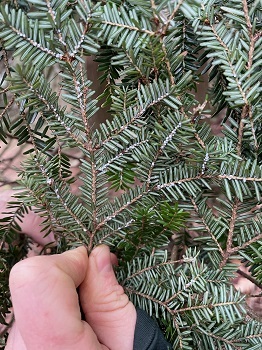
Hemlock woolly adelgid is a small insect that uses its long, siphoning mouthparts to extract sap from hemlock trees. This feeding weakens needles, shoots and branches. Over time, tree growth slows, and trees take on a grayish-green appearance. Without treatment, infested trees die within four to 10 years.
Hemlock woolly adelgid can be identified by looking on the undersides of hemlock branches for evidence of round, white ovisacs near the base of the needles. Up close, ovisacs resemble tiny cotton balls and may appear alone or in clusters. For assistance in identification, see the short video Hemlock Woolly Adelgid: Invasive Species in Michigan.
It's important to note that other, less damaging pests easily can be mistaken for hemlock woolly adelgid. Be sure to review photos and descriptions of common hemlock woolly adelgid look-alikes at Michigan.gov/HWA. Help in identifying eastern hemlock trees is also available at the same site.
Report suspected infestations
To report any suspected HWA infestations:
Be prepared to report the location of infested trees and, whenever possible, take one or two pictures of infested branches to help confirm identification. To avoid spreading hemlock woolly adelgid, do not collect sample branches or twigs.
For more information on hemlock woolly adelgid and other invasive species in Michigan, and to find out what you can do to help prevent them, visit Michigan.gov/Invasives.
Michigan's Invasive Species Program is cooperatively implemented by the Department of Environment, Great Lakes, and Energy; the Department of Natural Resources; and the Department of Agriculture and Rural Development.
|