In this newsletter
In this edition of the Midwest Glacial Lakes Partnership Newsletter, learn more about a compelling series of reporting on lake shoreline health and sign up for our upcoming webinars this Fall!
From Minnesota’s agricultural South to the pine forests of its North, the state’s 10,000+ lakes are not unlike those throughout the 9-state region comprising Midwest Glacial Lakes Partnership (MGLP). A recent reporting series by Minnesota Public Radio News focused on the health of Minnesota’s lake shorelines, providing insight into the challenges of increasingly developed shorelines and insights into successful solutions moving forward. The lessons of this excellent series, “Trouble by the water: Minnesota’s vanishing natural lakeshores”, apply more broadly than Minnesota, so we encourage you to check out the whole series!
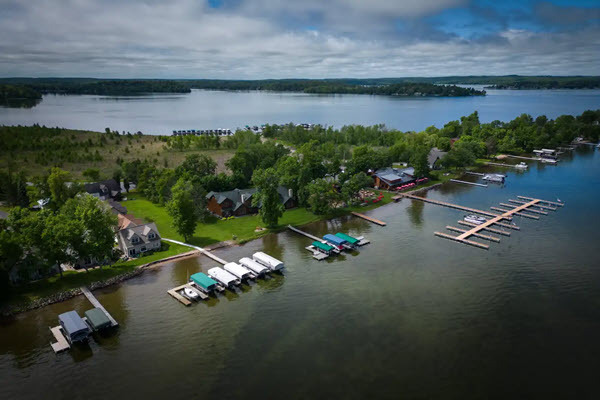 Mowed lawns, denuded shorelines, increased impervious surfaces, and more are becoming more common along shorelines on Minnesota’s lakes. Credit: Ben Hovland, Minnesota Public Radio News.
The first report, “Unchecked development, lax regulation push Minnesota lakeshores to the edge”, details trends identified in a recent Minnesota DNR report. Degradation of natural shorelines is occurring both through development of previously-natural shorelines, and more often through permits to redevelop existing properties. This redevelopment includes increases to the footprint of existing buildings, increased impervious surfaces that cause erosion, and mowed lawns that are more common in suburban landscapes. “It's no longer just the cabin up at the lake, with your path down to your dock,” said Randall Doneen, a water resources section manager with the Minnesota Department of Natural Resources (DNR). Paul Radomski, a longtime lake ecologist with the Minnesota DNR, echoed the concern. “We are a land of 10,000 lakes,” he said. “We don't want to be a land of 10,000 impaired lakes.”
So, what’s the solution? The second article in the series provides some answers. “Quit mowing’: Turning Minnesota lake homeowners into shoreline stewards, one lawn at a time” details the experience of Dorothy Whitmer, a lakefront property owner. Dorothy completed a survey helping her self-assess her property’s ecological effect on the lake and was surprised by her mixed results. “It could be summarized in two words: Quit mowing.” Whitmer continued, “What is good for the lakes actually saves money and effort, and it’s highly rewarding.” She used this information to encourage others on her lake and in her area to also complete the survey. When properties had a sufficiently high score, or when owners improved the ecological benefits on their properties, they received a “Minnesota Lake Steward” sign for their yard. “What that does is it signals to other people that there's a thought behind the way the property is being managed on the lake, that there's consideration being taken for the water quality,” said Jeff Forester, executive director of Minnesota Lakes and Rivers Advocates.
Another solution has emerged in Burnett County, Wisconsin. The third article, “In NW Wisconsin, a county finds paying homeowners to keep shorelines natural pays off”, details the county’s tax incentive program to that has preserved more than 50 miles of shoreline and helped cultivate a culture of stewardship with an investment of only $35,000 to $40,000 a year. With about 10% of lake properties enrolled and 350 of the county’s 500 lakes having at least one property enrolled, the program has been an enormous success.
The fourth article focuses on one of the key motivations for shoreline conservation in the state – loons. “On Cross Lake, loons make the case for protecting Minnesota's wild shores” provides information as to how natural shorelines benefit loons through water quality, nesting habitat, habitat for the fishes they eat, and more.
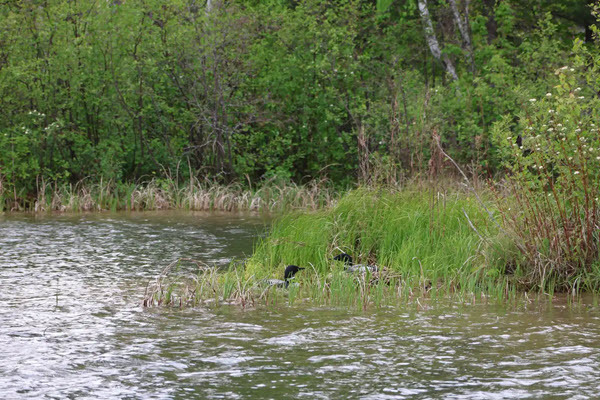 Loons guard their nest along a natural shoreline in Minnesota. Credit: Kirsti Marohn, Minnesota Public Radio News.
The last article in the series details the story of one family’s efforts to address these issues on their shoreline. “Native plants, lots of patience: How a Stearns County couple restored a damaged lakeshore”, details their journey as they’ve converted a mowing-intensive landscaping to native plants, saving time to enjoy the lake and providing beautiful flowers, monarchs, and reduced erosion. The project was supported in part by the Stearns County Soil and Water Conservation District.
|
Learn more about the Gallea family and nine other property owners that have restored or protected their properties in the MGLP’s Shoreline Living series. These glossy booklets are an effective tool used to promote natural shorelines. The booklets can be ordered at the cost of printing and shipping or downloaded for free along with all of the pictures they contain.
|
Our 2024 Lake Conservation Webinar Series rolls on with five webinars this Fall. Check out our lineup below and register using the links provided. You can view the full list of webinars plus recordings of past webinars on our Lake Conservation Webinars webpage.
|
Karen Alofs
October 8, 2024, at 1 PM Central
|
|
 |
The seminar will highlight research that has used data from a collaborative project digitizing over a century of historical lake survey records from the Michigan DNR Institute for Fisheries Research. We are using these records to examine changes in fish growth and abundance, and the timing of mass mortality events. I will present examples which empirically test several predicted impacts of climate change across Michigan lakes.
|
Eric Calabro
October 15, 2024, at 1 PM Central
|
|
 |
This presentation will review the Inland Lake Shoreline Energy Assessment Tool. The goal of this new tool is to educate the user on important inland lake shoreline characteristics and to provide a standardized approach for Michigan users to evaluate the erosive potential of an inland lake shoreline. Assessing an inland lake shoreline is important for selecting an appropriate shoreline protection design that minimizes impacts to inland lake resources. Some example best practices for shoreline protection will be highlighted.
|
Lareina Guenzel
October 22, 2024, at 1 PM Central
|
|
 |
This presentation will share information about the National Lakes Assessment (NLA), which is conducted in collaboration with states, tribes, other federal agencies and partners every five years as a component of the US EPA National Aquatic Resource Surveys (NARS). These statistical surveys sample and estimate the condition of the Nation’s different water body types on a rotating basis. The NLA reports on the condition of our nation's lakes, ponds, and reservoirs. To be included in the survey, the water body has to be >1 hectare, > 1 meter deep and > 0.1 hectare of open water. In 2022, 80 field crews collected chemical, physical and biological data from 981 lakes for the fourth lakes survey. The 2022 survey also included the resampling of 153 lakes that were originally sampled in the 1970’s as part of the National Eutrophication Study and a U.S. Forest Service intensification that increased the number of lakes sampled in the Northern Lakes and Forest Ecoregion. This webinar will provide an overview of NLA, results from the fourth field season, and NARS/NLA data tools.
|
Julia Kirkwood and Jen Buchanan
October 29, 2024, at 1 PM Central
|
|
 |
Bioengineering can offer a nature-based solution on lake shorelines for controlling erosion, adding beauty, and providing habitat for fishes, birds, and other fauna. However, reference materials for professionals conducting lakeshore bioengineering projects and for homeowners seeking to have them installed are lacking. This presentation will introduce two new MGLP-produced reference documents for professionals and homeowners that help build the foundation for understanding what is happening at the shoreline and provide some basic design tips for dealing with erosion across a range of environmental conditions.
|
Joe Nohner
December 10, 2024, at 1 PM Central
|
|
 |
Each Fall, the Midwest Glacial Lakes Partnership advertises the request for proposals to its Lake Conservation Grant. Do you have a conservation, assessment, or outreach project that would benefit glacial lakes in the partnership? Would you like to learn more about the types of projects the MGLP is seeking, past successes, and technical details for grant submission? This informational session will provide an overview of Lake Conservation Grant success stories, the grant proposal process, and grant implementation. There will also be plenty of opportunity to ask your own questions about the grant program during this session.
Would you like to present a future MGLP Lake Conservation Webinar? We want to hear from YOU! We encourage speakers from diverse backgrounds and areas of expertise in our webinar series. Please email MGLP Coordinator Joe Nohner to express your interest.
|