Keeping Michigan’s forests healthy in face of invaders
Protecting Michigan’s 20 million acres of forest land and urban trees from threats posed by invasive plants, diseases and pests is no small job.
Some of the Michigan Department of Natural Resources’ recent work on that front is detailed in the latest “Forest Health Highlights” report, which explores forest health trends in the state during 2023.
As we mark National Invasive Species Awareness Week – an annual event, this year taking place Feb. 26 through March 3, to bring attention to invasive species, the threats they pose and what we can do together to prevent their spread – it’s a great time to look at what the DNR and others are doing to keep Michigan’s forests healthy, productive and sustainable in the face of these risks.
An invasive species is one that is not native and whose introduction causes harm, or is likely to cause harm to Michigan's economy, environment, or human health. These pests often are fast-growing, reproduce rapidly and have few predators or natural controls in their new environments.
“One of the biggest challenges to maintaining healthy forests is addressing pests and diseases,” Sue Tangora, forest health and cooperative programs manager for the DNR’s Forest Resources Division, said in the report’s introduction.
Tangora went on to explain that climate change is altering forest pest and disease outbreaks – which historically were predictable, as forests evolved with native insects and diseases, adapting to maintain forest benefits – and creating new challenges for forest managers. Climate change creates uncertainty about the extent, timing and severity of outbreaks.
|
“This unpredictability increases with every new invasive insect, disease or plant introduced into our forests. The longer invasives are at play, the harder it is to reverse the negative impacts they have on forests and the people and wildlife who depend on them,” she said.
Examples of 2023 invasive species efforts highlighted in the report include teaming up with local and federal partners to treat hemlock trees in six west Michigan counties against a tiny, aphid-like invader, the hemlock woolly adelgid, and working to identify and respond to detections of beech leaf disease in seven southeast Michigan counties.
“The DNR’s forest health team works closely with local cooperative invasive species management areas, or CISMAs, federal experts, researchers and many others to address issues that are new or ongoing,” said James Wieferich, forest health unit manager with the DNR's Forest Resources Division. “Besides on-the-ground work, the Forest Health Program brings money into Michigan to help partners address forest health challenges and concerns across the state and, in many cases, prevent rapid spread of new pests and diseases into the region.”
Progress is being made against the pest
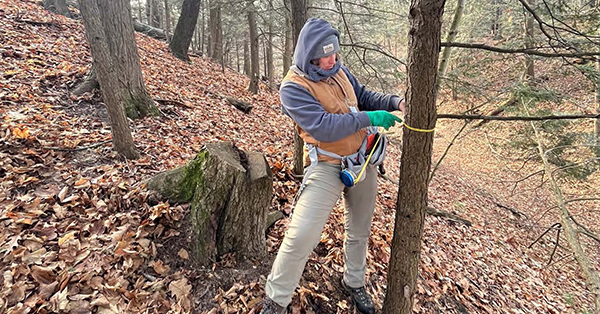
The battle against the hemlock woolly adelgid is one good example of the type of teamwork that takes place when Michigan’s forests are threatened. The tiny insect sucks sap from hemlock twigs, and ongoing infestations can weaken or kill host trees.
|

That threat means boots on the ground, first to find infestations, then to treat the trees. Over the past seven years, 12,468 acres and 231,429 trees have been treated as part of a strategy to keep the insect from spreading into northern forests. The good news: Most of Michigan’s hemlock trees are many miles away from established hemlock woolly adelgid populations.
Over the past seven years, more than $6.5 million has been raised to respond to the threat posed by the insect, and efforts continue to be funded through the Michigan Invasive Species Grant Program, Great Lakes Restoration Initiative, U.S. Environmental Protection Agency, Recreation Passport (state park user fees), fundraising efforts supported by Bob Ross Inc. and other state funds.
Balsam woolly adelgid also has become a threat
Balsam woolly adelgid poses a threat to the roughly 1.9 billion balsam fir trees within their native range in Michigan’s northern Lower and Upper peninsulas, as well as non-native Fraser and concolor firs. These fir species are important to Michigan’s Christmas tree industry. Producing nearly 13.5 million trees each year, Michigan is the country’s third-largest Christmas tree grower.
|

Balsam woolly adelgid was detected in Michigan in August 2021, when MDARD officials were notified of several infested Fraser firs in Kent County. No evidence of additional infestation was found within the survey area, and the eight infested Fraser firs were cut and chipped in winter 2021. Follow-up surveys in late 2022 found no evidence of balsam woolly adelgid in Kent County.
However, in 2023, additional infestations likely resulting from separate introductions were detected in limited areas of Missaukee and Oceana counties. Infestations are currently being evaluated, and treatment plans will be implemented once completed.
You can help
Forest health professionals cover a lot of ground throughout the state, but they can’t be everywhere. The program relies heavily on reports from people who notice unusual insects or sick or dying trees. If you see something unusual or have concerns about trees in your area, use one of these methods to report it.
|
MDARD’s suggestions for some ways to help limit the spread of invasive species include:
- Buy heat-treated firewood or buy wood where you burn it to avoid transporting insects or tree diseases that may be hitchhiking in untreated wood.
- When returning from international travel, declare food, plants and other agricultural items to U.S. Customs and Border Protection to ensure these items are pest-free.
- Avoid buying seeds or plants online from unknown vendors.
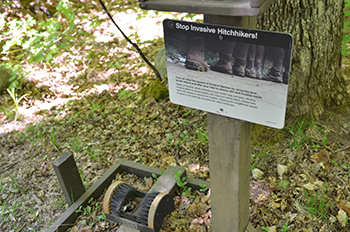
- After enjoying the outdoors, inspect and clean shoes, clothing, gear and vehicles to assure they are pest- and seed-free.
See MDARD’s “Buggin’ Out” video series to learn more about invasive pests posing a threat to plants and agriculture in Michigan.
Find out more about invasive species and how you can help protect our land and water resources against them at Michigan.gov/Invasives.
|
Check out previous Showcasing the DNR stories in our archive at Michigan.gov/DNRStories. To subscribe to upcoming Showcasing articles, sign up for free email delivery at Michigan.gov/DNREmail.
Note to editors: Contact: John Pepin, Showcasing the DNR series editor, 906-226-1352. Accompanying photos and a text-only version of this story are available below for download. Caption information follows. Credit Michigan Department of Natural Resources, unless otherwise noted.
Text-only version of this story.
Balsam: A close-up view of a tree branch infested with balsam woolly adelgid, an invasive pest relatively new to Michigan.
Beech: A beech leaf disease impact site is shown. Trees affected by the disease are marked with a yellow ribbon or paint.
Brush: Inspecting and cleaning shoes, clothing, gear and vehicles to assure they are pest- and seed-free can help limit the spread of invasive species. Shown here is a trailhead boot brush, where trail users can clean their footwear before and after their hike.
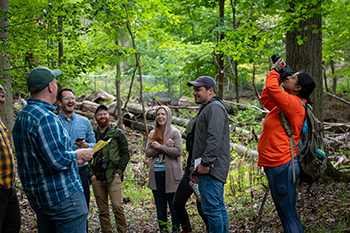
CISMA: Members of a local cooperative invasive species management area, also known as a CISMA, visit a beech leaf disease impact site in Waterford Township.
Disease: Leaves of a tree affected by beech leaf disease.
Firewood: A package of certified Michigan firewood is shown. Buying heat-treated firewood or buying wood where it will be burned to avoid transporting insects or tree diseases that may be in untreated wood is one way to help limit the spread of invasive species.
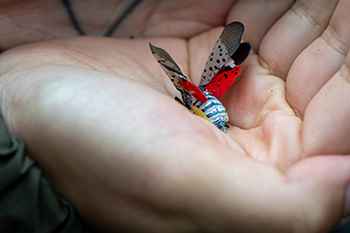
Lanternfly: Spotted lanternfly, shown here, is one of the invasive pests that threaten Michigan’s forests.
Ovisacs: This sprig of hemlock shows the small, fluffy white ovisacs that can infect and kill hemlock trees.
Report: The cover of the Michigan Department of Natural Resources’ 2023 “Forest Health Highlights” report, which explores forest health trends in the state.
Surveying: DNR crews spend winter months surveying for evidence of hemlock woolly adelgid infestation in west Michigan counties.
|