A fungi foray helps uncover mushroom mysteries
By RACHEL COALE, communications representative
Forest Resources Division
Michigan Department of Natural Resources
If you say, “Michigan mushroom,” most people will respond with “morel.”
That’s for good reason. The delicious mushrooms called morels are our state’s most famous fungi, beckoning hopeful foragers into the woods each May. These spring mushrooms are just a few among thousands, however. Fall is one of the best times to find mushrooms.
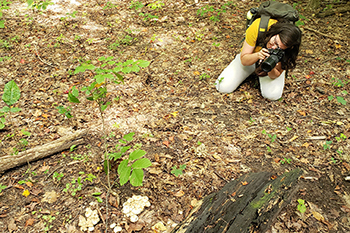
To learn more about autumn mushrooms, I joined a Sept. 17 community science project to document the species of mushrooms that grow at For-Mar Nature Preserve in Burton, near Flint.
The project, a collaboration of Genesee County and the Michigan Mushroom Hunters Club, invites participants on monthly forays to collect mushrooms in all their shapes and forms. The samples are used to learn more about the park’s ecosystem. Specimens are photographed for documentation, and some are sent for DNA analysis to help unravel their mysteries.
I arrived at the DeWaters Education Center with an all-ages group of about 20 people, where we were provided with paper bags and pocketknives to collect specimens.
Heather Johnson, a member of the Michigan Mushroom Hunters Club and the “hunt whip” for the event (the term for a mushroom foray’s leader is borrowed from fox hunting) started things off with a talk about fungi.
“They are not plants; they have their own kingdom,” she said, referring to scientific classification.
Michigan is estimated to have at least 2,500 species of fungi.
Johnson and other club members explained that the mushrooms we see sprouting from logs and soil are the fruiting body, or just part of the whole organism, which grows from a network of cobwebby mycelium in the ground or decaying wood.
|
Some of the world’s largest organisms are mycelial networks. They can be acres wide, like the Upper Peninsula’s appropriately named Humongous Fungus in Crystal Falls in Iron County. According to scientists, it’s nearly 100 acres in size.
The job of the visible mushroom on the surface is to spread spores and reproduce, much like a flower spreads pollen for a plant.
Equipped with tips for harvesting specimens and our tools, the group headed down a nearby trail. The plan: collect one of every kind of mushroom we could find.
Nature preserves normally don’t allow foragers to collect mushrooms, except for in special instances like this fungi study. In Michigan, you may collect mushrooms for personal use, but not for sale, in state forests, recreation areas and parks. Check other park and public land rules for local guidelines.
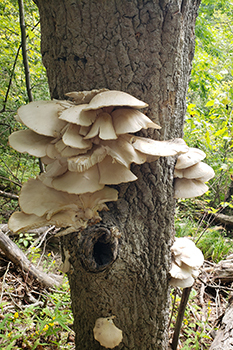
Our group fanned out into the forest, searching high and low for mushrooms, even inside hollowed dead trees and stumps. One of the first finds was a cluster of delicate, pearl-gray oyster mushrooms growing from a tree.
From all corners of the woods, I heard exclamations of “Look at this!” and “Ohhh, pretty.”
Seeing a glimpse of white in the spotted shadows of the forest canopy, I sliced a pancake-shaped shelf mushroom off a moss-covered rotten log, tucking it into my paper bag as I batted away persistent mosquitoes.
|
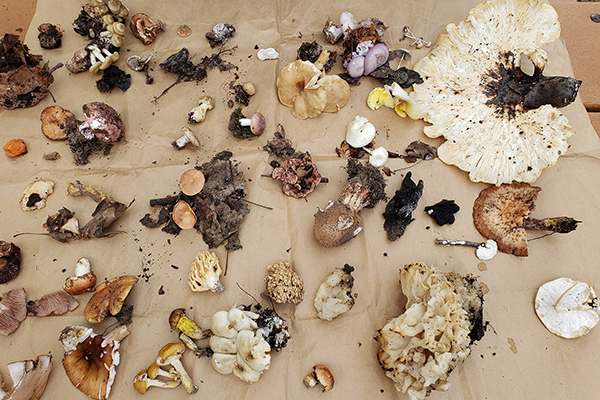
After an hour of rambling over fallen trees and through crunchy leaf litter in the warm, earthy-smelling September forest, we returned to our starting point and spread out our finds on picnic tables covered in brown craft paper.
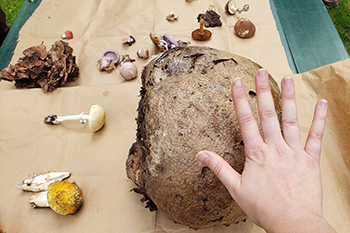
The mushroom variety was vast, ranging from the tiniest brown ones with gills so delicate you could see light through them, to a mighty mature puffball larger than a basketball. Johnson said it could contain trillions of spores.
Colors and appearances ranged from translucent white to deep russet brown, with some specimens sporting red, lavender, violet and orange on their caps or stems, called stipes.
The mushroom club members began to methodically organize and identify the mushrooms based on features including the cap, spore-bearing surface (gills or pores), stipe and base.
Johnson directed our attention to the remains of a veil covered in rusty spores on a purple specimen, providing critical evidence for identification as a type of cortinarius mushroom. She and her associates began to rattle off a dizzying set of Latin names for the official record, occasionally setting specimens aside for further research or DNA sequencing.
A few were mysteries – one, a whitish, parasitic mushroom growing from a shelf mushroom, and another, a tall, buff-colored mushroom that an associate tentatively identified as “amanita 4.” That’s right – there is still so much to learn about mushrooms that some don’t even have names yet.
|
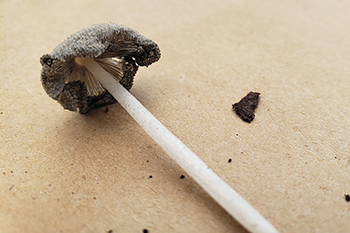
One of my finds, a delicate, gray mushroom with furled black, lace-like gills, was identified as a type of inky cap. The black gills are a sign that this strange mushroom had begun to digest itself, turning to liquid in a process called deliquescence. This melting allows the mushroom’s spores to escape.
Other finds from the group included fungi with fanciful names like the jewel-studded puffball, brittle cap, turkey tail, golden oyster, hen of the woods, honey mushroom, dead man’s fingers and a jelly fungus that quivered like a Jell-O cup when poked.
Learning about mushrooms is a way to explore how wild and weird nature can be and also get to know other people who enjoy the outdoors.
The best way to get involved in the world of mushrooms is to connect with a group like the Michigan Mushroom Hunters Club.
Experienced mushroom hunters can provide knowledge and mentorship, which is especially important if you are a forager looking for edible mushrooms.
Experts at the event stressed that “watching a few TikTok videos is not enough study; there are very toxic mushrooms out there.”
The consequences of a wrong ID don’t have to be imagined, with colloquial names like “the vomiter,” “destroying angel” and “deadly Galerina.”
|
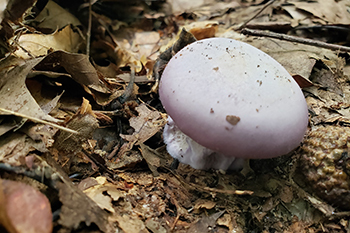
Mushroom hunting feels like a forest treasure hunt where you’re not always sure what the treasure will be. Each find is a surprise, and some discoveries provoke further questions and mysteries. It’s a great way to spend time outdoors, learn from enthusiasts and practice being observant of the amazing natural world.
Mushroom resources
Interested in assisting with a community science effort? Midwest Mycology is hosting a photo contest to add images to its gallery of specimens. Learn about contest rules and submit images by Nov. 30.
|
Check out previous Showcasing the DNR stories in our archive at Michigan.gov/DNRStories. To subscribe to upcoming Showcasing articles, sign up for free email delivery at Michigan.gov/DNREmail.
Note to editors: Contact: John Pepin, Showcasing the DNR series editor, 906-226-1352. Accompanying photos and a text-only version of this story are available below for download. Caption information follows. Credit Michigan Department of Natural Resources, unless otherwise noted.
Text-only version of this story.
Documenting: A participant in the mushroom documentation project at For-Mar Nature Preserve near Flint photographs some specimens found.
Frilly: This frilly mushroom was among the specimens found during a recent community science project to document fungi.
Inky: One of the author’s finds, this delicate, gray mushroom with furled black, lace-like gills, was identified as a type of inky cap.
Jelly: A jelly fungus, which quivered like a Jell-O cup when poked, was one of the mushrooms participants found.
Oyster: One of the group’s first finds was a cluster of delicate, pearl-gray oyster mushrooms growing from a tree.
Puffball: This mature puffball mushroom found was larger than a basketball.
Purple: A purple bolete mushroom is shown.
Table: Mushroom foray attendees spread out their finds on picnic tables covered in brown craft paper.
Trail: Participants in a community science project at For-Mar Nature Preserve in Burton head out on the trail to look for mushrooms.
Veil: The remains of a veil covered in rusty spores on a purple specimen provided critical evidence for identification as a type of cortinarius mushroom.
|