April Edition of Salmon in the Classroom

Having trouble viewing this email? View it as a Web page.

Bookmark and Share

Salmon Sense

=============

Information about the Salmon in the Classroom program


April 2012

 
In this issue...
Stocking Permit and Report

Where to release your fish

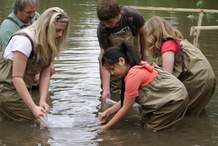
How to safely release your fish

Application deadline for new SIC teachers
=============
Salmon in the classroom
 

Thanks for helping empower your students!

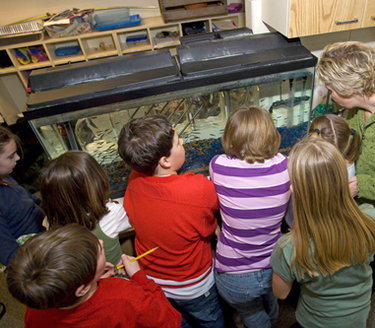
Typically, when people learn about conservation, they move through a progression of awareness and interest and, ideally, land at the empowerment level. You, as a teacher of Salmon in the Classroom, are key to helping students reach that empowerment level! 

When you share and discuss natural resource information with your students, you move them along that continuum toward empowerment. This can be done lots of ways; some of you have gone the extra mile by including hands-on activities like community projects (think river clean-ups and water quality testing). These projects—right in your students’ backyards—improve the local natural resources and empower students to make an impact on their (and your!) community.

You’ve got great ideas and we’d like to hear them! We’re gathering a list of your project ideas so we can all share them and learn from each other. We’ll highlight them on our webpage, and select some to be featured in future issues of Salmon Sense. 

Please send your best lessons, activities, community action projects or other great ideas to one of the coordinators today!

Today’s Salmon in the Classroom students will be voting before we know it, and with the knowledge they’ve gained about natural resources through this program, they’ll vote in an informed and responsible way, because they feel empowered!


Stocking Permit and Report 

Attached to this email, as a separate document, is your 2012 Stocking Permit and Report.


Permit 

By law you are required to possess a Stocking Permit issued by the Michigan DNR in order to release your Chinook salmon into a public body of water in Michigan. 


Report 

It is also required by law that you report all details to the Michigan DNR regarding the Chinook salmon you stock including; Teacher’s name, school name, school phone number, water body, county, date of stocking, species stocked, average size of fish (in inches) and number of fish stocked.  In addition to the aforementioned information, you are required to answer a brief questionnaire that will provide us with valuable information for the SIC program.


Remember 

  • Be sure to have the Permit in your possession when stocking your Chinook salmon.
  • Within 14 days of releasing your fish, please provide a completed Stocking Report and Questionnaire to Polly Gray by email at grayp@michigan.gov or by mail at


Michigan DNR

Attention: Polly Gray

P.O. Box 30028

Lansing, MI 48909


If you do not provide us with your completed Stocking Report, we will assume you DO NOT wish to continue your participation in the program. 

=============
Salmon release
 

Where to stock your fish

You’ve cared for them over the course of nearly an entire school year and now its time to release your Chinook salmon into the cool, clean waters of Michigan and send them on their way…but where? For details about where to put your salmon, read on…
 
1) Go to the SIC Program website at www.michigan.gov/sic
2) Click on, “Releasing Your Salmon” (this is the last bulleted option under, “How to Get Started”)
3) Determine which Fisheries Management Unit (FMU) your school is located in by downloading the FMU map link on the webpage.
4) Look at the list of Pre-Approved Stocking Locations which are listed by FMU and find out where you can release your fish.
5) Still not sure? That’s okay! Contact an SIC Program Coordinator for help in determining which location will be best for you, your students and your salmon! 
=============
Salmon release
 

How to safely release your fish

For the best chance of survival, it’s important that you take several steps to ensure your salmon will make it from your school to their release location safely. Here are some tips and tricks to help you along the way:
  • Do not overcrowd your fish in the buckets.  It is very stressful on the fish and the more room they have in the buckets, the better.
  • Use a battery operated aerator during transport.  Salmon are especially sensitive to oxygen levels in the water and will be consuming more than usual during their trip to the river so make sure they have more than enough.
  • If there is a temperature difference of more than 5 degrees F between the river water and the water in your buckets, you will need to acclimate your fish.  Only replace about ¼ of the bucket water volume every 15 minutes with the river to avoid temperature shock. Only have the students scoop out the fish into their personal cup AFTER the fish have been acclimated---then release them immediately.
  • Stock the fish AS SOON AS YOU ARRIVE TO YOUR STOCKING LOCATION!  Many well-intentioned teachers have planned elaborate activities and events for releasing their salmon and wait until the conclusion of these to release their salmon into the river resulting in less than favorable survival!  Remember, the longer the salmon are in the buckets, the more stressful it is on them.
=============
Application deadline
Know an enthusiastic teacher looking to get involved with the SIC program? Applications are available on the SIC website. Hurry! They are due April 15, 2012 for participation in the 2012-2013 school year. 
=============
Please take a moment to let the DNR know how we can serve you better by taking this survey (hurry, survey closes March 30, 2012).  
=============
Please direct SIC questions and comments to one of the coordinators:
Administration: Natalie Elkins, elkinsn@michigan.gov, 517-373-6919
Southern Michigan: Shana Ramsey, ramseys2@michigan.gov, 269-668-2876
Northern Michigan: Craig Kasmer, kasmerc@michigan.gov, 989-348-2537