|
It’s not too late to get out for some great Michigan waterfowl hunting this season. Grab some warm clothes and your retriever and head out for a day of winter fun!
You can buy your licenses and federal duck stamp online at eLicense, on the DNR Hunt Fish app or anywhere DNR licenses are sold.
Brush up on all the regulations in the 2022 Waterfowl Digest, available online only this year. Use the DNR Hunt Fish app to download the DNR digests right to your phone and have them whenever you need them.
- Middle Zone – Dec. 17-18.
- South Zone – now through Dec. 11 and Dec. 31 - Jan. 1, 2023.
The daily bag limit is six ducks of any species, with no more than four mallards (no more than two of which may be hens), no more than three wood ducks, two redheads, two canvasbacks, two black ducks, one pintail, and one or two scaup. Similar to previous years, there are changes to the scaup daily bag limit during the season, and depending on when and where you are hunting in the state, you may harvest either one or two scaup daily. See the table on page 8 of the 2022 Waterfowl Digest for more details. In addition to the duck limit, hunters may take five mergansers, only two of which may be hooded mergansers.
- North Zone – now through Dec. 16.
- Middle Zone – now through Dec. 23.
- South Zone – now through Dec. 11, Dec. 31 - Jan. 8 and Feb. 4-13, 2023.
- Allegan County Goose Management Unit – Dec. 17 - Feb. 13, 2023.
- Muskegon County GMU – now through Dec. 22.
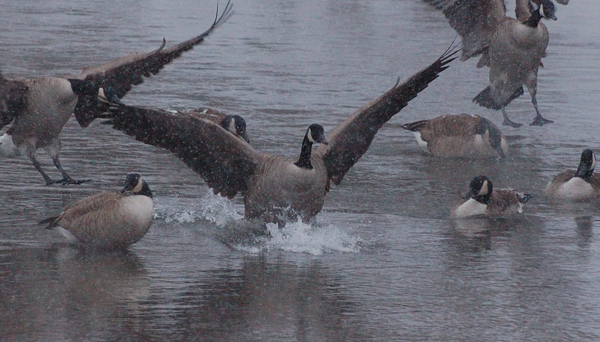
Canada geese, white-fronted geese (or specklebellies) and brant are part of a dark goose aggregate daily bag limit. During the entire goose season, the dark goose aggregate daily bag limit for Canada geese, white-fronted geese and brant is five, only one of which can be a brant. An aggregate bag limit is also in place for light geese including snow, blue and Ross’s geese. Hunters may harvest 20 light geese per day during goose seasons.
This December, why not check out one of Michigan’s Wetland Wonders? These seven premier managed waterfowl hunt areas in the state, scattered across the southern Lower Peninsula, were created in the 1960s to provide exceptional waterfowl hunting opportunities, and are still managed today to provide waterfowl habitat for nesting and migration and for the benefit of other wetland-dependent wildlife.
Remember to be observant and careful when harvesting and handling wild birds, due to the presence of the highly pathogenic avian influenza virus. Dabbling ducks are the most commonly infected waterfowl, but geese, swans, shorebirds and other species also can be infected.
Highly pathogenic avian influenza primarily affects birds, but it is also a zoonotic disease, or one that has the potential to pass from domestic or wild animals to humans. According to the U.S. Centers for Disease Control and Prevention, the public health risk associated with HPAI remains low, but people are advised to avoid handling any sick or dead wild birds.
Learn more about HPAI, what to watch for and safety guidelines for hunters.
Get the latest information and updates on the current outbreak of avian influenza.
Contact the DNR Wildlife Division at 517-284-WILD (9453).
|