With a reverence for nature: Traveling Mathias Alten exhibit in Lansing
By JILLIAN REESE
Curator, Michigan History Center
Michigan’s beautiful landscapes have inspired artists for generations. As spring turns to summer, bubbling brooks and lush forests beg to be memorialized in art.
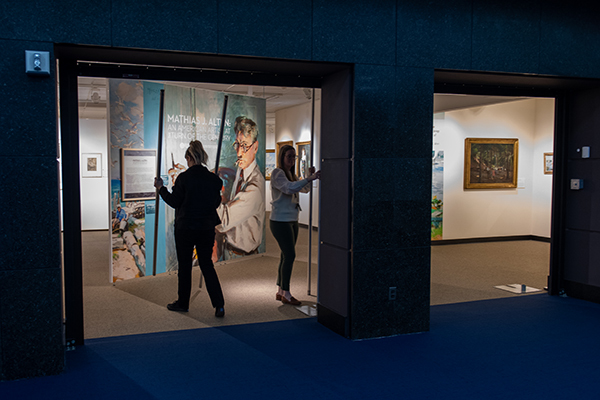
The new exhibition at the Michigan History Center’s museum in Lansing, “Mathias J. Alten: An American Artist at the Turn of the Century,” features artwork that captures Michigan’s natural charm and glory.
The exhibition, organized by Grand Valley State University with support from the George and Barbara Gordon Endowment for the Gordon Gallery and the Mathias J. Alten Endowment, covers Mathias Alten’s prolific career. It offers a glimpse to a time when Michigan was rapidly changing through the eyes of an artist with incredible reverence for nature.
Life and work
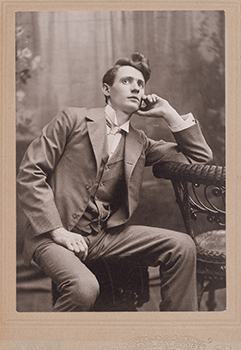
Born in what is now Germany in 1871, Alten immigrated to the United States at age 17 to Grand Rapids, Michigan. He had completed a painting apprenticeship in Germany and secured a job decorating furniture soon after arriving in Grand Rapids.
Alten met his wife, Bertha Schwind, at her father’s paint and wallpaper shop, which the couple would go on to run as Schwind and Alten. He set up an art studio, and his career bloomed.
Alten’s Grand Rapids was a bustling town benefitting from the booming lumber and furniture industry. Change was happening across Michigan — a move from a largely agrarian economy to businesses focused on manufacturing and resource extraction.
New products like affordable automobiles and gasoline-powered farming equipment changed labor practices in cities and on farms. In 1900, one in four Michigan residents was foreign-born. Americans from the Southern United States moved here looking for opportunity. Between 1890 and 1910, the population of Grand Rapids nearly doubled.
|
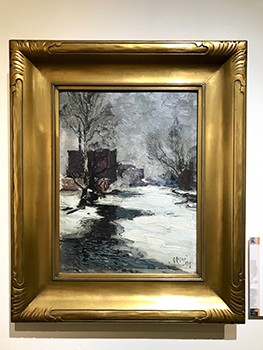
Alten’s artwork harkened to an earlier time. He created over 3,000 works in his lifetime and is best known for his landscapes of rural areas, rivers and lakes. He rarely included modern elements that were certainly present in these spaces, but instead captured a nostalgic worldview, painting oxen and horses, sails and oars instead of engines.
Exhibition process
Grand Valley State University has worked with collectors George H. and Barbara Gordon to build a vast collection of Mathias Alten’s artwork. GVSU also holds Alten family records in its archives.
The Michigan History Center’s exhibition combines artwork with archival materials to deepen visitors’ understanding of Alten’s work and his connection to Grand Rapids.
“Scenes of farmers working Michigan fields with horses, or autumn trees aglow with changing colors make up a major part of Mathias J. Alten’s body of work and reflect a passion for Michigan’s outdoor spaces,” said Joel Zwart, curator of exhibitions and collections at GVSU. “It is one of the many reasons that the Grand Valley State University Art Gallery is honored to be a caretaker of his legacy.”
Hosting a traveling exhibition has its own considerations.
Traveling exhibits allow us to tell stories that might not be found in our collection. The range and diversity of artworks from throughout Alten’s career in GVSU’s collection are unmatched. This exhibit is an opportunity to display fine art, which can attract new audiences.
|
At the same time, staff wanted this exhibit to be accessible to the museum’s traditional audiences.
Most traveling exhibits have restrictions on how and where artifacts can be displayed. Luckily, GVSU was flexible about layout changes required to fit the exhibit into our gallery space.
In addition to layout changes, the Michigan History Center added other exhibit elements. Because its visitors might not have as much background in art history as visitors at a traditional art museum, labels that defined specific art terms used in the exhibit text were added.
To work toward fulfilling the center’s institutional commitment that all new exhibits will be accessible to all visitors, staff wrote and recorded visual descriptions for every object and image in the exhibit and also recorded audio versions of the exhibit labels provided by GVSU. These recordings are available for download or streaming on Soundcloud.
Michigan landscapes
“Although he was drawn to some of the major artistic communities for training and work, Alten always returned to his home state,” Zwart pointed out.
Alten’s artworks call to any lover of Michigan’s great outdoors.
|

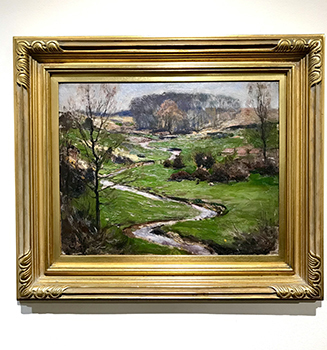
Early spring is a special time in Michigan. Optimism is at a seasonal high. Every time I look at this painting, I can feel cool spring breezes on my face. Spring green is the star of the painting.
As Alten told the Grand Rapids Herald, about the emotions color evokes, you “cannot express what that is in words. You feel it, that is all. It is like a dream.”
Alten’s natural landscapes paired well with his style – impressionism, an art movement that was popular at the turn of the 20th century. Impressionists painted with visible brush strokes and favored everyday scenes over scenes of aristocratic life. They painted outdoors, a method Alten used frequently for his landscapes, capturing the same subject, like trees, at different moments in time.
Toward the end of his life, Alten traveled frequently within Michigan. He visited Leland and painted several water and shore scenes from that area.
I am struck by the dynamic movement of the flock of gulls over the sailor’s shoulder. You can hear their cries as they swoop for their next meal.
Visit the Michigan History Center
“Mathias J. Alten: An American Artist at the Turn of the Century” is on view at the Michigan History Museum until Aug. 15.
This exhibit is included with museum admission. The Michigan History Museum — flagship of the Michigan History Center's museums and historic sites — is found in the east wing of the Michigan Library and Historical Center, at 702 W. Kalamazoo St. in downtown Lansing. Sunday admission and weekend parking are free. For hours and to plan your visit, go to Michigan.gov/Museum.
|
Check out previous Showcasing the DNR stories in our archive at Michigan.gov/DNRStories. To subscribe to upcoming Showcasing articles, sign up for free email delivery at Michigan.gov/DNR.
Note to editors: Contact: John Pepin, Showcasing the DNR series editor, 906-226-1352. Accompanying photos and a text-only version of this story are available below for download. Caption information follows. Credit Michigan Department of Natural Resources, unless otherwise noted.
Text-only version of this story.
Gallery: Michigan History Center staff put the final touches on the gallery before opening the exhibit to the public.
Gas Works: This painting exemplifies Alten’s focus. The painting’s subject, the Grand Rapids Gas and Light Company, simply looms in the background of a typical rural scene of a horse-drawn cart along a river. The emphasis is placed on tradition and nature as opposed to modern advancements. View of the Gas Works from Lower Island on the Grand, Mathias J. Alten, ca. 1905, Gift of George H. and Barbara Gordon.
Portrait: Mathias J. Alten sat for this portrait soon after arriving in Grand Rapids. Thomas Frederick Noble, a Canadian immigrant, photographed Alten several times. Mathias J. Alten Portrait, Thomas Frederick Noble, ca. 1890, Special Collections, Grand Valley State University Libraries, Mathias J. Alten papers, RHC-28.
Stream: Alten depicts a vibrant green field near his home in Grand Rapids. A spring stream zig-zags through the landscape. Early Spring Landscape with Meandering Stream, Mathias J. Alten, 1914, GVSU Permanent Collection, Gift of George H. and Barbara Gordon.
Upright Pines: This painting includes every color found in a Michigan forest, from different shades of green to pinks and oranges. Upright Pines, Mathias J. Alten, 1915, GVSU Permanent Collection, Gift of Anita M. Gilleo.
|