Bear hunters are required to bring their harvest to a bear registration station to be examined, registered and have an official seal attached to the animal within 72 hours after harvesting.
After stopping into a bear registration station to have your harvest examined and sealed, you may wonder why a tooth, hair, rib or tissue sample was collected. These biological samples provide information about the bear’s age, diet or genetics, helping wildlife managers further their understanding of Michigan’s bear population.
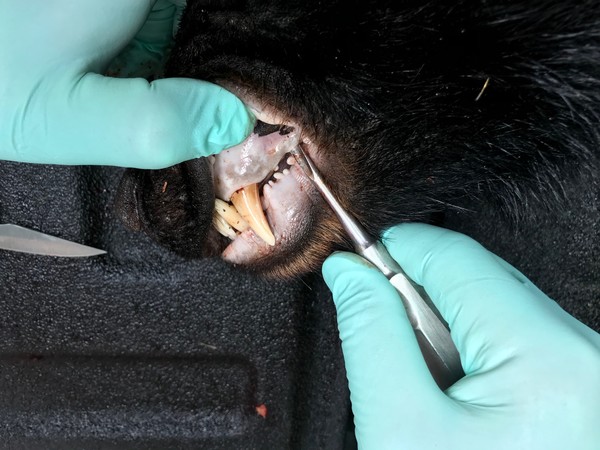
The age of the bear will be determined by examining a premolar tooth removed at the time of registration. Laboratory staff use a microscope to examine thin slices of the tooth and count the number of cementum layers, which are similar to growth rings in a tree stump. Based on the number of layers and the spacing of each layer, we can determine the age of the bear and the reproductive history of females. To learn the age of your bear, visit Michigan.gov/DNRLab. Age results will be posted after June 1, 2022.
A small sample of hair and/or rib also may be collected from harvested bears as part of a future stable isotope analysis of bear diet. The study will investigate black bear consumption of human-provided food sources and how such food sources may impact bear distribution and abundance.
Bears harvested in the Upper Peninsula will be sampled for a small piece of tissue. The tissue will be removed from the rib sample or from another area of muscle or tongue. The tissue samples will be analyzed to gather genetic information on how closely related the harvested bears are to one another. In collaboration with university researchers, the Department of Natural Resources will use the genetic data to test, and hopefully implement, a technique called close-kin mark-recapture (CKMR) to estimate the population size of U.P. bears. This population estimate will provide data for the statistical model the DNR uses to monitor changes in the bear population over time.
To have your bear sealed and registered, you must call the bear registration station to schedule a date and time to arrive. Registration appointments are mandatory. Locations and contact information for registration stations can be found online at Michigan.gov/Bear.
Hunters arriving for their registration appointment must have the unfrozen bear head and pelt or the entire carcass to complete the registration process. In addition to the bear, hunters will need to have their hunting license, identification and the township, range and section information for their harvest site. If you need assistance finding harvest location information, consider using the Mi-HUNT interactive map. This free mapping tool can provide the township, range and section information for any location in Michigan.
Bear registration protocols may change due to the ongoing COVID-19 pandemic. Please call the bear registration station prior to visiting to learn of any protocol changes.
|