|
This issue of the DNR Forest Utilization and Marketing Newsletter contains information on DNR program updates, the Good Neighbor Authority, forest health conditions, workshops, professional development and more. Contact Brenda Haskill with questions.

About five years ago, the DNR released the Online Bidding System for state forest timber sales. Since then, most received bids have shifted from paper to electronic. The next update is a companion application that will allow registered users to view all of their DNR timber sale data online and electronically sign contract-related documents. It will use the same login and password as Online Bidding, and everyone who is registered for Online Bidding will automatically be registered for the Customer Utility application. A view-only, test version is now available. The data is live and current, but some functionality such as e-signatures is not yet implemented. The full version of the application is expected to roll out later this summer. If you have questions about Online Bidding or the Customer Utility application, contact Donovan Asselin, 517-930-1326.
|
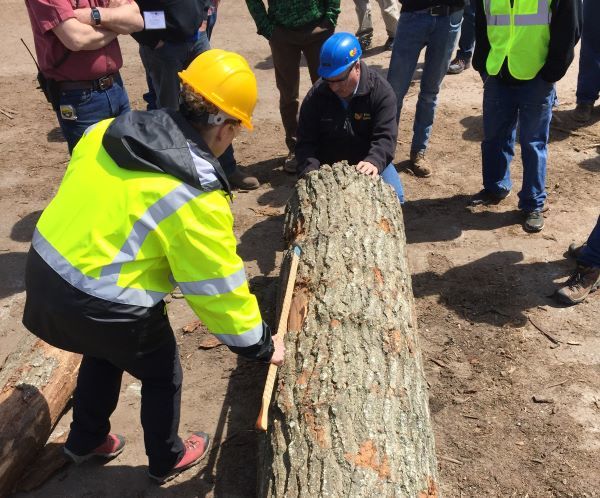
Sales have started to occur with volumes determined using the upgraded timber cruise methods developed from the MacFarlane taper model. All sales being prepared in 2021 use this new methodology, which will become more common on prospectuses in the months ahead. So far, 14 sales have been sold, and one offered sale went No Bid. Eight additional sales are on a prospectus with a scheduled bid date. Fifty sales are in the reviewing process, which occurs before advertisement, and 42 sales are in preparation for review.
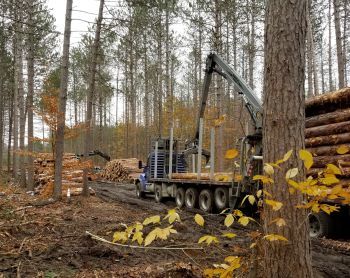
Cadillac area forest specialist Derek Cross was assigned to oversee the DNR Good Neighbor Authority program in early 2021. Derek has been working on GNA Huron Manistee National Forest lands since 2016 in addition to other DNR forest inventory and planning activities. There are now four additional DNR foresters and forest technicians around the state working on the GNA program to assure planned acres are prepared and sold as closely to the plan as possible each fiscal year. GNA program revenue is collected by the state and used under the direction of each national forest.
|


2020 was a year that offered unique challenges, but the Forest Resources Division’s nearly 300 employees adapted to the challenges brought by the COVID-19 pandemic.
Staff established safety protocols to get back out in the woods to mark timber, conduct forest health surveys, fight wildfires and serve the public. The Forest Resources Division 2020 Accomplishments Report celebrates the successes the division achieved despite the pandemic.
|
Progress continues on the latest update to the Michigan State Forest Management Plan. DNR staff recently participated in virtual meetings for review and feedback. Public participation results, generated from a survey, are available in a public questionnaire summary.
The US Department of Agriculture, Forest Service Eastern Region Forest Health Conditions Report for 2020 is now available.
Data for this report was collected from State Forest Health Highlights publications, aerial detection surveys, remote sensing, ground surveys, Pest Event Reporter, Animal and Plant Health Inspection Service and direct communication with forest health professionals and the Northern Research Station.
The annual Forest Health Conditions Report synthesizes forest health data collected across the 20 Midwest, Mid-Atlantic and New England states and the District of Columbia. This report gives a regional perspective on changes in forest health conditions caused by insects, diseases and other factors. It includes links to additional information, lists recent publications by Forest Health Protection staff and provides a staff directory of Eastern Region Forest Service FHP employees.
Produced annually, forest health condition reports are part of the USDA Forest Service's Forest Health Monitoring Program, designed to determine the status, changes and trends in indicators of forest condition.
Contact Eastern Region FHM Coordinator Stephen Burr with questions.
|

The Department of Forestry at Michigan State University is offering an online summer course starting July 6 and running through Aug. 19 called Contemporary Issues in Forests and the Environment, which has been approved by Society of American Foresters for 25.5 Cat. 1 Continuing Forestry Education credits. The course is $200 and is an “introductory-level" course. MSU is also offering other fee-based courses this summer and fall.
Questions? Contact MSU Department of Forestry manager of communications & alumni relations Lauren Noel, 517-355-8239.
|
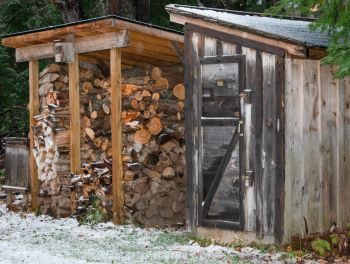
The 2021 National Firewood Workshop was held as a webinar and a set of pre-recorded videos in early June, hosted by North Carolina State University. The annual workshop provides information on the latest technology and business practices for commercial firewood producers, helping businesses be more profitable and efficient. The target audience includes firewood manufacturers and entrepreneurs who might be interested in starting a firewood business. The workshop touched on business management strategies, best practices for managing insects and disease and finding firewood sources, including urban logs. Recorded webinars will be available in July on the NCSU YouTube channel. For more information, contact Harry Watt, 704-880-3067.
|
Northeast-Midwest Region Economic Analysis state fact sheets with data from 18 states are now available. They were created by the Northeast-Midwest State Foresters Alliance Forest Markets and Utilization Committee, addressing forest utilization issues of regional significance. In particular, the committee works to support sustainable forest management and other forest-based benefits by working with NMSFA leadership to maintain and enhance markets for traditional and nontraditional forest products. The committee produced the economic data in a coordinated effort with the benefit of a grant from the U.S. Department of Agriculture.
|
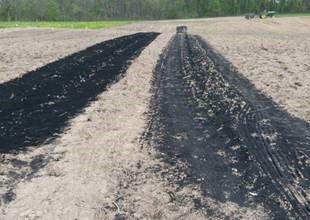
Biochar is a charcoal-like product produced from wood or agricultural biomass by pyrolosis, described in layman’s terms as a process of combustion in the absence of oxygen. Fine-grain or ground biochar has been used as a soil additive and crop production aid, for water filtration (as activated charcoal) and for remediation of degraded sites. Soil applications have been proposed by some as a strategy for sequestering carbon.
Biochar can be produced from timber harvest and sawmill residues, manure, crop residues and other solid biowaste. Michigan currently has one commercial manufacturer of biochar or activated charcoal – National Carbon Technologies in Gwinn.
To share more about emerging uses for this material, Michigan State University, supported by a 2019 Landscape Scale Restoration grant from the USDA Forest Service, will be offering a series of webinars and launching a regional network. The webinars, planned for September - November, will cover topics such as the new Great Lakes Biochar Network, biochar economics and supply chain considerations.
Questions? Contact Dr. Jessica Miesel of Michigan State University.
Photo by Daniel Warnock, MSU.
|
|