|
This e-newsletter is made specifically for students, parents and teachers. Expect to receive Fish Bites about four times each year and have your friends sign up too!
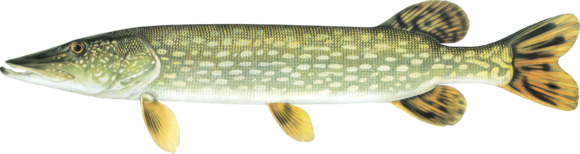 Can you name this species? Scroll to the bottom of the email to learn more!
Illustration by Joseph R. Tomelleri ©
- March 30: To mark the department's 100th anniversary, we've curated 100 ways to celebrate the DNR's centennial this year! Go fishing. Catch a big fish. Try a new fishing spot. And more!
- April 22: Earth Day
- June 12 & 13: 2021 Summer Free Fishing Weekend
- Fish are one of the oldest animal families to live on Earth. They were here long before the dinosaurs – about 500 million years ago — and they still thrive.
- Fish can communicate with each other through the use of acoustic communication. Acoustic communication includes the transmission of acoustic signals in fish from one individual of a species to another.
- Fish are cold-blooded like reptiles and amphibians. They can’t control their body temperature.
- Fishes have smaller brains, relative to their body size, in comparison to most other animals.
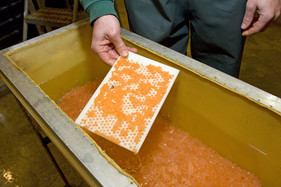
Take a virtual field trip by watching our Michigan DNR Fish Hatcheries video!
Michigan DNR Fish Hatcheries - YouTube
A fish hatchery is a facility where fish eggs are hatched and the fry (baby fish) are raised, mostly to stock lakes, streams, and ponds.
A weir is an obstruction placed across a river designed to block the passage of fish. Weirs are typically used to catch fish in order to harvest their eggs. Eggs taken at the weirs are sent to state fish hatcheries where they are raised and stocked all over Michigan.
We operate six fish hatcheries, five permanent egg-take stations and up to 40 rearing ponds. In addition to the permanent egg-take stations, we collect eggs and milt (sperm) from natural spawning runs of walleye, lake sturgeon and muskellunge.
Crossword Puzzle
Can you finish the Fish Hatchery Crossword Puzzle? Visit our fish hatcheries webpage to help you find the answers!
|
After ice and snow cover melt on Michigan lakes this early spring, it may be more likely for people to discover dead fish or other aquatic animals. While such sights can be startling, winterkill is the most common type of fish kill.
As the season changes, fish kill can be particularly common in shallow lakes, ponds, streams and canals. These kills are localized and typically do not affect the overall health of the fish populations or fishing quality.
Fish can become easily stressed in winter due to low energy reserves because feeding is at a minimum in winter. They are then less able to handle low oxygen and temperatures swings. Once the oxygen is reduced and other aquatic animals die and start decomposing, the rate that oxygen is used for decomposition is additionally increased – that means that dissolved oxygen levels in the water decrease even further, leading to increasing winterkill.
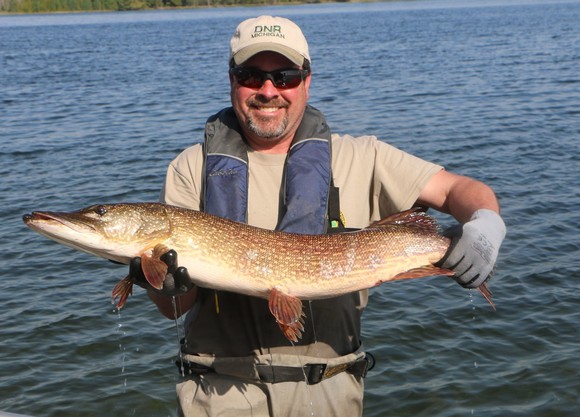 Northern pike are toothy predators most commonly associated with the weedy shallows of both the Great Lakes and inland waters. In rivers, they are often found around log jams or fallen timber.
Pike consume large numbers of smaller fish - about 90 percent of their diet - but seem willing to supplement their diet with any living creature their huge jaws can surround, including frogs, crayfish, waterfowl, rodents and other small mammals. Their preferred forage fish are yellow perch, sunfishes, minnows and suckers. As predators, northern pike can have significant impact on their prey species. As with muskies, pike lurk in the cover of vegetation in the lake's clear, shallow, warm waters near shore, although they retreat somewhat deeper in midsummer.
Visit our northern pike webpage to learn more.
|