|
Sept. 01, 2020
This summer, crews have been working in the Lower Grand River and Pentwater Lake and River to locate and remove European frog-bit, an invasive aquatic plant first detected in these waters in 2019.
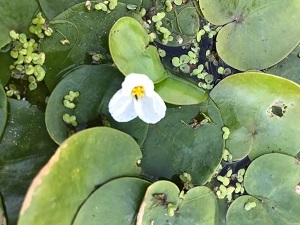
European frog-bit resembles a miniature water lily with leaves about the size of a quarter. It can form dense mats on the surface of slow-moving waters like bayous, backwaters and wetlands. These mats can impede boat traffic and alter food and habitat for ducks and fish.
Staff from the West Michigan Cooperative Invasive Species Management Area (CISMA), Gun Lake Tribe, Michigan State University Extension and the Department of Environment, Great Lakes, and Energy (EGLE) are collaborating on survey and removal efforts.
|
Work underway in West Michigan
Work started later than anticipated this year, so plans focused on removing the plant from areas around public boat launches and protecting culturally and ecologically significant areas including wild rice beds in the Lower Grand River.
Because European frog-bit can be spread when plants or seeds attach to boats and trailers, focusing on heavy-use areas reduces the likelihood of spread to uninfested waters around West Michigan.
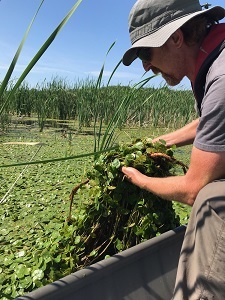
On August 12, joint efforts resulted in the removal of 1,055 pounds of European frog-bit around the 144th Ave. public boat launch and wetlands leading up to Stearns and Connor bayous.
West Michigan CISMA conducted herbicide treatment in late August around the 144th Ave. boat launch and at the public boat access site at East Grand River Park. Both locations are seeing heavy use by boaters, which is expected to continue throughout the fall.
In Pentwater Lake and State Game Area, EGLE staff completed surveys to determine the extent of the infestation. The West Michigan CISMA began herbicide control in the uppermost patches to prevent further spread in areas that are still primarily frog-bit free. The lower wetland area is heavily infested and will be challenging to control.
Collaborative response efforts will continue in both Oceana and Ottawa Counties to contain European frog-bit and prevent spread to uninfested waters while protecting key ecological and culturally significant areas.
|
How you can help
“We are asking local leaders, including municipalities and environmental organizations, to help raise awareness about this invasive plant and what can be done to prevent its spread,” said Joanne Foreman, invasive species communications coordinator with the Department of Natural Resources.
You can help by sharing information about European frog-bit in public meetings, with lake and community associations, and through your websites, newsletters and local news media. A list of available resources is included at the end of this document.
Local law enforcement agencies and their marine divisions can help by providing education to boaters and waterfowl hunters regarding the need to clean, drain and dry their boats and trailers.
New boating laws, effective as of March 2019, are aimed at preventing the movement of aquatic invasive species like European frog-bit. It can be helpful to remind all boaters that they are responsible for the following prior to transporting any watercraft over land:
- Removing all drain plugs from bilges, ballast tanks, and live wells.
- Draining all water from any live wells and bilges.
- Ensuring that the watercraft, trailer, and any conveyance used to transport the watercraft or trailer are free of aquatic organisms, including plants.
European frog-bit spreading around the state
European frog-bit was first detected in southeast Michigan in 1996 and has since spread along the coastal areas of lakes Erie and Huron up to the eastern Upper Peninsula.
In 2016, the plant was discovered in Reeds and Fisk lakes in East Grand Rapids. It was found in several small bodies of water in Oakland County in 2018 and in the Lower Grand River in Ottawa County and Pentwater Lake in Oceana County in 2019.
The Oakland County CISMA is continuing its survey of lakes and wetlands and has begun controlling the invasive plant from some infested areas in Oakland County.
More recently, EGLE confirmed the presence of European frog-bit in 2020 in an impoundment in the Dansville State Game Area and in Mud, Mills, Winnewanna and Green lakes in the Waterloo State Recreation Area.
See the related story: Invasive European frog-bit found in Mid-Michigan.
Need more information on European frog-bit in West Michigan?
Contact:
Drew Rayner, West Michigan CISMA Coordinator
616-402-9608
drew.rayner@macd.org
Information and resources to share with the public
Reporting new locations of European frog-bit:
- Any sightings of European frog-bit can be reported through the Midwest Invasive Species Information Network (MISIN) through the MISIN website, at MISIN.MSU.edu or by downloading the MISIN app to a smartphone.
- MISIN offers a short identification tutorial which helps distinguish between European frog-bit and similar aquatic plants.
- Reports also can be made to EGLE Aquatic Invasive Species Program by emailing EGLE-WRD-ANC@michigan.gov or calling 517-284-5593.
- If you encounter European frog-bit on the water, take some photos. These can be uploaded on the MISIN website, attached to a report via the MISIN app, or sent via email to EGLE.
Public education:
Preventing the spread of European frog-bit is essential to protect the ecosystems and recreation opportunities in Michigan. The best way to prevent further spread is to educate recreational users and riparian landowners about the issue and what they can do about it.
Key messages to share with the public:
- Invasive European frog-bit is harmful to the environment and can hinder recreational activities like boating, fishing and hunting.
- European frog-bit can be moved from one location to another when plant fragments or turions stick to boats, trailers or equipment.
- Clean, Drain & Dry boats, gear and equipment before going to another location.
- Learn how to identify and report European frog-bit.
Online resources:
Use these on websites, social media, or for distribution or presentation in meetings.
Print resources:
The following resources are available through the Michigan Department of Environment, Great Lakes, and Energy – contact Kevin Walters at Waltersk3@michigan.gov:
Boat launch sign (16” x 24”)
- Sturdy, weather-resistant sign reminding boaters to clean, drain and dry boats and trailers and to dispose of bait in the trash.
- Place at all municipal boating access sites.
- Encourage private launch sites to install.
- Available at no cost while supplies last.
Rack card (4" x 9" double-sided)
- This rack card describes new boating laws requiring boaters to remove all debris and aquatic plants from boats and trailers and to remove plugs and drain all water from bilges and live wells before transporting.
- Place or distribute rack cards at local offices, public places and any locations visited by boaters.
- Available at no cost while supplies last.
Photos:
Click on the links for high-resolution photos for use in press, social media or websites. Captions follow.
European frog-bit plant: European frog-bit resembles small water lilies, with white, three-petaled flowers visible between June and August.
Turions: Turions are seed-like structures that can spread European frog-bit when they attach to boats and gear.
European frog-bit illustration: European frog-bit is a free-floating aquatic plant with small (0.5 to 2.5-inch) leaves. Illustration courtesy of Bruce Kerr.
Removal: EGLE Aquatic Biologist Tom Alwin removes European frog-bit from a backwater area in Pentwater River State Game Area.
Michigan's Invasive Species Program is cooperatively implemented by the Department of Environment, Great Lakes, and Energy, the Department of Natural Resources, and the Department of Agriculture & Rural Development.
|