Four Fun Fishy Facts:
-
Do you know what mudpuppies are? These large, aquatic salamanders can be found in some parts of Michigan. They live permanently in the water!
- “School” is the name given to a group of fish.
- Fish don’t blink because they do not have eyelids (except for sharks!) and so they may not close their eyes to sleep like we do, but they have periods of rest that’s like our sleep.
- A salmon’s ability to smell is far better than the smelling sense of a dog! They use this smelling superpower to find their way back to their home stream when it's time for them to reproduce.
Fun Fish Activity - Fish Dissection
Have you ever dissected a fish? Why not try the next time you are cleaning your catching from a fishing trip?
Each species of fish that you might catch may have slightly different anatomy (the organs and bones inside). But fish have similar organs to you and me! You will find their heart, brain, liver and stomach. But you will also find some specific fish organs like gills, swim bladders, scales and more!
Use this handy diagram to help identify some of the organs you might find when you dissect your next catch. And check out this website to learn what fish organs do!
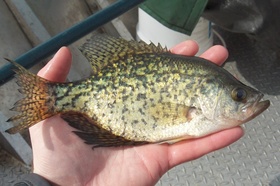 Name that Fish!
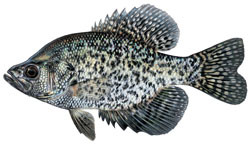
Black crappie are part of the panfish family! These fish have dark, spotted markings all over their body. Michigan has white crappie too, but their markings tend to resemble bars that go up and down on their sides. Black crappie have seven or eight dorsal spines.
These fish are typically caught with live minnows or jigs, either while casting or still-fishing under a bobber. Sometimes fly fishermen even catch them!
Crappie have large mouths, capable of eating fairly good size minnows, so if you do fish for them you should use a larger hook than what you would use for bluegill or sunfish.
Crappie are a schooling fish, so if you’ve found one then you’ve generally found several!
Black crappie are often found in clear water lakes, often in and around weed beds. They are among the first of the panfish species to move shallow for spawning in the spring, when most anglers spend lots of time targeting them. After they’re done spawning they usually move out into deeper water.
|