Fish Bites
October 2018
Welcome to the 16th edition of Fish Bites! This e-newsletter is made specifically for students, parents and teachers. Expect to receive Fish Bites about four times each year and have your friends sign up too!
Name that Fish!
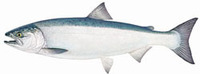
Can you name this Pacific salmon species? Scroll to the bottom to find out!
Illustration by Joseph R. Tomelleri ©
|
|
 |
|
In the Current:
- Want to do some fall fishing? Don’t forget to check out our Weekly Fishing Report that’s full of information about where the fish have been biting!
- Why not visit one of our state fish hatcheries or egg-take weirs this fall? There’s a lot to see if you visit any of these facilities – plan a trip by visiting Mi.gov/hatcheries.
- Save-the-Date for the 2019 Winter Free Fishing Weekend: February 16 & 17

|
Four Fun Fishy Facts:
- The size of a salmon is usually related to its age. Chinook can live up to nine years, the longest of all salmon species, which is why some can grow to more than 100 pounds.
- Did you know steelhead (rainbow trout) first came to Michigan back in 1876? Today our state is considered one of the best steelhead fishing locations in the U.S.
- Michigan has 11,000 inland lakes that are five acres or larger. The largest inland lake in Michigan is Houghton Lake with a surface area of 31.3 square miles.
- There are about 32,000 species of fish in the world and scientists are still discovering new species every day!
|
|
 A Fisheries friend – bats!
Did you know Michigan has nine different kinds of bats?
Bats in Michigan are commonly found near lakes, streams and ponds – but they don’t hang out to eat fish.
All nine Michigan bats eat bugs – and lots of them! They eat things like beetles, stinkbugs, moths, flies and, yes, mosquitoes.
Bats can eat up to 600 to 1,000 insects per hour!! A bat may eat more than its weight in insects in a single night!
Many insects will start life in the water as larvae. Once they grow wings and become adult insects, they leave the water. Bats feast on these flying insects, which is why you are likely to see bats hanging out near the same places you might go fishing.
Bats use echolocation to find their food! Using high frequency sounds, they listen for the echo to determine where objects are. They are well adapted for flying in complete darkness and can avoid even the smallest obstacles!
Learn more about these amazing flying mammals at Mi.gov/bats.
You can be a bat hero and help bats during Bat Week, Oct. 24 – 31!
|
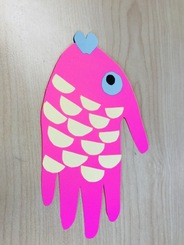 ACTIVITY: Make a Handprint Fish!
Materials:
Colored paper
Scissors
Glue stick
Glitter, stickers or other decorations
Trace your hand on colorful paper. Cut out, rounding off where your wrist attaches. Cut out a small heart shape and glue as your fish’s mouth. Cut out and glue on an eye. Decorate your fish by adding scales, glitter, beads or stickers. When you are done, add a popsicle stick and you have a puppet! Or make several and put them on your wall as a school of fish!
|
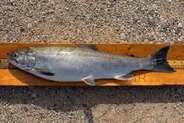 Name that fish!
Coho salmon have two dorsal fins including one adipose fin and have a dark blue to green back with silver sides and a white belly. The average adult Great Lakes coho salmon weighs five pounds.
In the Great Lakes, larger coho feed primarily on smelt and alewives; however they will eat anything they can get their mouths on if necessary. They compete primarily with steelhead for food.
Coho’s typically migrate later than the other salmon and travel longer distances. Although natural reproduction has been documented, the fishery is largely supported through stocking. The bulk of coho are stocked in the Platte River, just downstream from the state's coho hatchery.
This is the fish that really started the Great Lakes salmon fishery. Like Chinook, coho are native to the Pacific coast of North America and parts of Asia. They were successfully introduced into the Great Lakes in 1966, when smolts where stocked in two Lake Michigan tributary streams; Platte River and Bear Creek (Big Manistee River tributary). There was excitement from anglers and fish managers when coho made their first spawning run in the fall of 1967. Since that time, the coho has become a popular sport fish, and many people come from all over the world to fish Michigan's great coho fishery.
Coho can be caught in Lake Michigan at any time, though the best fisheries on the lake's east side occur in early spring and again in late summer and early fall.
|
|