2018-19 Waterfowl Hunting Season Update
It’s almost time to polish up the
shotgun, warm up the retriever with some practice throws and don that
camouflage as we near the season for hunting ducks and geese in Michigan! Area
wildlife managers have been working hard all summer to make sure that migrating
waterfowl have great habitat conditions on Michigan’s state game and wildlife
areas this fall.
During this special early season, blue-winged
and green-winged teal are the only ducks that can be harvested. Hunting hours
are from sunrise to sunset, and the bag limit is six teal. Hunters are strongly
encouraged to study their duck identification skills for early teal season.
Don’t shoot if you aren’t sure of your target.
Canada
geese, white-fronted geese (or specklebellies) and brant are now part of a
dark goose aggregate daily bag limit. From Sept. 1-30, the dark goose aggregate
daily bag limit for Canada geese, white-fronted geese and brant is five, only
one of which can be a brant. After Sept. 30, the daily limit for dark geese is five,
only three of which can be Canada geese and one of which can be a brant.
In
simpler terms, hunters can harvest five dark geese per day in September, only
one of which can be a brant. All five dark geese harvested could be Canada
geese. After Sept. 30, hunters can still harvest five dark geese per day; however, only three can be Canada
geese, and only one can be a brant. Three Canada geese can be harvested daily
after Sept. 30, and the remainder of the aggregate daily bag limit can be filled
with two white-fronted geese or a white-fronted goose and a brant. This change was made to make it easier for
hunters to harvest any of the goose species they encounter during the season.
An
aggregate bag limit is also in place for light geese. including snow, blue and
Ross’s geese. Hunters may harvest 20 light geese per day during goose
seasons.
- North Zone – Sept. 1 - Dec. 16
- Middle Zone – Sept. 1-30 and Oct.
6 - Dec. 21.
- South Zone – Sept. 1-30, Oct. 13
- Dec. 9, Dec. 29-30 and Jan. 26 - Feb.11, 2019
- Allegan County GMU – Sept. 1-16,
Nov. 3-13, Nov. 22 - Dec. 9 and Dec. 15 - Feb. 14, 2019
- Muskegon County GMU – Oct. 16 -
Nov. 13 and Dec. 1-22
Youth
Waterfowl Hunting Weekend will be Sept. 15-16 statewide for properly
licensed youth 16 years of age and younger. Ducks, mergansers, geese, coots and moorhens may be harvested; accompanying adults are not permitted to harvest
these species during the hunt unless hunting during the September portion of
the Canada goose hunting season or the early teal season. The daily limits and
species restrictions are the same as those allowed in the regular waterfowl
hunting season. Youth 16 years of age also must possess a waterfowl license and
a federal duck stamp.
Regulation changes for 2018-2019
include an increased pintail limit. Hunters may take two pintails per day this
season. Also new this year for our nonresident waterfowl hunters, a
nonresident seven-day or a non-resident three-day small game license allows the
purchase of a waterfowl license without the purchase of a nonresident base
license.
Waterfowl hunting regulations and
bag limits can be found in the 2018-2019 Michigan Waterfowl Hunting Digest.
Digests are available at DNR Customer Service Centers, wildlife field offices
and license agents or on the web at michigan.gov/waterfowl.
- North Zone – Sept. 29 - Nov. 25
and Dec. 1-2
- Middle Zone – Oct. 6 - Dec. 2 and
Dec. 15-16
- South Zone – Oct. 13 - Dec. 9 and
Dec. 29-30
This
fall, why not check out one of Michigan’s Wetland Wonders? Michigan's Wetland Wonders are
the seven premier managed waterfowl hunt areas in the state: Fennville
Farm Unit at the Allegan State Game Area (Allegan County), Fish Point State
Wildlife Area (Tuscola County), St. Clair Flats State Wildlife Area on Harsens
Island (St. Clair County), Muskegon County Wastewater Facility (Muskegon
County), Nayanquing Point State Wildlife Area (Bay County), Pointe Mouillee
State Game Area (Monroe and Wayne counties) and Shiawassee River State Game
Area (Saginaw County).
These
areas, scattered across the southern Lower Peninsula, were created in the 1960s
to provide exceptional waterfowl hunting opportunities, and are still managed
today to provide waterfowl habitat for nesting and migration and for the
benefit of other wetland-dependent wildlife. Since the beginning, these areas
have been funded by hunting license fees, but they are open for anyone to
visit, use and enjoy most of the year.
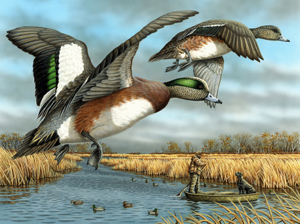 The Michigan Duck Hunters
Association, in cooperation with the Michigan DNR, has introduced the 2018
special Governor’s Edition Michigan duck stamp and print. This special edition
features a pair of American wigeons in flight, by wildlife artist Christopher
Smith, with Governor Snyder’s signature. Only 100 copies of the Governor’s
Edition print are available, along with 200 copies of the special-edition stamp.
A standard version of the 2018
Michigan duck stamp, featuring the artwork only without the governor’s signature, also is available.
The Michigan Duck Hunters Association is a nonprofit
organization dedicated to waterfowl and wetland conservation. Proceeds from
stamp sales will be used to fund MDHA projects, with 10 percent used to match
DNR funding for purchasing wetlands. Learn more about the waterfowl stamp
program and how you can support conservation efforts in Michigan through the
purchase of collector’s-edition waterfowl stamps and prints at michigan.gov/waterfowl.
The stamp is a voluntary purchase
and does not replace the state waterfowl hunting license. MDHA will mail
waterfowl hunters a free copy of the standard-edition stamp (subject to
availability) if they send a self-addressed, stamped envelope with a copy of
their Michigan waterfowl hunting license to: MDHA Waterfowl Stamp Program, P.O. Box
186, Kawkawlin, MI 48631.
|
Invasive
plants and animals like phragmites, European frogbit and zebra mussels can
cause significant harm to wildlife habitat, reduce hunting opportunities and
damage equipment.
Invasive
species often are spread unintentionally. Microscopic organisms and aquatic vegetation readily attach to
equipment, and without proper steps to remove them, are unknowingly transported
from one lake, river or wetland to another. Watch this video for reminders about how to help prevent the spread of
invasive species and protect waterfowl habitat.
Call 517-284-WILD (9453) or email dnr-wildlife@michigan.gov.
|