Grasslands are great: Grasslands for wintering wildlife
Dec. 21, 2017
Over the course of the year, we’ll be sending a series of stories about grasslands and the benefits they provide to wildlife and to people. Many may not know that grasslands help to improve water and air quality – important for all of us in Michigan and throughout the world. They also are simply stunning to view in mid- to late summer when the prairie wildflowers are in full bloom. This month, we’re featuring the important partnership between grasslands and wintering birds and insects. Grasslands provide hunting grounds, thermal cover for some species and habitat for larval insects.
 Today is the first day of winter – a day that some Michiganders love and other Michiganders love to hate. Regardless of your personal opinions on these frosty months, the wildlife here in Michigan has adapted strategies to thrive in the winter weather. Grasslands provide important winter habitat for many birds and insects. Today is the first day of winter – a day that some Michiganders love and other Michiganders love to hate. Regardless of your personal opinions on these frosty months, the wildlife here in Michigan has adapted strategies to thrive in the winter weather. Grasslands provide important winter habitat for many birds and insects.
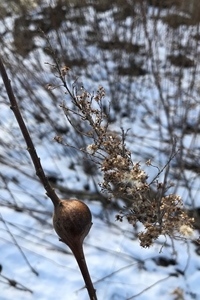
If you’ve been to a field or grassland recently, you’ve probably seen stems of certain plants with a round ball somewhere on the stem. The stems are goldenrod plants, and the round balls are formed by the goldenrod gall fly. The female lays several eggs on the tip of the goldenrod plant, but after hatching, just one larva burrows down into the stem of the goldenrod plant. The larva’s chewing and saliva action results in the production of the galls.
There it grows through the summer, passing through two larval stages and then spends the winter in its third larval stage, which it reaches by late summer. This larval stage is freeze-tolerant, and the insect will remain in the gall as a larva until the warmer temperatures of the spring cause it to pupate and then emerge as an adult in later spring. These larvae are sometimes winter food sources for birds like downy woodpeckers and chickadees.
Some avian species head to grasslands in the winter for excellent hunting opportunities. Birds – like one of Michigan’s endangered species, the short-eared owl, as well as rough-legged hawks and even snowy owls – find grasslands, with their plentiful mouse and vole populations, irresistible. The open country makes hunting a breeze for these large raptors, and tall, thick grasses like switchgrass and cattails in wet meadows provide important roosting cover, especially for short-eared owls.
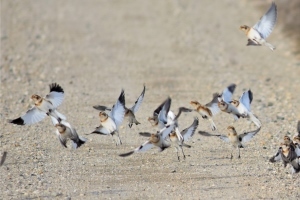 Small songbirds called snow buntings come to Michigan from their breeding grounds in the Arctic to spend the winter feeding on small grains and seeds in grasslands and fields. Their graceful flight and white plumage has earned them the nickname “snowflakes.” Small songbirds called snow buntings come to Michigan from their breeding grounds in the Arctic to spend the winter feeding on small grains and seeds in grasslands and fields. Their graceful flight and white plumage has earned them the nickname “snowflakes.”
Grasslands also provide important wintering habitat for some of Michigan’s most prized game species. White-tailed deer and cottontail rabbits like the thick grasses for bedding, hiding from predators and getting out of the harsh winter winds. Ring-necked pheasants use grassland habitat in every season of the year. Wetlands, windbreaks and dense covers of cattails or switchgrass protect the birds from heavy snow and cold winds in the winter. This thick cover also protects pheasants from predators, and fields of grain and weeds provide a consistent winter food supply.
Some of the state’s most imperiled species are grassland species. This habitat type has declined drastically over the last 150 years due to the conversion of grasslands to agriculture, residential and commercial development, and the succession of grasslands into forestlands. This decline in habitat has directly led to declines in short-eared owl populations, among other species.
The Michigan Pheasant Restoration Initiative is working to improve and enhance Michigan’s remaining grasslands on private and public lands in southern Michigan. This includes planting diverse mixes of grasses and wildflowers for birds, insects and other wildlife. Extensive grassland restoration work is in progress at Lake Hudson State Recreation Area in Lenawee County, Verona State Game Area in Huron County, Sharonville State Game Area in Jackson and Washtenaw counties, and Maple River State Game Area in Gratiot County as well as other public and private lands in southern Michigan.
Made up of many partners, the Michigan Pheasant Restoration Initiative is a conservation initiative to restore and enhance Michigan pheasant habitat (grasslands), populations, and hunting opportunities on private and public lands. The initiative works by acquiring state, federal and partner resources to assist landowners in cooperatives to improve wildlife habitat on their properties and by improving grassland habitat on selected state game areas, recreation areas or other public lands. To learn more, visit www.mi.gov./pheasant.
/Note to editors: Contact – Holly Vaughn, 313-396-6863. Accompanying photos are available below for download. Suggested captions follow.
Goldenrod gall: Goldenrod gall flies live in these round balls, called galls, in the summer and fall as larva and then pupate in the winter. When spring rolls around, the adults fly out of the gall and start a new generation of flies.
Snow buntings: Snow buntings can be found eating seeds and grain in fields and grasslands in the winter.
The Michigan Department of Natural Resources is committed to the conservation, protection, management, use and enjoyment of the state’s natural and cultural resources for current and future generations. For more information, go to www.michigan.gov/dnr.
|