|
|
|
Current/Upcoming Seasons
-
Deer Season Dates
- Regular Firearm: Nov. 15 through Nov. 30
- Late Archery: Dec. 1, 2017 through Jan. 1, 2018
- Muzzleloading
- Zone 1: Dec. 1 through Dec. 10
- Zone 2: Dec. 1 through Dec. 10
- Zone 3: Dec. 1 through Dec. 17
- Late Antlerless Firearm: Dec. 18, 2017 through Jan. 1, 2018
Thank you, hunters for your interest in Michigan deer hunting, and good luck this season as you enjoy the hunt while contributing to the conservation of Michigan's natural resources!
|
|
|
Regular Firearm Season
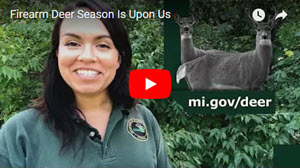
Season opens Nov. 15! Watch the video below for things you should know. Happy hunting!
|
|
|
Decide Before You Buy!
Don’t forget, when purchasing your licenses, you will need to decide if you want to hunt one antlered deer or two. If you choose to purchase one single deer license you cannot buy another. If you harvest one deer and want to continue hunting, the combo deer license is for you! A deer or deer combo license can be purchased at a license agent so you can have your kill tag in time for opening day.
|
|
|
Helpful Reminders for Michigan's Firearm Deer Season
Tens of thousands of Michigan residents and nonresidents will take to the fields and forests Wednesday, Nov. 15, to enjoy deer hunting. The Department of Natural Resources would like to share a few helpful reminders with those who will be heading out to hunt.
|
|
|
Mandatory Deer Check In DMU 333, 359 and Montcalm-Kent Core CWD Areas
- DMU 333 is within the CWD Management Zone and includes Bath, DeWitt, Eagle, Olive, Riley, Victor, Watertown and Westphalia townships in Clinton County; Alaiedon, Delhi, Lansing, Meridian, Wheatfield and Williamstown townships in Ingham County; Woodhull Township in Shiawassee County; Delta, Oneida and Roxand townships in Eaton County; and Danby and Portland townships in Ionia County.
- DMU 359 consists of Mecosta, Austin, Morton, Hinton, Aetna, and Deerfield townships in Mecosta County, and Cato, Winfield, and Reynolds townships in Montcalm County.
- Montcalm-Kent consists of Douglass, Eureka, Fairplain, Maple Valley, Montcalm, Pine and Sidney townships in Montcalm County; and Oakfield and Spencer townships in Kent County.
- DMU 419 consists of the parts of Clinton, Ingham, Shiawassee, Eaton and Ionia counties not included in DMU 333 and is referred to as the CWD Management Zone.
- Deer registration is mandatory for deer harvested in DMU 333 and DMU 359, though hunters are encouraged to check any deer harvested in DMU 419 for CWD at any DNR deer check station.
- All deer harvested in DMU 333 must be submitted to a DNR check station that is located within DMU 333 within 72 hours of harvest, at which point hunters will be given a CWD tag to confirm deer were properly registered.
- If CWD is found in a submitted deer, the hunter will be notified by phone. If CWD is not found, test results will be posted online at mi.gov/dnrlab within seven business days of head or carcass submission.
- Deer check station hours and locations can be found at mi.gov/deer.
To find deer check stations across the state, visit mi.gov/deercheck.
|
|
|
Reminders for Those Who Hunt Deer in Areas of the State That Also Have Wild Elk
The Michigan Department of Natural Resources reminds deer hunters hunting in the northern Lower Peninsula that wild elk also are found in this area and cannot be harvested without an elk hunting license.
Elk and white-tailed deer are close relatives and from the same Cervidae family, but hunters can tell the difference between them by looking at a few characteristics:
- Deer and elk have significant size differences. Elk can weigh several hundred pounds more and stand 2-4 feet taller than deer.
- Elk males also have a different appearance, with a lighter back and hindquarters and a darker, reddish-brown neck and head.
- Female elk are a reddish-brown color without a color variation.
- Both male deer and elk have antlers. Adult bull elk antlers are typically significantly larger than white-tailed deer antlers and branch beyond the ears; however, young spike bulls can have significantly smaller, unbranched antlers.
- These occurrences often happen in low light conditions (right at the start or end of shooting hours) with hunters who would have been able to distinguish between the animals easily in better light conditions.
If you know of a wildlife violation that has taken place or you have made a mistake, call the Report All Poaching line at 1-800-292-7800.
Michigan has had an elk hunting season annually since 1984, and a weighted lottery system has been used since 2003. In 2017, 200 elk hunting licenses were available to those selected in the random drawing. To learn about how the elk hunting lottery works, see this video.
|
|
|
Know Before You Go
Part of hunting preparation includes reviewing and understanding pertinent deer regulations. Visit mi.gov/deer, which provides highlights of regulation changes, information about deer management, and links to additional resources, such as deer check stations. Refer to the 2017 Hunting and Trapping Digest and Antlerless Digest, also available at DNR Customer Service Centers and license vendors, for a map of all deer management units (DMUs) and other regulation details.
An overview of the 2016 deer season and other information such as deer harvest numbers, can be found in the 2016 Deer Season Summary.
Wondering what to expect for this year’s deer hunting season? Check out the 2017 Michigan Deer Hunting Forecast!
|
|
|
Places to Hunt
Mi-HUNT
- No matter where you are in Michigan, you can find public hunting land. This interactive map application, which now works on mobile devices, contains the most up-to-date information to help you plan your next hunting trip, and includes both public hunting land and private land open to the public for hunting.
HAP - Hunting Access Program
- There are private lands open to public hunting through the Hunting Access Program. HAP is a voluntary land-leasing program. There are thousands of private-land acres across the state that are open to public hunting.
Questions?
Call 517-284-WILD (9453)
|
|
|
|