Conservation officers often work alone in remote areas
Week 4: Aug. 6-12, 2017
“Stop! Get away!” the recruit barked while assuming a defensive posture. But the “suspect” continued his menacing advance until the recruit’s self-defense tactics forced an end to the “assault.”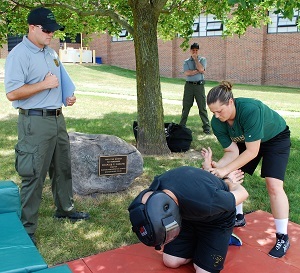
Fortunately, this was only a practice scenario during Week 4 of the Michigan Department of Natural Resources Conservation Officer Recruit School. But the week’s training highlighted the risks inherent to a law enforcement career. While the vast majority of interactions between conservation officers and the public are peaceful, an officer never knows if a situation will escalate into a violent encounter.
DNR conservation officers typically work alone, often in remote areas where backup assistance is miles away. That’s why this week’s training introduced recruits to two of a conservation officer’s best friends: communications technology and survival tactics.
Using RAP
After returning to the academy Sunday night, recruits crammed in some studying before touring the DNR’s Report All Poaching (RAP) communications center in downtown Lansing. The RAP program is a valuable investigative tool for conservation officers. It enables citizens to report the illegal taking of fish or game or damage to Michigan’s natural resources via text messaging or a toll-free phone number. The RAP line is open 24 hours a day, seven days a week.
Staying fit, staying safe
Monday morning was all about health and wellness. The class learned about proper food choices, vitamins and supplements, and body changes due to stress and physical training. The afternoon was devoted to officer safety. Cpl. Steve Martin and his team explained the different types of handcuffing procedures. Recruits also were quizzed on laws 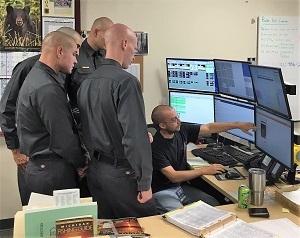 and policies governing use of force. and policies governing use of force.
Better service through technology
Sgt. Jason Wicklund, Recruit School commander, led Tuesday morning’s instruction on communications. Sgt. Wicklund walked recruits through the various computer programs they will use to gather information in the field, such as confirming residency, license purchases and wildlife registration. Recruits also checked out Sgt. Wicklund’s patrol truck and familiarized themselves with the computer and radio technology available to conservation officers in the field.
“Every conservation officer’s patrol truck is equipped with the latest radio and computer technology,” Sgt. Wicklund said. “We have wireless connectivity that enables us to access the Law Enforcement Information Network as well as the Internet, on which many of our other programs are based. With this technology, we can quickly access information, which equates to more productivity and better service for the public.”
Tuesday afternoon saw recruits refocus on their handcuffing techniques in preparation for their first survival tactics test, which awaited them on Wednesday.
Professionalism matters
Report writing is a big part of a conservation officer’s job, and as Sgt. Wicklund explained Wednesday morning, the quality of these reports directly reflects on officers and their organizations. “An articulate, well-written report is the most 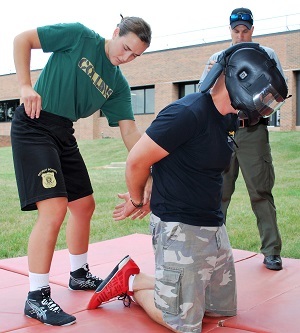 visible manifestation of a professional officer,” he said. “It is often the only basis others have for determining the competence and work quality of both the individual officer and the organization he or she represents.” visible manifestation of a professional officer,” he said. “It is often the only basis others have for determining the competence and work quality of both the individual officer and the organization he or she represents.”
Following three hours of learning the basics of report writing, recruits were put to the test. Conservation Officers Jon Busken and Richard Stowe staged an outside scene in which recruits observed a dead coyote, a shotgun shell casing and a rubber glove. Class members were under a time limit to observe the scene and return inside to write a report based on their observations.
Pass or fail
The class faced further challenges Wednesday afternoon. Recruits were tested on their handcuffing competency based on what they learned earlier in the week. There was a lot on the line because the test was pass or fail. Recruits who failed were counseled with corrective instruction and given another attempt.
Each recruit participated in a scenario in which he or she was advised prior to entering a room that the subject inside has a misdemeanor warrant for his arrest. Upon entering the room, recruits saw a single subject wearing a High Gear protective helmet, designed to heighten their levels of alertness and stress while protecting the subject.
Recruits immediately had to evaluate the scene before making a tactical approach toward the subject, displaying their knowledge of verbal commands and officer safety skills. Once handcuffs were properly applied recruits assisted the suspects to their feet.
Night moves
A night of uninterrupted sleep sounded great to the weary recruits, but they had no such luck.
Instructors surprised recruits by rousting them from bed at 11 p.m. for their first nighttime scenario. The scene was similar to the one earlier in the day except this time, the suspects being arrested were not compliant with the recruits’ commands. The outside darkness heightened the challenge.
“Arresting people who are angry or under the influence of alcohol or drugs can be dangerous,” Cpl. Martin said. 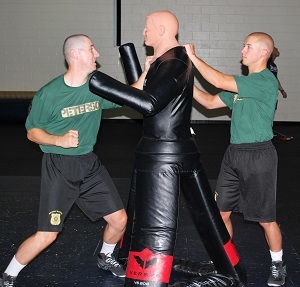 “Conservation officers often work alone and in these situations, we need to make sure we do things right and that we communicate effectively. These situations can go bad very fast so we train recruits how to approach the subject, handcuff them and have a plan if both of those techniques fail.” “Conservation officers often work alone and in these situations, we need to make sure we do things right and that we communicate effectively. These situations can go bad very fast so we train recruits how to approach the subject, handcuff them and have a plan if both of those techniques fail.”
Learning the law
Thursday morning introduced a new element to the academy – legal training. Retired Michigan State Police inspector David Greydanus shared his expertise. He presented the basics of the legal system and the elements that comprise a crime. Conservation officers handle more than just fish and game violations. As state peace officers, recruits must have the knowledge and training to recognize all violations of criminal law.
The afternoon brought recruits back to the gym for additional survival tactics training, with an emphasis on the proper way to search a suspect.
Every day is different
Recruits received additional legal training Friday morning before getting an education on the diverse types of patrols from Conservation Officer Shannon Kritz. Conservation officers do not conduct patrols the same way every day. Their duties may require them to be on foot, a Jet Ski, a boat, a snowmobile, a truck or an airplane, depending on the season, terrain and mission.
“Conservation officers have multiple ways to patrol their assigned areas,” Kritz said. “Since every day is different, the vehicles or types of patrol are as well.”
After completing another long but productive week, recruits were dismissed until Sunday night. When they return, though, they’ll be expected to use the foundation of knowledge and skills they have built during the past four weeks to tackle the next training phase.
Subscribe to the weekly conservation officer academy blog, which also will be posted on the Michigan DNR Facebook page. View previous blogs from Recruit School #8.
/Note to editors: Accompanying photos are available below for download. Caption information follows.
Field_survival: While the vast majority of contacts that conservation officers have with citizens are peaceful, all law enforcement professionals must be ready to defend themselves in a dangerous encounter. Conservation officer recruits are taught how to subdue an attacker and defend themselves if a situation escalates.
Proper_technique: Conservation Officer Ken Lowell, left, and Cpl. Steve Martin evaluate a recruit’s technique as she is tested on proper arrest procedures. Issuing clear verbal commands, maintaining an adequate distance from the suspect to ensure an officer’s safety, and the right way to handcuff suspects are skills recruits must master.
RAP_Room: Recruits get a firsthand look at the Report All Poaching (RAP) communications center in Lansing. The RAP system is a valuable investigative tool for conservation officers. It enables citizens to report the illegal taking of fish or game or damage to Michigan’s natural resources via text messaging or a toll-free phone number. The RAP line is open 24 hours a day, seven days a week.
Latest_technology: Conservation officers’ vehicles are equipped with the latest radio and computer technology, enabling them to quickly access information and deliver better service to the public.
Controlling_a_suspect: A recruit is graded on her ability to place a suspect under arrest safely. As fully commissioned peace officers, conservation officers must know how to control the scene and secure a suspect when arrests are made.
The Michigan Department of Natural Resources is committed to the conservation, protection, management, use and enjoyment of the state’s natural and cultural resources for current and future generations. For more information, go to www.michigan.gov/dnr.
|