|
March 7, 2017
Contact: Lynne Thoma, 517-284-5838 or Elyse Walter, 517-284-5839
DNR sees increasing number of recipients in Master Angler program
 The Michigan Department of Natural Resources has announced the 2016 results from its Master Angler program. This program, in place since 1973, recognizes large fish caught by recreational anglers. The Michigan Department of Natural Resources has announced the 2016 results from its Master Angler program. This program, in place since 1973, recognizes large fish caught by recreational anglers.
This past year, 1,807 anglers representing 24 states and the countries of Canada and Austria submitted catches that were recognized as Master Angler fish. That's an increase from the 1,542 fish recognized in 2015 and nearly double the 987 fish recognized in 2014. Of the entries accepted, 1,078 were in the catch-and-keep category while 729 were in the catch-and-release category. A total of 241 anglers received certificates for fish placing in the top five for both categories.
Here is a breakdown of the most popular 2016 Master Angler entries by species:
- 201 bluegill
- 101 smallmouth bass
- 93 crappie
- 90 common carp
- 89 pumpkinseed sunfish
- 88 walleye
- 87 freshwater drum
- 75 channel catfish
- 73 rock bass
Master Angler entries for 2016 included one state record: the 9.98-pound smallmouth bass caught on the Indian River by Robert Bruce Kraemer of Treasure Island, Florida.
Submissions already are being accepted for the 2017 Master Angler program, and will be until Jan. 10, 2018. To download an application, visit Michigan.gov/masterangler. Anglers are encouraged to submit their applications as they catch their fish and to not hold onto them until the end of the year.
/Editors' note: Accompanying photos of two 2016 Master Angler recipients are available below for download.
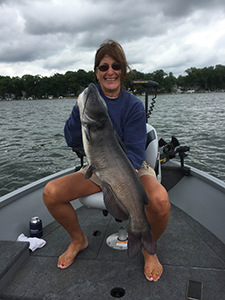
Eric Stewart, of Purcellville, is pictured here with the 52.75-inch muskellunge he reeled in from the Saginaw River; and Janet Huff, of Marcellus, shows off the 31.25-inch channel catfish she caught in Devils Lake – both catches were made in July 2016./
The Michigan Department of Natural Resources is committed to the conservation, protection, management, use and enjoyment of the state’s natural and cultural resources for current and future generations. For more information, go to www.michigan.gov/dnr.
|