The bald eagle: December’s Migratory Bird Treaty Centennial featured bird
Dec. 20, 2016
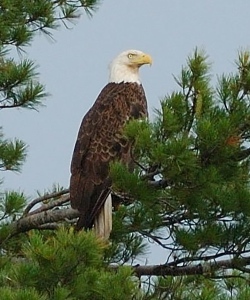 Perhaps one of the most recognizable birds in North America is the bald eagle. These regal raptors, with distinctive all-white heads and chocolate-brown bodies, are the symbol of our nation. Perhaps one of the most recognizable birds in North America is the bald eagle. These regal raptors, with distinctive all-white heads and chocolate-brown bodies, are the symbol of our nation.
Bald eagles are not, in fact, bald as their name suggests. In Old English, the word for white was “balde,” thus they are named for their white heads. Along with their unique white heads, other features that make these birds easy to identify include their white tail feathers, large, hooked yellow beak and 2-inch-long taloned feet.
Weighing about 16 pounds with a wing span of 6.5-8 feet, bald eagles are second only to golden eagles in size. Unlike golden eagles, which mainly migrate through Michigan with only a handful of the birds overwintering here, bald eagles both overwinter and breed in Michigan.
The diet of the bald eagle consists mainly of fish; however, it is common to see bald eagles hunting birds, and they will also eat reptiles, amphibians and invertebrates. They are even known to eat prey such as rabbits and muskrats and will dine on carrion.
These birds, while excellent hunters, often steal food from smaller birds of prey such as osprey by harassing them until the other birds drop their meals. The bald eagles then swoop in and take the food for themselves.
Bald eagles do not reach maturity until they are 4 or 5 years old, at which point they obtain their fully white heads and tails. They then select a mate with whom they typically remain for their whole lives, unless their mate is killed, in which case they will find a new mate. In the wild, bald eagles live to be around 20 years of age. In captivity, they can live up to 50 years.
Beginning in mid-February through mid-March, males will start to establish territories and build nests to attract their mate. Nests are usually located in tall trees, which can hold the massive weight of a bald eagle nest. Each year the pair will add to the nest, allowing a single nest to grow as large as 10 feet deep and 20 feet across. The female will lay, on average, two white eggs that are about twice as large as a chicken egg. The eggs hatch after a little over a month of incubation, and by late summer the offspring are ready to fly.
These magnificent birds are considered one of our nation’s greatest conservation success stories. Bald eagle populations steadily decreased through the first half of the 1900s due to human disturbances at their nest sites, loss of habitat and human persecution. Starting in the 1950s their slow decline took a sudden, sharp and dramatic plummet towards extinction across the lower 48 states, including Michigan.
Pesticide use was the largest contributor to this steep decline, especially pesticides containing DDT and PCBs. These pesticides limited eagles’ reproductive success by preventing the absorption of calcium. Without the necessary calcium, the eggs laid by the female eagles had brittle shells that could not withstand the weight of an incubating adult. At the peak of DDT chemical use (1967), the success rate of rearing one chick to fledging had dropped to only 38 percent. For Michigan’s population to remain stable, reproductive success rate needed to be at least 70 percent.
The dramatic decline of this species was not fully realized until the 1960s. Michigan was the first state to ban DDT, and in 1972, DDT was banned across the whole country. In 1961 Michigan started an intensive bald eagle monitoring program. The bald eagle was federally listed as an endangered species in 1967. It wasn’t until 1975 that reproductive success began improving and the minimum reproductive success rate of 70 percent was reached.
Starting in 1981, the bald eagle population in Michigan began to steadily increase, and in 1999 a survey estimated there were 343 nests producing 321 offspring, resulting in a success rate of 96 percent. The population rebound of this species prompted its removal from the federal Endangered Species List in July of 1995. The bald eagle remained on the Michigan Endangered Species List until June of 2007. Today there are over 800 nesting pair of bald eagles in Michigan.
Although the bald eagle has a stable population and is no longer protected under the Endangered Species Act, it is still protected under the Migratory Bird Treaty Act. Continued monitoring and protection is vital to the continued presence of this species in North America.
The year 2016 marks the centennial of the Convention between the United States and Great Britain (for Canada) for the Protection of Migratory Birds (also called the Migratory Bird Treaty), signed on Aug. 16, 1916. Three other treaties were signed shortly thereafter with Japan, Russia and Mexico. The Migratory Bird Treaty, the three other treaties signed later, and the Migratory Bird Treaty Act form the cornerstones of efforts to conserve birds that migrate across international borders.
This story concludes the 2016 Migratory Bird Treaty Centennial celebration. We hope you have enjoyed learning more about Michigan’s great migratory birds and their conservation success stories.
To learn more about the Migratory Bird Treaty Centennial, visit www.fws.gov/birds/MBTreaty100. To sign up for DNR Wildlife Viewing emails, visit www.Michigan.gov/dnr and click on the red envelope.
/Editors’ note: Contact – Holly Vaughn, 313-396-6863. An accompanying photo is available below for download. Suggested caption:
Bald eagles are the symbol of our nation. In the past 50 years, bald eagle populations have recovered from the brink of extinction./
The Michigan Department of Natural Resources is committed to the conservation, protection, management, use and enjoyment of the state’s natural and cultural resources for current and future generations. For more information, go to www.michigan.gov/dnr.
|