The common loon: August’s Migratory Bird Treaty Centennial featured bird
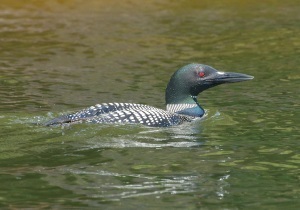 A trip to northern Michigan in the summertime is not complete without catching a glimpse of a handsome common loon. Their stunning black and white plumage and their haunting sound give an air of beauty, mystery and wilderness to northern lakes. A trip to northern Michigan in the summertime is not complete without catching a glimpse of a handsome common loon. Their stunning black and white plumage and their haunting sound give an air of beauty, mystery and wilderness to northern lakes.
In late March or April, common loons return to Michigan from their wintering grounds along the Atlantic and Gulf coasts. They remain in the state until September. A few individuals may overwinter if large lakes remain open and food is available.
Common loons are excellent divers. With legs placed far back on their bodies, they are ungainly on land, but swift in the water. They are able to dive over 200 feet and can remain submerged for up to five minutes, though the average dive is about a minute long. They dive after fish, frogs, crayfish, leeches and aquatic insects.
Building their nests atop muskrat lodges, on small islands or projecting shorelines, common loons lay one to three spotted, olive-colored eggs. The eggs are incubated for three to four weeks before hatching. Both parents share in the nest-building, incubation and rearing of the young. Growing quickly from black, downy chicks, by the time loons are six weeks old, they are nearly the same size as their parents.
Common loons in Michigan are found breeding almost exclusively in the northern two-thirds of the state, with just a few nesting sites south of that. They are most common on Isle Royale and the western portion of the Upper Peninsula. Even where they are most common, loons use only 50 percent of the “highly suitable breeding lakes.” The low population size is believed to be due to high levels of disturbance by humans.
Easily disturbed and stressed, adult common loons may desert their nest if approached too closely by a person, boat or other water vehicle, or wake from such a vehicle. As the populations of humans living around inland lakes have increased, loon nest disturbance has also increased. Everyone in Michigan can help to protect and foster our common loon population by remembering to give them the seclusion they need, and letting others know if there is a nest nearby so that it can be avoided.
Exact historic loon population sizes in Michigan are unknown; however, they were common in most regions and bred in every county. Populations had noticeably decreased by 1912 in southern Michigan. By the early 1980s, the population was down to only 200 pairs, but by the end of the 1980s was back up to 300 pairs.
There are several other factors which may have contributed to the decrease of common loons in Michigan. These include accumulations of poisons such as mercury, which can cause decreases in productivity; type E botulism, which has been known to kill loons; increases in raccoon and herring gull populations that have meant increases in egg and chick mortality; pesticides that have caused thinning of egg shells; water-level changes caused by hydroelectric dams or storms, which can affect nesting sites; fishing nets and oil spills encountered during winter migrations, which can be devastating; and lead poisoning from ingestion of fishing tackle, which is also a known cause of death.
Common loons were listed as a Michigan state-threatened species in 1987, and a recovery plan was created shortly thereafter. Recommendations include protection of current and potential breeding lakes, reduction of causes of mortality, and public education programs. The Michigan Breeding Bird Atlas published in 2011 estimates current populations between 500 and 775 pairs.
The common loon is protected under the Migratory Bird Treaty Act. The year 2016 marks the centennial of the Convention between the United States and Great Britain (for Canada) for the Protection of Migratory Birds (also called the Migratory Bird Treaty), signed on Aug. 16, 1916. Three other treaties were signed shortly thereafter with Japan, Russia and Mexico. The Migratory Bird Treaty, the three other treaties signed later and the Migratory Bird Treaty Act form the cornerstones of efforts to conserve birds that migrate across international borders.
The 2016 Migratory Bird Treaty Centennial celebration will include monthly featured bird stories to DNR Wildlife Viewing email subscribers, celebration events including a weekend of bird-based programming at State Parks and Visitor Centers in June, an education program for schools and conservation groups, and more!
To learn more about the Migratory Bird Treaty Centennial, visit www.fws.gov/birds/MBTreaty100. To sign up for DNR Wildlife Viewing emails, visit www.Michigan.gov/dnr and click on the red envelope.
The Michigan Department of Natural Resources is committed to the conservation, protection, management, use and enjoyment of the state’s natural and cultural resources for current and future generations. For more information, go to www.michigan.gov/dnr.
|