|
July 20, 2016
Contact: Holly Vaughn, 313-396-6863
Peregrine falcons in southeast Michigan banded for monitoring
DNR bands peregrine chicks in Detroit, Mount Clemens, Warren, Jackson, Ann Arbor, Flint and Southfield
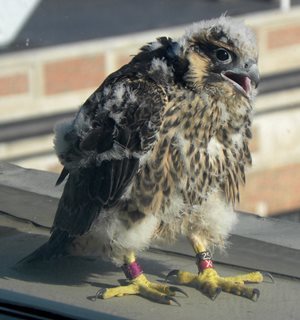 The Department of Natural Resources recently banded 15 peregrine falcon chicks hatched in southeast Michigan this spring. The Department of Natural Resources recently banded 15 peregrine falcon chicks hatched in southeast Michigan this spring.
At about 3 weeks of age, and before they can fly, peregrine chicks are given two bands on their legs. One is a bicolored band with large numbers and letters that can be read from a distance, and the other is a U.S. Fish and Wildlife Service band that bears a serial number specific to that bird. These bands are placed on young birds so that scientists can monitor and track the dispersal, migration, life span, reproductive success, behavior and population growth of the falcons.
Peregrine falcon chicks banded in previous years have turned up in nearby states and provinces, including Illinois, Indiana, New York, Ohio, Wisconsin and Ontario, and have even ventured as far as Florida.
Peregrine chicks were banded at the following sites this year:
- The former Lowe Campbell Ewald/GM Building in Warren (one female).
- The Jackson County Tower Building in Jackson (one female and two males).
- The old Mt. Clemens County Building (one female).
- The Whittier Hotel Building in Detroit (two females and two males).
- The Durant Building in Flint (one male).
- The North Bank Towers in Southfield (one male).
- The University of Michigan Hospital Building in Ann Arbor (two male and two female).
Tracking peregrine falcons through banding is important as their population recovers from a major population decline in the 1960s. The shells of peregrine falcon eggs became extremely fragile because DDT, a pesticide that interfered with calcium metabolism, accumulated in the adult birds. By 1968, the entire U.S. peregrine falcon population east of the Mississippi was gone. Peregrines are considered endangered in Michigan, though they no longer are federally endangered.
Michigan began its peregrine recovery efforts in 1986. In 1993, the peregrines in Michigan began reproducing successfully. In 2015 there were 48 nest sites in the entire state of Michigan; 28 of them produced young, and 14 of those 28 sites were in southeast Michigan. There currently are 21 sites being monitored for peregrine nesting in the southeastern part of the state.
/Editors’ note: An accompanying photo is available below for download. Suggested caption:
A recently banded peregrine falcon chick displays bands on both legs. Photo by Barb Baldinger./
The Michigan Department of Natural Resources is committed to the conservation, protection, management, use and enjoyment of the state’s natural and cultural resources for current and future generations. For more information, go to www.michigan.gov/dnr.
|