|
March 18, 2016
Contact: Cadillac Operations Service Center, 231-775-9727 or Elyse Walter, 517-284-5839
Anglers reminded Muskegon River walleye egg collection to occur this spring
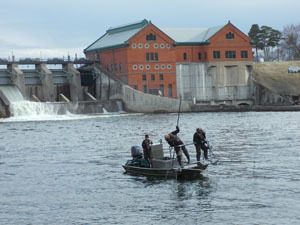
The Michigan Department of Natural Resources reminds Muskegon River anglers that fisheries personnel will be taking walleye eggs below Croton Dam this spring.
The DNR plans to collect approximately 67 million walleye eggs from the Muskegon River in 2016, resulting in 16.8 million fry for transfer to rearing ponds and direct fry plants throughout the Lower Peninsula. Walleye fry transferred to ponds will be raised to fingerling size (approximately 1.5 to 2.5 inches) and stocked in late spring or early summer in lakes and rivers throughout the state.
Lake Michigan walleye populations in the Lower Peninsula depend on the fingerlings produced from Muskegon River eggs, as do as many inland lakes in the Lower Peninsula. The size of the walleye spawning run in the Muskegon River presently is about 40,000 to 50,000 each year. DNR crews will strip milt (sperm) and eggs from approximately 700 adult fish, which will be returned to the river – except for 60 that will be sent to Michigan State University for fish health testing.
"This adult population consists of mostly stocked fish," said Rich O'Neal, fisheries biologist for the DNR's Central Lake Michigan Management Unit. "The Muskegon River has the largest run of walleye in the Lake Michigan watershed south of Green Bay."
The DNR plans to collect walleye with an electro-fishing boat beginning as early as the week of March 21 and concluding by April 15. Five days of fish collections are planned during this period. The actual date those collections will begin depends on water temperatures and the presence of ripe fish. This schedule can change on a daily basis for many reasons, but it is anticipated most work will be completed from the last week of March through the second week of April.
Sampling using electrofishing usually begins each day at Croton Dam at about 8:30 a.m. and proceeds downstream to the Pine Street Access Site. If more eggs are needed, additional collections may occur downstream to the Thornapple Street Access Site.
Egg collection and fertilizing is conducted at the Pine Street public access site, about 2 miles downstream of Croton Dam. This process generally begins between 10:30 and 11:30 a.m. The public is welcome to observe how the eggs are removed from the fish and fertilized before they are packed and shipped to Wolf Lake and Platte River state fish hatcheries.
Anglers who wish to avoid the walleye collection activities should fish downstream of the areas previously noted. The DNR asks anglers to exhibit caution when fishing near the electro-fishing boats. Wading anglers will be asked to exit the water when the boat approaches, to ensure anglers' safety during the electro-fishing work. The DNR appreciates angler cooperation during this critical egg-take operation.
/Editors’ note: An accompanying photo is available below for download. Suggested caption follows.
DNR employees will collect walleye on the Muskegon River this month and next in an effort to gather their eggs and milt. Fish reared as a result of this collection will be stocked into the state's water bodies in the future. /
The Michigan Department of Natural Resources is committed to the conservation, protection, management, use and enjoyment of the state’s natural and cultural resources for current and future generations. For more information, go to www.michigan.gov/dnr.
|