Traffic stops and tactical operations
Week 8: Feb. 21-27
Sunday evening, the 20 recruits reported back to the Michigan Department of Natural Resources conservation officer academy, held at the Michigan State Police (MSP) training facility in Lansing.
Monday morning, as they do every day of the academy, the recruits awoke at 5, powered through an hour of physical training – beginning at 6 a.m. – marched into the cafeteria for breakfast, had room inspections and reported to the classroom for their first instruction of the day.
No routine traffic stop
The four-hour class, stopping vehicles and occupant control, instructed by Assistant Recruit School Commander Cpl. Michael Mshar, detailed the step-by-step procedures for safely stopping a vehicle. Conservation officers, who are fully commissioned peace officers, make numerous traffic stops every day while on the job.
 “It’s important to remember that there is no routine traffic stop,” Cpl. Mshar told the recruits. “You may have stopped the driver for a seat belt violation, but you don’t know the occupants’ frame of mind. You must be prepared for all situations.” “It’s important to remember that there is no routine traffic stop,” Cpl. Mshar told the recruits. “You may have stopped the driver for a seat belt violation, but you don’t know the occupants’ frame of mind. You must be prepared for all situations.”
During the training, Mshar also stressed the safety of the vehicle occupants. “Once you stop a vehicle, you’re responsible for their safety on the roadway,” he explained.
Recruits learned the proper way to stop, park and exit a vehicle, contact and communicate with the occupants and how to run vehicle and driver information through the Law Enforcement Information Network (LEIN) system. LEIN, used by Michigan law enforcement officers, is a statewide computerized criminal justice information system. When training and testing is complete, recruits will be certified LEIN operators.
Recruits also trained on how to issue a citation and, when the situation warrants, make an arrest. Later in the morning, the recruits moved to a nearby facility where they walked through a traffic stop training scenario, practicing each step of the process.
Respect for all
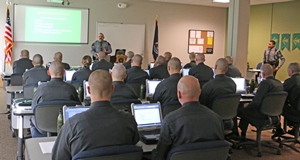 After lunch, recruits were immersed in cultural awareness and diversity training, instructed by Sgt. Damon Owens and Conservation Officer (CO) Ivan Perez. Through discussion and role-playing scenarios, Sgt. Owens and CO Perez emphasized the importance of respect for everyone. After lunch, recruits were immersed in cultural awareness and diversity training, instructed by Sgt. Damon Owens and Conservation Officer (CO) Ivan Perez. Through discussion and role-playing scenarios, Sgt. Owens and CO Perez emphasized the importance of respect for everyone.
“This very important training session focused on respect for all cultures, nationalities, genders, ages, religions and more,” Cpl. Mshar said.
Recruits will continue cultural awareness and diversity training during week nine.
The tank
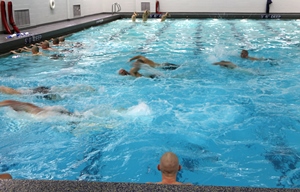 Recruits were in “the tank,” the nickname given to the 12-foot-deep training pool, at 6 a.m. Tuesday for physical training. They swam laps, treaded water and passed bricks around while in a circle formation, making certain to keep the bricks above water at all times. Recruits were in “the tank,” the nickname given to the 12-foot-deep training pool, at 6 a.m. Tuesday for physical training. They swam laps, treaded water and passed bricks around while in a circle formation, making certain to keep the bricks above water at all times.
Emergency response situations
Following an hour of report writing, recruits began a full day of tactical operations training with MSP Detective 1st Lt. Andrew Fias and, in the afternoon, Lt. Dave Bower from the MSP emergency services team.
During the tactical operations training, recruits learned about their roles during emergency response situations, such as an armed standoff in a facility with an active shooter. In these situations, law enforcement officers, including Michigan conservation officers, are dispatched to stop the threat of an active shooter upon arrival. In other calls they may serve as backup, forming perimeters around facilities to contain the location of the assailant. This includes keeping the public safely away.
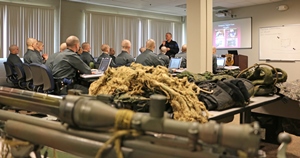 Through presentations and videos, the recruits learned their many possible roles during an emergency response. This will lead to hands-on training scenarios during future weeks. Through presentations and videos, the recruits learned their many possible roles during an emergency response. This will lead to hands-on training scenarios during future weeks.
Warrants
Wednesday, recruits studied in-depth the different criteria for search warrant and warrantless search procedures. Learning these laws is of utmost importance, and will be part of their final Michigan Commission on Law Enforcement Standards (MCOLES) exam, required to become fully commissioned and licensed peace officers.
Breathalyzers
After lunch, recruits returned to the classroom to find a breath alcohol testing device set on the table by each of their name badges. This specific type of breathalyzer is housed at local and county jails and its results are permissible for use in court. These tests are administered to persons at local jails who are suspected of driving under the influence and failed on-scene field sobriety testing. Recruits learned how to properly use the machine during training. By graduation, they will be certified in its use.
Explosive devices
Although conservation officers never handle explosive devices, they respond to and assist when these devices are reported or suspected. Thursday morning, the recruits took to the classroom for explosive devices training with MSP Sgt. David Buck of the MSP Bomb Squad.
Conservation officers are trained to evacuate areas where explosive devices are suspected or reported, secure the area and contact appropriate response agencies. During training, nonfunctional explosive devices were on display so recruits can learn to recognize them. It was a good segue to the afternoon session on emergency preparedness, focusing on conservation officers’ roles during any high level emergency situation.
That evening, recruits took several exams, including one on stopping vehicles and occupant control, finishing after 8 p.m.
After more Friday morning classroom instruction on warrantless search procedures, followed by an exam review, recruits were dismissed for the weekend.
Subscribe to the weekly conservation officer academy blog, which will also be posted weekly on the Michigan DNR Facebook page. View past blogs from Recruit School No. 7.
# # #
/Photo details: Accompanying photos are available below for download. Caption information follows.
Emergency response training.jpg: During emergency response training, recruits had the opportunity to view equipment used by the Michigan State Police Emergency Response Team, including sniper rifles, camouflage, packs, body armor, optics and more.
Traffic stops.jpg: Recruits ran through a scenario instructing them on the proper way to conduct a traffic stop.
Physical training pool.jpg: Recruits swam laps during morning physical training in the 12-foot-deep pool.
Cultural awareness and diversity training.jpg: Conservation Officer Ivan Perez (front, left) and Sgt. Damon Owens (front, right) instructed cultural diversity and awareness training./
The Michigan Department of Natural Resources is committed to the conservation, protection, management, use and enjoyment of the state’s natural and cultural resources for current and future generations. For more information, go to www.michigan.gov/dnr.
|