|
Building renewable energy sources on brownfields isn’t new. Just look at the Cadillac Solar Garden in the city of Cadillac. The 450-kilowatt facility came online in 2021 and was Consumers Energy’s first “brownfield to brightfield” project in Michigan. You may start seeing even more redevelopments like this over the next couple years as EGLE ramps up the Brownfield Renewable Energy Pilot Program.
The program will offer grants for renewable energy projects on sites that were previously developed and either abandoned or underused because of environmental contamination. Funding for the $10 million pilot program is coming from a $129.1 million federal Climate Pollution Reduction Grant awarded to the state in 2024. Program development is underway now and program roll out is anticipated for this fall. Your EGLE brownfields team will keep you updated along the way.
Legislation that would overhaul Michigan’s brownfield redevelopment program has been assigned to the House Committee on Economic Competitiveness. House Bills 5286 and 5287 were introduced last year by Rep. Alabas Farhat (D-Dearborn) and would make the following changes:
- Double the cap on grant and loan awards from $1 million to $2 million per project — the first increase since the program began in 1998.
- Remove the one-project-per-community limit, allowing communities with multiple contaminated sites to pursue more than one redevelopment per year.
- Reduce cost-share barriers for local governments that own contaminated property, enabling more cleanup projects to move forward.
- Clarify and simplify the application process, making it easier for local partners to access funding.
- Allow projects associated with casinos or professional sports teams to apply for funding
Current state law limits the number of grants to one project per community per year. The goal was to make sure state funding was distributed statewide. But the actual result is that smaller projects (often in environmental justice areas) are not considered as a community’s top priority when there are several projects to consider. In addition, large urban communities have a higher percentage of the brownfield properties in the state. It should be noted that the statewide distribution of funds is specifically addressed elsewhere within the legislation and would remain a consideration for funding.
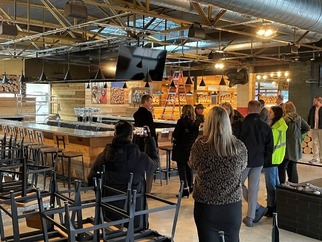
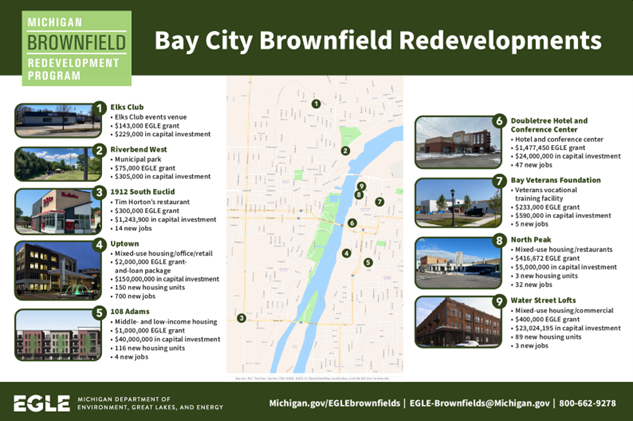
Bay City has been one of the more successful communities in Michigan when it comes to brownfield redevelopment, which is why EGLE Director Phil Roos held his latest brownfield tour and roundtable there in February. Director Roos, EGLE staff, city leaders, and developers toured two formerly contaminated sites: North Peak, which is being turned into a restaurant and a brewery with three loft-style apartments above; and Water Street Lofts, a mixed-use commercial building with 89 housing units. Those are two of the nine successful redevelopments the community has done with EGLE support. Nearly $12 million in State of Michigan funding has drawn more than $226 million in capital investment and created 208 new housing units and almost 1,000 jobs (see the graphic at the end of this story for the breakdown).
|
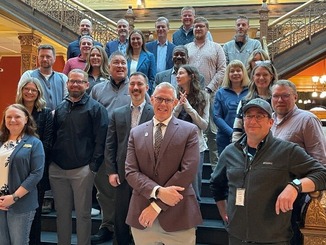
The roundtable focused on Bay City’s transformation, the future of brownfield redevelopment, and the proposed brownfield legislation. “Bay City is a strong example of how sustained investment in brownfield redevelopment can completely change a community,” said Director Roos. “Over the last 30 years, Bay City has transformed former industrial and contaminated sites into housing, jobs, riverfront access and destinations people are proud to call home. This is what is possible when state and local partners work together to turn environmental challenges into long-term opportunities."
|
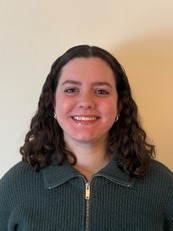
The EGLE brownfields team has grown since our last newsletter. Say hello to our new members:
 |
|
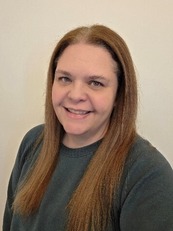
Kieran Tyrrell, Brownfield Technician
TyrrellK@Michigan.gov / 517-290-7144
Kieran works on electronic document management (EDM) for the brownfields section. She joined EGLE in 2025 after working as an EDM contractor for the department. Before that, she worked on habitat restoration for the Eastern Massasauga Rattlesnake with the Grand Traverse Regional Land Conservancy. She also studied historical spawning grounds for the Coregonid fish species at the United States Geological Survey Great Lakes Science Center. Kieran graduated from Michigan State University with a BS in Fisheries and Wildlife Biology and Management.
|
 |
|
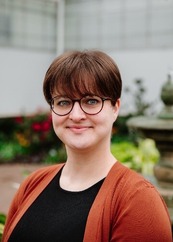
Kate Dancer, Secretary
DancerK1@Michigan.gov / 517-898-3398
Kate is the secretary for the Brownfield Assessment and Redevelopment Section. She joined EGLE in 2015 and most recently worked as the lead technician on electronic document archiving and environmental data systems. Kate has trained hundreds of State of Michigan employees and contractors on electronic document management processes over the years. Prior to EGLE, Kate worked in the financial industry performing customer service and administrative assistant duties. She studied business management at Cleary University.
|
 |
|
Kala Sperbeck, Brownfield Renewable Energy Specialist
SperbeckK1@Michigan.gov / 517-899-3355
Kala is developing and running the Brownfield Renewable Energy Pilot Program we told you about at the top of this newsletter. She joined EGLE in 2024 as a member of the MI Healthy Climate Corps where she helped launch the Michigan Climate Investment Accelerator and worked to bring Greenhouse Gas Reduction funds to Michigan. Kala earned a Bachelor of Science from the University of Notre Dame and a Master’s in Public Policy from Michigan State University.
|
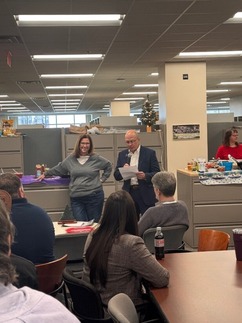
Congratulations to EGLE Brownfield Coordinator Michelle Bakun, who was honored for 30 years of service. EGLE Remediation and Redevelopment Division Director Mike Neller presented her with the award in December. Michelle joined the Superfund team in 1991 while she was still a student at Michigan State University working on her bachelor’s in environmental science. She did field work, attended public meetings, and reviewed work plans. She was later hired into the Livonia District Storage Tank Program of what was then the Environmental Response Division. Michelle has spent her entire career in various roles within EGLE RRD. She worked as a project manager on leaking underground storage tank sites from 1993-2001, as the district enforcement coordinator from 2001-2013, and since 2013 as a Brownfield Coordinator. Michelle’s wealth of environmental experience and passion for helping her communities has made her a true asset in accomplishing the work of RRD.
|
It’s never too early to start planning. Keep an eye out for the following:
- RRD’s Soil Background document is in the process of being updated to clarify when the use of soil background numbers is appropriate and its applicability to sites containing fill material. Keep your eyes open in the very near future for what will be a much-needed update.
- EGLE is in the early stages of planning what will become the bi-annual Michigan Brownfield Conference. The inaugural conference will be held in 2028, 40 years after the 1988 Environmental Protection Bond was passed, establishing EGLE’s Brownfield Program. Look for more information in the coming months on dates and locations.
Struggling to get caught up on the new Michigan Risk-Based Corrective Action (MIRBCA) policy? EGLE’s Remediation and Redevelopment Division has updated the MIRBCA FAQ page with this video of the MIRBCA Tier 1 Forms training along with a PDF of the slides and frequently asked questions about the forms. You can check out the FAQ page here. You can also reach out to Part 213 Program Coordinator Dr. Steve Beukema at BeukemaS@Michigan.gov or 269-547-0125.
Lansing hosted the mParks Conference in early March, and a brownfield redevelopment success story was one of the highlights.
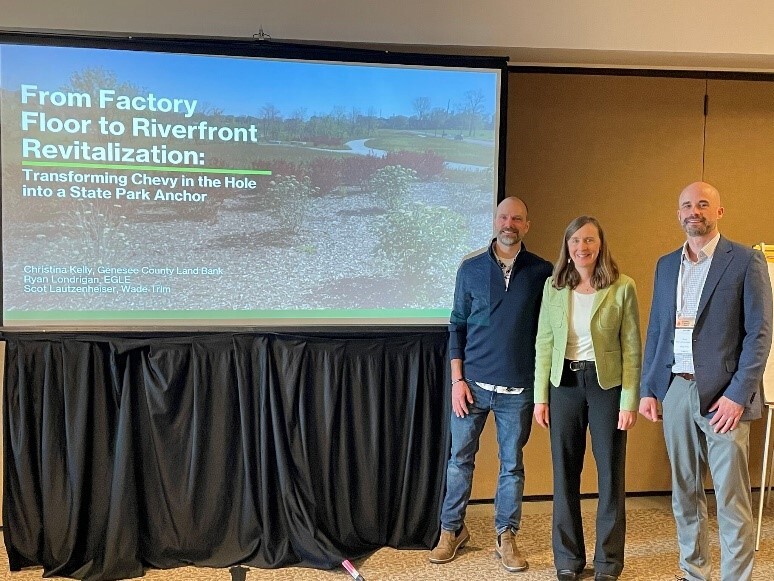 Brownfield Redevelopment Unit Manager Ryan Londrigan, Christina Kelly with the Genesee County Land Bank Authority, and landscape architecture specialist Scot Lautzenheiser with Wade Trim presented “From Factory Floor to Riverfront Revitalization: Transforming Chevy in the Hole into a State Park Anchor.”
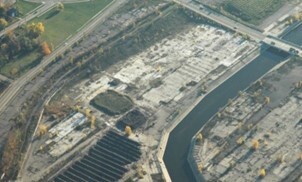
Chevy in the Hole, before
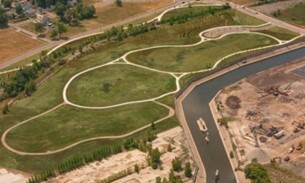
Chevy in the Hole, after
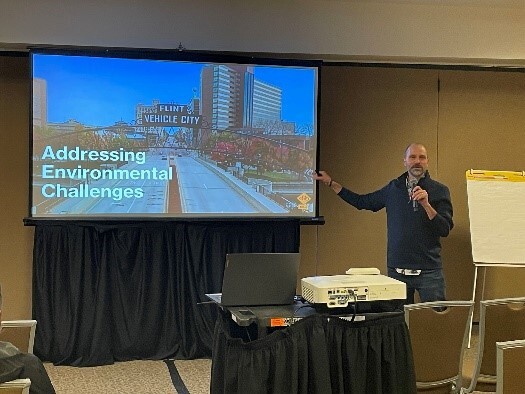
“Chevy in the Hole” is how people in Flint referred to the factory where the United Auto Workers Union formed in 1936. General Motors demolished the plant in 2004, leaving a 60-acre contaminated site behind on the banks of the Flint River.
It took 20 years of incremental progress and more than $15 million in funding from EGLE, the Michigan Department of Transportation, the U.S. Environmental Protection Agency, the U.S. Forest Service, the Michigan Land Bank, the Mott Foundation, and others to make it happen. The Michigan Department of Natural Resources recently acquired Chevy Commons and is combining it with 200+ acres along the Flint River to create the first state park in Genesee County.
|
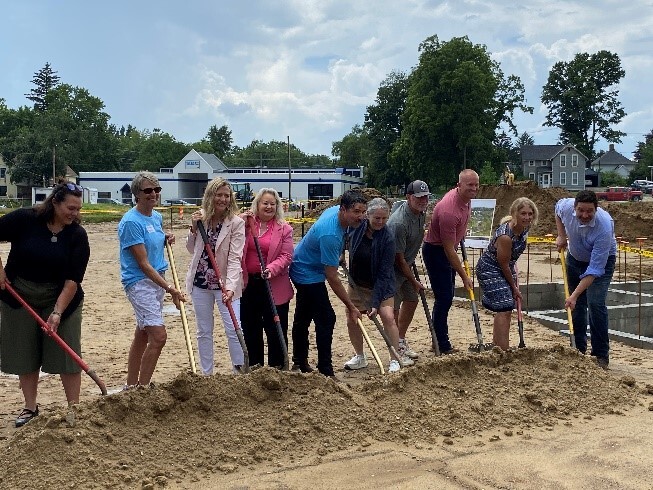
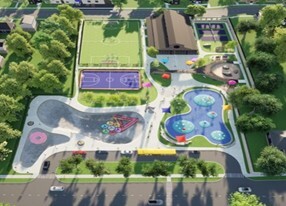
Another major EGLE park redevelopment is wrapping up, while construction is underway on a third. We’ll start with the groundbreaking for Main Street Park in Chelsea. The former site of Federal Screw Works, Detroit Urban Railroad Transformer company, and Consumers Energy was so contaminated that developers wanted nothing to do with it. The Main Street Park Alliance bought it along with a neighboring contaminated property in 2023. A $1 million EGLE Brownfield Redevelopment Grant paid for the excavation, transportation, and disposal of more than 31,500 tons of contaminated soil. Other funding came from the city of Chelsea, Washtenaw County, and the Michigan Natural Resources Trust Fund. The park will have a pavilion, community gathering space, a skate park, a climbing wall, and courts for basketball, bocce, and other games. In addition to the on-site amenities, the park is expected to have ¾ of an acre of green space, ¼ of an acre of native plants, and, eventually, more than an acre of tree canopy.
|
 |
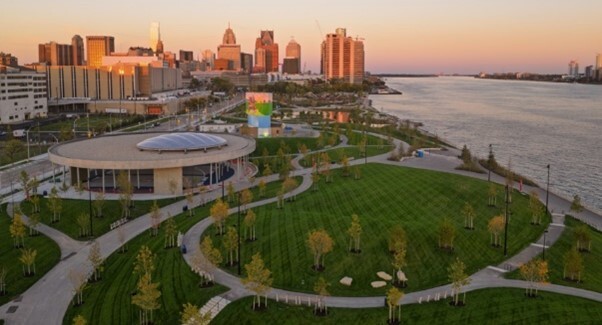
And as for the park project that’s wrapping up, we present Ralph C. Wilson Centennial Park on the shore of the Detroit River. A $1 million EGLE Brownfield Redevelopment Grant helped turn a contaminated section of the Detroit riverfront into a 22-acre park that’s expected to draw as many as a million extra visitors a year to the riverwalk.
The site at the corner of West Jefferson Avenue and Rosa Parks Boulevard has a long history of rail transportation and industrial uses and was home to the Detroit Free Press printing and distribution center from 1979 until it was bought by the Detroit Riverfront Conservancy (DRC) in 2007. The property was transferred to the State of Michigan in 2009 and leased back to the Conservancy. The Free Press building was demolished, leaving behind an empty field that was West Riverfront Park. In 2017, the DRC formed a Community Advisory Team to identify community priorities for the new Ralph C. Wilson, Jr. Centennial Park.
|
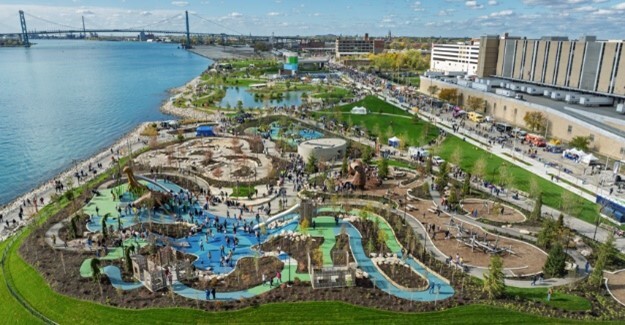
Before any redevelopment work could begin, the contamination on the site needed to be addressed. Environmental assessments found metals and organic compounds in soil and sediment, likely originating from the Detroit River’s long industrial history. EGLE awarded the project a $1 million Brownfield Redevelopment Grant to pay for installation of fill material, gravel, and direct contact barriers for the new park’s Water Garden. The U.S. Environmental Protection Agency (U.S. EPA) provided $20 million through the Great Lakes Legacy Act Program to cap contaminated sediment in the river. The Ralph C. Wilson, Jr. Foundation, named for the philanthropist and Detroit native, contributed $43.5 million, with tens of millions more coming from other charitable organizations.
Ralph C. Wilson, Jr. Centennial Park opened in October of 2025. It has four-acres of playgrounds, a large lawn for performances and events, an open-air sports pavilion, and the aforementioned Water Garden. The new park is the next step in revitalizing 5.5 miles of Detroit’s riverfront, leaving only about a half mile still to be redeveloped.
|
BY THE NUMBERS
- $1 million EGLE Brownfield Redevelopment Grant
- $20.8 million in U.S. EPA Great Lakes Legacy Act Program funding
- $43.5 million from the Ralph C. Wilson Foundation
- $110,500,000 million in capital investment
- 8 new jobs
- More than 900 new trees planted

|