 November 17, 2026
Welcome to the Soil and Agricultural Stewardship Newsletter – the Michigan Department of Agriculture and Rural Development’s (MDARD) quarterly publication providing Michigan farmers and landowners with the latest news, updates, and resources related to regenerative agriculture, the Michigan Agriculture and Environmental Assurance Program (MAEAP), and other conservation topics!
Stewardship Spotlights
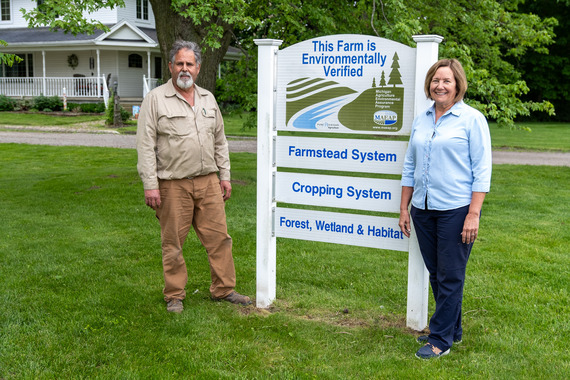
As fifth-generation farmers, Laurie and Jim Isley know a few things about soil health. So when strong winds began eroding the sandy topsoil at Sunrise Farms in Lenawee County, the Isleys leaned into regenerative agriculture.
Today, the Isleys use conservation tillage, strip-till and no-till farming, and cover crops at their MAEAP-verified, thousand-acre corn and soybean farm. These regenerative practices help reduce erosion, protect soil health, and improve the efficiency and productivity of their farming operation.
Over time, the Isleys expanded their approach to include conservation tillage, strip-till and no-till farming, and cover crops. These practices help reduce erosion, protect soil health, and improve efficiency while maintaining a productive operation.
Regenerative Agriculture in Practice
The Isleys began addressing wind erosion by installing windbreaks and leaving crop residue on their fields. Rather than tilling under corn stalks and soybean stubble each fall, they began planting directly into the residue in the spring, keeping the soil covered and reducing disturbance.
A dozen or so years ago, the Isleys added cover crops to their management strategy. They typically aerially seed cover crops into growing crops in August, allowing the cover crops to establish before harvest. The cover crops continue growing into the fall and are terminated in the spring before planting.
The Isley’s goal is to keep the soil covered year-round, protecting it from erosion while supporting soil structure and biological activity.
Soil Health and Water Quality
For the Isleys, healthy soil is the foundation of a productive farm. They recognize the importance of maintaining soil structure, organic matter, and the organisms that support a living soil system.
“The soil is really the lifeblood of what we do,” said Laurie. “So, if we protect that and take care of the soil, then the farm continues to take care of us.
With technical assistance from local conservation districts, the Isleys have continued to learn about the broader benefits of conservation practices for water quality, an especially important consideration given the farm’s location in the Western Lake Erie Basin. Laurie said they are always mindful of the potential impacts of runoff and consider how their management decisions affect the surrounding watershed.
Balancing Profitability and Sustainability
The Isleys have found that while conservation practices have not dramatically increased yields, they have benefited the farm’s bottom line. Yields have remained consistent, however, reducing the number of passes across the field has helped lower fuel and labor costs.
By using strip-till and no-till practices, the farm reduces the time and expense required to plant crops. These efficiencies are particularly valuable during narrow windows when field conditions are suitable for planting.
Laurie encourages other farmers to view regenerative agriculture as both an environmental and a business decision. Farmers don't need to adopt every practice at once; they can start small, evaluate the results over several years, and build on what works for their operation.
Passing on a Legacy of Stewardship
The Isleys' commitment to conservation reflects their desire to protect the land for future generations. Their son, Jacob, represents the sixth generation and has worked on the farm since graduating from college. With relatives raising their own families nearby, the Isleys see soil conservation as an investment in their farm's future.
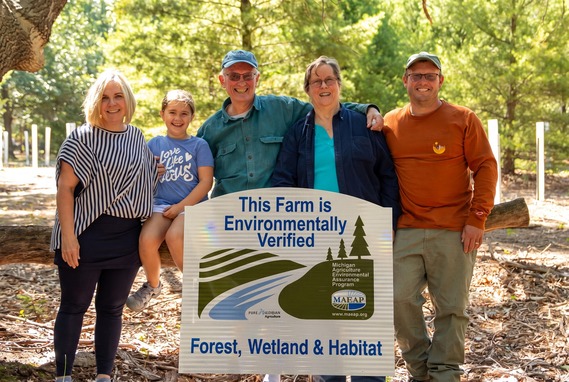
Jim Sherrill is no stranger to conservation. He worked for an environmental consulting firm that helped farmers reduce agricultural runoff pollutant loads and improve water quality in Saginaw Bay. So when Jim and his family bought an additional 35 wooded acres next to their property near Manistee in 2019, he knew the Manistee Conservation District (MCD) could help him protect his forestland.
“Our 35 acres consisted of both native and invasive forest that had not been touched for over 50 years,” said Jim. “My son Jason and I wanted to convert the overgrown forest into an accessible one and improve wildlife habitat. We asked ourselves what we could do to improve that. I worked with conservation districts a long time ago in the Saginaw Bay region, so I knew they could help.”
When Jim contacted the MCD, they put him in touch with MDARD’s Forestry Assistance Program (FAP). FAP works with conservation district foresters, like Josh Shields, who provide technical guidance and resources, and can refer landowners to private sector professionals for forest management plans and Natural Resources Conservation Service (NRCS) programs.
“The meeting with Josh turned out to be very informative and game changing on what we could do with the attached forested area,” said Jim. “He provided technical guidance, expanded our forest objectives, and explained that there were NRCS cost-share programs to improve conservation and wildlife habitat in our forested area.”
With the help of Josh, Jim and Jason enrolled in the Environmental Quality Incentives Program, which put him in contact with a private sector forester who helped draft their forest management plan. After completing that plan in 2021, they signed two different five-year Conservation Stewardship Program (CSP) contracts with NRCS. Those contracts provided cost-share to remove invasive species, assist with forest management, and support wildlife habitat.
“We completed our first CSP in 2025. We removed invasives like autumn olive, Japanese barberry, black locust, and garlic mustard [and] planted native trees, shrubs, grasses, wildflowers and milkweed to provide habitat,” said Jim. “Our current CSP contract ends in 2030. We will plant more native plants, create wildlife habitat, and thin out surrounding trees to provide open areas for our stands of the rare American Chestnut trees.”
“We were already doing a lot of great work with Josh,” said Jim. “Getting verified in the FWH System for MAEAP seemed like a next step. Our existing work performed under our forest management plan and CSP fully supported the requirements of MAEAP. We worked with the MCD Technician and got our environmental verification in 2023.”
The FWH System was created to help landowners sustain their forest health; protect air, soil, and water; create land management plans; and take care of natural resources.
“Jim and Jason were doing all the hard work, so MAEAP was a natural fit,” said Josh Shields. “MAEAP is not just a program for farmers, but also for landowners who manage non-agricultural habitats such as forests. By participating in MAEAP, they become even better stewards of the environment.”
Jim and Jason are grateful for help from the MCD, MDARD, private sector forester, and NRCS. They are proud of the work they have done for Sherrill Forest and are excited about the future.
“As a result of all of the conservation and wildlife habitat activities implemented by the Sherrill Family, our family now takes great pride and refers to our forested area as the Sherrill Forest,” said Jim. “We would recommend any landowner that has a forested area, and is thinking of implementing conservation practices, and creating or preserving wildlife habitat, to give your local conservation district a call.”
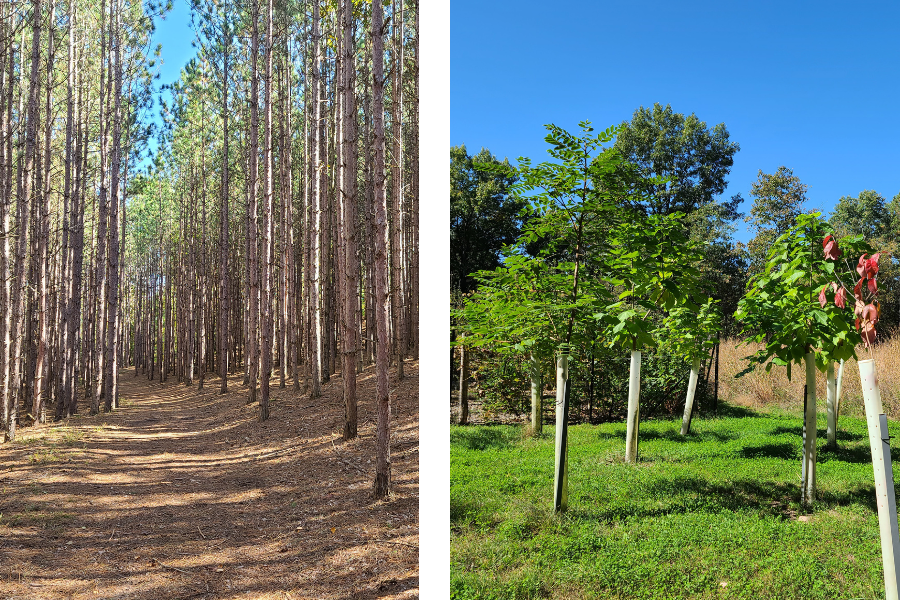 (Left) Thinning of the red pine trees and road that provides access to the forest. (Right) Seedings growing out of protective tubes. Native grasses, wildflowers, and milkweed pictured in a field behind the seedings.
Stewardship Strategies
By Madelyn Celovsky, Conservation Agronomist Educator, Michigan State University Extension
Do you struggle to get cover crops seeded after harvest? Interseeding cover crops may be for you.
With a short growing season, it can be difficult for Michigan farmers to get cover crops established. By overseeding cover crops into standing corn or soybeans, farmers can seed cover crops earlier. Doing so increases potential cover crop growth and takes cover crop seeding off the already long, post-harvest to-do list.
Airplane and modified high clearance ground sprayers are the typical methods for interseeding over crops at leaf drop/senescence. Unmanned aerial vehicles (UAVs) are a newer technology that is becoming more widely available for this purpose. Thanks to the Michigan Department of Agriculture and Rural Development (MDARD) supported on-farm research trials in 2024-2025, Michigan State University (MSU) Extension has updated recommendations for successful overseeding into corn and soybeans.
Target late August to mid-September when corn is just starting to turn or just before leaf-drop for soybeans. Because drilling or incorporating seed is not possible while the cash crop stands, it is crucial to time seeding before rain.
Species and seeding rates
The following list is not exhaustive, but it provides a good starting point for species that can increase your chances of establishment success when overseeding into corn or soybeans in September. To look at more species and rates, MSU Extension suggests exploring the Midwest Cover Crop Selector Tool, which ranks species for their compatibility with interseeding (late and early). To compensate for anticipated stand loss due to reduced seed to soil contact, rates should be higher than the seeding rate used for drilling or broadcasting with incorporation.
-
Grasses
-
Annual ryegrass (18-22 pounds (lbs.) pure live seed (PLS) per acre).
-
Cereal rye (50-100 lbs. PLS per acre). MDARD-funded research on farms in the Western Lake Erie Basin (WLEB) tested cereal rye rates overseeded into corn and soybeans at 15 lbs. per acre (in a mix with clover and radish), 35 lbs. per acre and 70 lbs. per acre. The 70 lbs. per acre seeding rate, produced greater biomass and canopy cover than lower seeding rates at two of the three sites.
-
Oats (35-70 lbs. PLS per acre) can also establish well in the fall, though they generally will not overwinter.
-
Brassicas: Only oilseed radish was tested in Michigan. This species can establish well in the fall but does not overwinter. Other small-seeded brassicas that may be suited for overseeding but have yet to be tested in Michigan trials include rapeseed and camelina.
-
Legumes: Only crimson and red clover were tested in overseeding trials in Michigan. While crimson and red clover have successfully established in previous early interseeding trials, successful clover establishment from overseeding is still elusive and highly dependent on September rainfall. Red clover overseeded in September in the 2024-2025 WLEB trial did not successfully establish, likely due to dry seeding conditions and limited rainfall for three weeks following seeding.
-
Mixtures: Overseeding multiple cover crop species can help achieve multiple goals. For example, radish offers quick fall growth scavenging fall soil nutrients while annual ryegrass grows slowly in the fall but can scavenge spring soil nutrients. To protect the soil in both fall and spring, seed two lbs. per acre radish with 10 lbs. per acre annual ryegrass. When seeding mixtures, single species seeding rates or grasses and brassicas should be cut by 30-50%. When seeding a legume in a mixture, keep the full single species seeding rate to maximize nitrogen fixation.
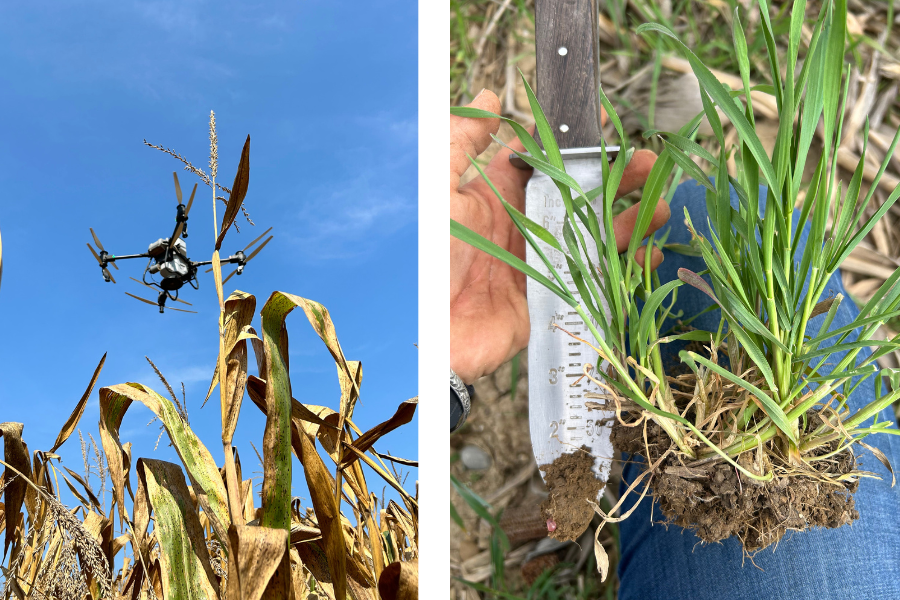 (Left) UAVs/drones are a new tool to fly on cereal rye seed over standing corn. (Right) Cereal rye seeded by UAV/drone and airplane in September 2024 for MDARD-funded on-farm research in the Western Lake Erie Basin. Aboveground biomass and canopy cover were measured in the spring before cash crop planting. Photo credit, Madelyn Celovsky
There’s no such thing as an off-season for farmers. As harvest winds down across Michigan, winter offers an opportunity to shift from fieldwork to planning, recordkeeping, and professional development. Taking time to review farm practices, prepare for upcoming requirements, and explore new research and technology can help farmers protect natural resources while improving soil health and farm productivity.
Here are a few ways to make the most of the winter months:
-
Maintain pesticide certification credentials. Complete any required continuing education and testing to keep certifications current before spring fieldwork begins.
-
Explore educational opportunities and new technology. Attend workshops, connect with agricultural experts, and learn about the latest research and tools that can improve soil health, crop yields, and farm efficiency.
-
Organize farm records. Review and update records related to nutrient applications, pesticide use, conservation practices, and other farm activities to support planning and compliance.
-
Remediate risk. Review potential environmental risks on the farm and take steps to address concerns before the next growing season.
Taking the time to plan and improve farm management now can make a big difference when the next growing season begins.
|
Field Notes
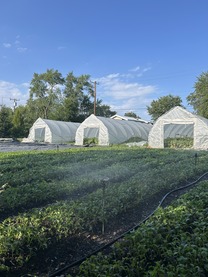
Farmers in Detroit are showing how regenerative agriculture can strengthen neighborhoods, expand food access, and support biodiversity.
“Our goal is to demonstrate how regenerative agriculture can thrive in an urban environment while contributing to neighborhood food access, biodiversity and long-term stewardship of the land,” said Ashley Atkinson, co-director of Keep Growing Detroit.
Network farmers are implementing practices that improve soil health, conserve water and build resilience to changing environmental conditions. These include composting, reduced tillage, cover cropping, permanent growing beds, crop diversity and pollinator habitat.
The network also creates space for growers to share experiences and address challenges unique to urban agriculture. Many describe it as rebuilding relationships with the natural world, with one another and with the land. By strengthening these connections and improving soil health, the network aims to support resilient farm businesses, neighborhood food access and biodiversity.
The Detroit Regenerative Growers Network demonstrates how regenerative agriculture can thrive in an urban setting while contributing to healthier soils and stronger communities.
|
Grower Opportunities
Michigan Agriculture Advancement’s ninth annual Underground Innovations event will take place February 3–4, 2027, at the Bavarian Inn Lodge in Frankenmuth. The two-day event features innovative farmers sharing practical experiences with diversified farming systems, cover crops, no-till, grazing, food-grade grains and emerging crop markets, along with opportunities for networking.
The Michigan Craft Beverage Council will host the fourth annual Michigan Craft Beverage Summit in Muskegon from March 22 to 24, 2027. This year’s summit will offer valuable networking, educational, and marketing opportunities for growers of barley, hops, rye, wheat, wine grapes and other craft beverage inputs. The agenda will includea session on regenerative agriculture for perennial crops.
The NextGen Crop Insurance Pilot continues to develop a model for incorporating soil health practices into insurance pricing, giving farmers greater flexibility and the potential to save money while building long-term farm resilience.
The pilot’s Phase I findings confirm that soil health-aligned insurance can help Michigan farmers save money while accurately reflecting field-level risk. Phase II will expand enrollment, continue validating soil health data and compare costs with federal crop insurance buy-up options ahead of the March 15, 2027, crop insurance deadline.
Interested in learning more? Visit NextGen Crop Insurance webpage. The pilot is available for the 2027 crop year to eligible corn and soybean producers in Huron, Saginaw, Sanilac and Tuscola counties who use cover crops, crop rotation and no- or low-till practices.
In Case You Missed It
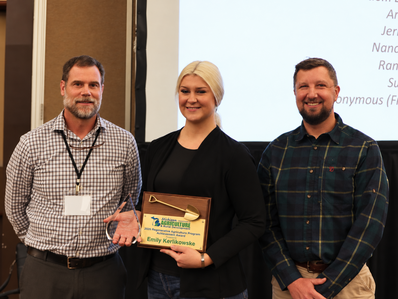
MDARD awarded Emily Kerlikowske with the MAEAP Award of Excellence and the Regenerative Agriculture Program’s (RAP) Achievement Award for her exemplary work with landowners. The awards were given at the Michigan Association of Conservation Districts Conference in Lansing on October 22, 2026. Emily is the Conservation Technician for the Berrien Conservation District and serves Berrien and parts of Cass counties.
The MAEAP Award of Excellence is given to a conservation technician for their outstanding customer service, going above and beyond the duties of a technician, and achieving the most MAEAP verifications this year.
The RAP Achievement Award is given annually to a conservation technician who effectively champions regenerative agriculture in their region and supports farmers with soil health assessments, samples, and management plans that lead to increased adoption of regenerative practices.
Emily’s hard work, dedication to her producers, strong organizational skills, and unwavering commitment to Michigan agriculture has brought added value to the programs and her producers. Congratulations, Emily – and thank you for your support of Michigan farmers and landowners!
MAEAP Assessments outline the requirements a farm or property must meet to become verified in the Michigan Agriculture Environmental Assurance Program.
Interested individuals may submit input on the assessments via:
-
Email:
-
Website:
-
U.S. Mail:
-
Post written comments to MDARD MAEAP, P.O. Box 30017, Lansing, MI 48909
|