 Welcome to the Soil and Agricultural Stewardship Newsletter – the Michigan Department of Agriculture and Rural Development’s (MDARD) online publication providing Michigan farmers and landowners with the latest news, updates, and resources related to Regenerative Agriculture Program (RAP) and the Michigan Agriculture and Environmental Assurance Program (MAEAP)!
Log Cabin Livestock
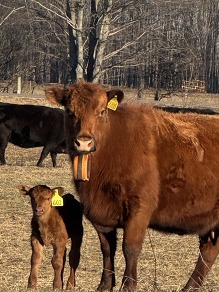
For more than 50 years, Benjamin and Denise Bartlett have raised cattle and sheep at Log Cabin Livestock, their farm in Michigan’s Upper Peninsula, which is MAEAP-verified in the Cropping, Livestock, and Forest, Wetland & Habitat Systems.
The farm runs a mixed herd of about 85 cows and a 150-ewe flock across roughly 800 acres. Built around a grass-based system rooted in regenerative agriculture the operation focuses on growing and using as much forage as possible during the summer, then marketing livestock in the fall. By matching production to the growing season, the Bartletts keep winter feed costs in check while getting the most out of their ground.
Regenerative Agriculture in Practice
Log Cabin Livestock’s management approach reflects decades of experience balancing profitability and long-term stewardship.
“We’ve learned to work with the land, not against it. When you see soil, plants, and livestock as one system, you start making decisions that last, not just for this season, but for the long haul,” said Benjamin Bartlett. “If we take care of that cycle, it takes care of us. And at the end of the day, a regenerative system must do both, support the land and keep the farm profitable.”
Grazing management is central to that system. Through rotation and careful pasture use, the Bartletts maintain forage productivity while improving soil health. They see grazing as “exercise for plants,” helping drive regrowth, strengthening roots, and supporting biological activity in the soil.
Soil Health and Nutrient Cycling
The Bartletts emphasize the role of microbes and fungi in nutrient cycling, as healthy soil biology helps ensure more productive, resilient pastures.
During the winter, they feed out hay on pasture, so manure and organic matter are spread naturally. That cuts down on fertilizer needs while improving soil structure maintaining long-term productivity across the farmland.
Livestock Integration and Diversity
Log Cabin Livestock takes an active approach to livestock, using managed grazing to support pasture health, improve nutrient cycling, and keep the operation running smoothly. Raising both cattle and sheep also allows them to make better use of available forage while diversifying income.
The Bartletts have shaped their strategy around working with the Upper Peninsula’s harsh climate. They raise calves and lambs when forage is abundant and sell them in the fall rather than carried through the winter. That reduces costs during the toughest part of the year and keeps the system in line with what the land can support.
Technology and Innovation
While the Bartletts have built their farm on long-standing principles, they continue to make practical updates. They recently adopted a virtual fencing system using GPS-enabled collars, which allows them to adjust grazing without using time-consuming temporary fencing. In an area where snow can take a toll on infrastructure, they hope this technology can help cut down on some physical labor and improve efficiency.
Balancing Profitability and Sustainability
Farming in the Upper Peninsula comes with challenges, especially around marketing and input costs. The Bartletts have addressed these challenges by building a regenerative system that balances economic viability with environmental stewardship.
Looking ahead, the Bartletts’ goal is to keep the operation profitable while improving flexibility and quality of life. By continuing to fine-tune grazing and adopting tools, Log Cabin Livestock shows how regenerative principles can work in a practical, day-to-day farm setting in Michigan’s Upper Peninsula.
|
Mitchell Cat Creek Farms
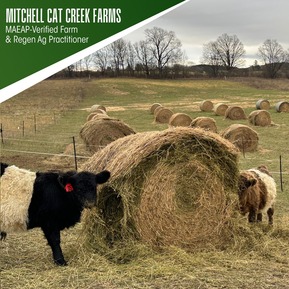
Mitchell Cat Creek Farms in Hersey is a grazing beef operation dedicated to regenerative agriculture and responsible land stewardship. The farm holds the distinction of being MAEAP-verified in all four of that program's systems.
Owners Jordan & Brandi Mitchell focus on building healthier soils and improving the long-term functionality of their farm by utilizing practices like managed grazing, winter feeding on pasture, and reducing disturbances. This leads to enhanced water infiltration and retention, increased organic matter, more plentiful diverse forages, increased wildlife habitat, and improved soil structure. Their goal is to strengthen their grazing beef operation while restoring and sustaining the land for future generations.
“We felt becoming MAEAP verified was an important step in showing that we are good stewards of the land and committed to meeting strong environmental standards,” said Brandi. “Our customers value knowing that we’re verified, and for us, it’s about making a lasting, positive impact through the way we farm.”
|
Schomaker Farms
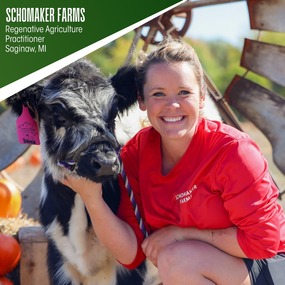
Since 2018, Schomaker Farms in Saginaw has been a growing hub for quality livestock, hand-harvested products, and educational programming for local schools and families. The operation is MAEAP-verified in the Farmstead and Cropping Systems.
Co-owner and operator Taylor Schomaker brings a thoughtful approach to the farm’s operation with a focus on soil health, responsible farming practices, and nutritious food. She leverages regenerative agriculture practices to restore and sustain the land while strengthening the connection between how food is grown and its impact on overall well-being.
“For us, regenerative agriculture is about stewardship—caring for our land, animals, and community for the long term,” said Taylor. “We want our farm to be a place where families can learn, connect, and see firsthand how sustainable practices make a difference.”
|
Russell Blueberry Farm & Nursery
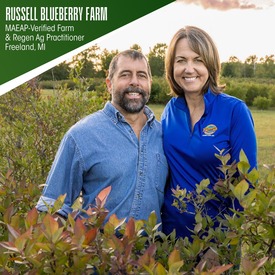
Russell Blueberry Farm & Nursery is a MAEAP-verified farm in Freeland that prioritizes sustainable practices and environmental responsibility.
The farm is dedicated to improving soil health as the foundation of its success, recognizing the demands blueberry production places on the land. By focusing on natural nutrient cycling and regenerative approaches, they work to replenish what is taken from the soil while strengthening long-term productivity. Their efforts support healthier soils, more resilient crops, and a farming system that benefits both the environment and future generations.
“Soil health is the foundation of sustainable agriculture,” said Co-owner Laura Russell Varhola. “My husband and I wanted to improve our soil health and be good stewards of our land. Growing blueberries demands a lot from the soil, so we aim to ensure the nutrients we take out to produce great-tasting blueberries go back in as naturally as possible. This not only benefits our land but also supports our farm’s long-term productivity.”
|
How Conservation Technicians Can Help Get You Started with MAEAP
If you’re considering participating in the Michigan Agriculture Environmental Assurance Program (MAEAP), Conservation Technicians offer free, confidential support to help you get started.
Conservation Technicians work one-on-one with farmers and landowners, providing the expertise needed to complete Environmental Risk Assessments. These assessments evaluate farmstead operations, cropping systems, livestock operations, and natural habitats to identify potential risks across the entire site. Participation is flexible and completing an assessment does not require you to make changes. Clients (farmers and landowners) can progress as far as they feel comfortable or as needed to meet individual farm or property goals.
After an initial assessment, you will work with your Conservation Technician to develop an Improvement Action Plan to reduce any identified environmental risks. This may include alternative practices, equipment updates, and potential sources of technical and financial assistance. Many improvements are simple and low-cost, while others can be phased in over time.
In the spring, Conservation Technicians commonly assist clients with risk-reduction practices such as:
-
Mapping sensitive areas like waterways, wells, and erosion-prone soils
-
Testing drinking water for nitrates and bacteria
-
Updating farm emergency plans
-
Reviewing pesticide drift management plans
-
Conducting soil tests to guide nutrient applications
Once you’ve addressed the risks identified in your plan, you can request MAEAP system verification. Being verified demonstrates that your operation follows recognized environmental standards and best practices. Verification may also open the door to incentives and provide added peace of mind that your farm or property meets state and federal environmental regulations.
Michigan’s agriculture community continues to show strong participation in MAEAP verification, with nearly 2,000 sites (as of April 30, 2026) across the state committed to environmental stewardship and best management practices.
As of this newsletter’s publication, there were 1,990 verified sites across Michigan. These sites represent farms and properties that together include 3,885 verified:
-
Forest, wetland, and habitat systems
Top Five Counties by Verified Sites
Several counties continue to lead the way in verified participation:
-
Allegan County – 100 verified sites
-
Huron County – 85 verified sites
-
Tuscola County – 85 verified sites
-
Sanilac County – 82 verified sites
-
Van Buren County – 72 verified sites
Farm Size Breakdown (FY21–FY25)
Looking at farm acreage among verified farms statewide (excluding forest, wetland, and habitat-only properties), participation spans operations of all sizes:
|
Hands-on Learning
Looking to see regenerative practices in action, hear directly from fellow farmers, or pick up practical ideas you can apply on your own operation? Through support from the Michigan Department of Agriculture and Rural Development (MDARD), workshops, field days, and farmer meetups across Michigan are creating more opportunities for hands-on learning and farmer-to-farmer connection.
At these events, you can:
-
See proven regenerative practices in action on working farms
-
Hear firsthand about the challenges and opportunities from fellow farmers
-
Pick up practical ideas you can try on your own operation
-
Build connections through farmer-to-farmer networking
Whether you're experimenting with new approaches or looking to fine-tune your system, these hands-on learning opportunities offer real-world insight you can use.
Last Food Mile Grants Boost Regen Ag, Local Food Access
Following overwhelming interest from Michigan farmers and agribusinesses, MDARD announced 21 Last Food Mile grants last week to invest in the refrigerated transportation necessary to give more Michigan families access to nutritious, affordable, locally grown foods. These grants will support projects that involve more than 300 Michigan food producers, most of whom implement regenerative agriculture practices.
What does this mean for regenerative farmers Michigan farmers in Michigan? We asked Kyle Rasch, director of Third Leaf Farm in Greenville.
"The Last Food Mile grant is a meaningful step forward for Third Leaf Farm and our wider grower network, as it strengthens our cold-chain and delivery capacity so Michigan-grown regenerative food can move more reliably from orchard to table, across more months of the year, and into more communities that need it," said Kyle. "Investing in locally grown foods here in Michigan keeps farms economically viable, keeps food dollars circulating close to home and builds the practical infrastructure that helps our state feed itself with fresher, higher-quality food."
Mason Lake Conservation District Farm Field Day Summer 2026
Jackson County Conservation District’s Regenerative Agriculture Field Day
Berrien County Conservation District’s Regenerative Agriculture Field Day
Saginaw County Conservation District's Blueberries: A Family Legacy
Eaton County Conservation District’s Pasture Walk with Joe Hetrick
Eaton County Conservation District’s Pasture Walk with Bridget Kavanagh
Eaton Conservation District’s Cropping System Field Day
Osceola–Lake Conservation District’s Healthy Soils for Strong Farms
Grand Traverse Conservation District’s Perennial Farm Ecosystem Conference
Contact your local Conservation Technician
Are you looking to get involved in MAEAP or RAP? Do you have questions about conservation practices or soil sampling help? Contact your local Conservation Technician today!
|