|
April 2026
Around the Table is produced by the Michigan Department of Agriculture and Rural Development’s (MDARD) Bureau of Food Safety and Animal Health to share important regulatory updates and program information. The newsletter will be shared periodically via email to licensed food establishments and will also be available on the department’s website. Please feel free to email article suggestions and feedback to MDARD’s Communications Team.
In this Edition:
|
|
|
All food establishment licenses expire on April 30 of each year. MDARD sent license renewal reminders for current licensed establishments earlier this year. Any license renewals postmarked or computer date-stamped after April 30 will be assessed a $150 late fee.
Renew your food establishment license online.
If you are notified because your renewal was late, promptly submit your late fee to avoid additional fines and penalties. Continued non-compliance will result in additional fines being assessed in addition to closure orders and other legal actions.
Please also remember that your food establishment license must be conspicuously posted in your food establishment. For additional information or questions, contact your MDARD inspector or MDARD’s Customer Service Center at 800-292-3939.
|
|
Resources
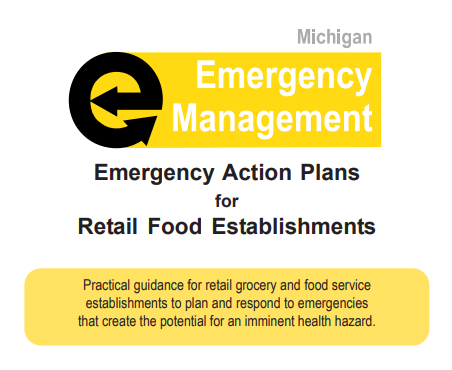
Springtime in Michigan can mean severe weather that can have a big impact on your food business. Make sure you are prepared when disaster strikes. MDARD’s Emergency Action Plan (EAP) provides practical guidance for retail grocery and food service establishments to plan and respond to emergencies that create the potential for an imminent health hazard, like interruption of electrical or water service, a contaminated water supply, sewage back-up, fire, flood, and more.
The EAP includes a checklist to help you start your emergency response, prepare an "emergency menu," maintain an inventory of single-service and single-use articles, and develop a business agreement with a bottled water supplier. The plan also outlines steps to take during a widespread emergency, such as locating public water supplies and developing a contingency plan for toilets.
Your MDARD food inspector is a great resource for information. If you do not have direct contact information for your inspector, please contact the department and provide the zip code for your food business.
|
|
Reminders
As a reminder, MDARD advises Michigan food establishments that unapproved food additives are illegal in Michigan. Psychoactive or psychotropic substances, when added to foods or dietary supplements and consumed, can affect perception, consciousness, cognition, mood and emotions and are not legal to use as food ingredients. Many food products claiming to contain these and similar ingredients may be inaccurately labeled and could produce unexpected or potentially harmful side effects.

Unapproved ingredients include non-noble forms of kava, kratom (including 7-OH), and other potentially harmful ingredients; psychotropic and/or psychoactive mushrooms like psylocibin and A. muscaria; and cannabis-based ingredients. Potential side effects of consuming these types of unapproved ingredients could include liver toxicity, seizures, elevated blood pressure and heart rates, reduction in motor skills and hallucinations.
These ingredients have not satisfied the criteria necessary for being listed on the generally recognized as safety (GRAS) list for use. Consumable products containing any form of these unapproved ingredients are considered adulterated according to the Michigan Food Law and the federal Food, Drug and Cosmetic Act (Sec 402(f)(1)(B)). Dietary supplements are defined as food under the Michigan Food Law and therefore are not allowed in the manufacturing, holding, distribution or sale of food in Michigan.
Many consumable products containing these unapproved ingredients have entered the market in recent years, although these products are unlawful and cannot be legally sold or produced in Michigan, or cross state lines.
Outside of marijuana regulations, any substance that will be added to food, drink or animal feed (including dietary supplements) must first be approved by the U.S. Food and Drug Administration (FDA) for that intended use. There is no legal path for manufacturing, selling or holding food products containing other psychoactive or psychotropic food additives in Michigan.
|
|
|

As spring arrives, staying on top of pest control in your food establish-ment is crucial. Foodborne diseases carried and transferred by pests remain a constant concern in the food industry.
Once inside a facility, pests become a health and safety hazard for employees and customers. These pests can be a source of pathogens and spoilage microorganisms, toxins, and allergens. Implementing preventive practices to keep pests out and using effective treatments for pests if they do get in can go a long way toward keeping your facility clean and pest-free.
Under the Michigan Modified Food Code, food establishments must actively control pests, specifically by preventing their entry and eliminating harborage areas. Key requirements include maintaining the integrity of the facility; using authorized pest control devices properly; and ensuring that no pests are present in food or on food contact surfaces. If pests are found, immediate corrective action must be taken to remove them and prevent future infestations.
Pests can create hazards in food establishments in two ways: direct incorporation of filth from the bodies of pests into food; and contamination of food surfaces by the metabolic products released by those pests and the organisms they carry (e.g., feces and urine).
Take these steps to effectively exclude pests from your food establishment:
- Seal entry points to prevent pests from entering.
- Conduct regular deep cleans of your facility to remove food debris, spills, and crumbs that attract pests.
- Store food properly – off the floor, in airtight containers, sealed packaging, refrigerated or frozen for perishable products, etc.
- Use “first in, first out” inventory management.
- Implement traps, baiting, and professional pest control services to capture and eliminate pests effectively.
- Clean surfaces, equipment, and storage areas regularly.
- Focus on employee hygiene, including clothing and food they may bring into your facility.
As a reminder, sanitation eliminates food sources for pests. Keeping food contact surfaces clean and sanitized and focusing on employee hygiene can help keep pests under control. Exclusion techniques help to keep pests out. If pesticides are used, they must be used according to their labels and stored safely, away from food storage and preparation areas.
To find a licensed pesticide applicator, visit MDARD’s licensing website. Information and resources can also be found on the department’s Integrated Pest Management web page.
|
|
|
|
Millions of Americans have food allergies and may experience adverse reactions to products that contain food allergens. While most allergic reactions cause mild symptoms, some are severe and may even be life-threatening.
The Food Allergy Safety, Treatment, Education, and Research (FASTER) Act recognizes nine major food allergens—milk, eggs, fish, Crustacean shellfish, tree nuts, peanuts, wheat, soybeans, and sesame. These foods account for most serious allergic reactions in the United States. Manufacturers must clearly declare these allergens on food labels.
Sesame was recently added to the “Big Nine.” Because some packaged foods can have a long shelf life, it’s hard to say when all food products will have updated labels, so double check your products for proper sesame seed labeling.
To protect people with food allergies and other food hypersensitivities, MDARD and federal agencies enforce regulations, complete inspections, and sample products to ensure companies list all ingredients on packaged foods and beverages. For certain foods or substances that cause allergies or other hypersensitivity reactions, there are more specific labeling requirements.
See the FDA’s Food Allergies Website and the FDA’s Food Allergens Social Media Toolkit for more information.

|
|

As spring weather starts to arrive in Michigan, more people are out and about with their pets. As a reminder, pets who are not service animals, including emotional support animals, are not allowed in licensed food establishments in Michigan.
The Americans with Disabilities Act (ADA) requires every business to allow people with service animals to enter and go anywhere the public is normally permitted to go. However, pets and non-service animals are not allowed to enter food establishments due to risks to food safety. Not only is it against the law to allow pets into food establishments, it’s common for other customers to complain about the animals. MDARD has recently seen an uptick in the number of complaints of customers bringing pets into food establishments such as grocery stores.
What is a service animal? A service animal, as defined by the ADA, is a dog that has been individually trained to do work or perform tasks for an individual with a disability. The task(s) performed by the dog must be directly related to the person’s disability.
Establishment operators have a duty to exclude pets and other non-service animals from entering their licensed food establishment. Animals such as therapy animals, comfort animals and companion animals are NOT protected by the ADA and are NOT allowed to enter food establishments such as retail grocery stores.
Operators of food establishments should be aware of the potential liability of allowing customers to bring pets into their businesses, as well as the liability of excluding people with bona fide service animals.
In situations where it is not obvious that the dog is a service animal, staff may ask only two specific questions:
(1) Is the dog a service animal required because of a disability?
(2) What work or task has the dog been trained to perform?
Staff cannot request any documentation for the dog, require that the dog demonstrate its task, or inquire about the nature of the person’s disability. You should also inform your customers that service animals are welcome, but pets are not.
Some disabled people who need service animals consider it a disservice when businesses allow untrained animals to enter these buildings as they may interfere with the service animals’ work. For more information visit the Michigan Department of Civil Rights Service Animal web page.
|
|
|
Michigan Food Systems
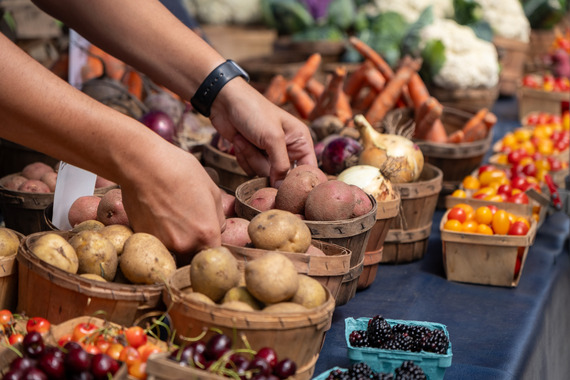
MDARD's innovative Farm to Family Program is working with partners statewide to strengthen Michigan's middle-of-the-supply chain agri-food systems. In practical terms, this means creating more opportunities for Michigan farmers to sell in their communities while giving Michigan families more access to nutritious, locally grown foods.
Since launching 18 months ago with bipartisan support from the state legislature, the Farm to Family Program has introduced three new grant programs:
- The Food Hubs and Farm Stops grants have spurred more than $1 million of local food purchasing while moving more than 140,000 pounds of local foods to Michigan consumers.
- The Last Food Mile grants will help Michigan farmers and farm businesses invest in transportation infrastructure to get locally grown foods to market.
- The Regenerative Value Chains grants will expand market opportunities for farmers who implement regenerative agriculture practices.
In addition, the program launched the Good Food for Michigan project to help Michigan institutions like community colleges and hospitals source healthy foods grown by Michigan farmers.
If your business or institution is interested in making more locally grown foods available to Michigan families, visit the Farm to Family Program's website and keep an eye out for upcoming outreach events.
|
|
|
|
|