October 2017
Oct. 17 - JETCC - High Velocity Sewer Cleaning, Auburn, DEP 6 WW TCH
Oct. 18, 23, 25, 30, & Nov. 1 - MRWA - VSWS/Class 1 Water Operator Exam Preparatory Course, Newport & Richmond, WOB 25 TCH
Oct. 19 - JETCC - Automation Overview: A practical Guide to the Industrial Internet, Portland, DEP 6 WW TCH, WOB 6 TCH
Oct. 24 - JETCC - High Velocity Sewer Cleaning, Caribou, DEP 6 WW TCH
Oct. 25 - JETCC - Pump Station Operation & Inspection, Presque Isle, DEP 6 WW TCH, WOB 6 TCH
Oct. 25 MWUA - GIS Solutions for Water Utilities, Gardiner, DEP 3.5 WW TCH, WOB 3.5 TCH
Oct. 25 Thru 27 - NEWEA - Northeast Residuals & Biosolids Conference, Burlington VT, WW 15 TCH
Oct. 26 - JETCC - High Velocity Sewer Cleaning, Bangor, DEP 6 WW TCH
Oct. 30 Thru Nov. 1 - NEIWPCC - O & M of Wastewater Collection Systems with Optional NEWEA Exam, Portland, DEP 15 TCH
Nov. 1 - MRWA - Capital Improvements Plan (CPI), Lewiston, DEP 4 WW TCH, WOB 4 TCH
Nov. 1 - JETCC - Introduction to Membrane Filtration & Membrane Bioreactors, Oxford, DEP 6 WW TCH, WOB 6 TCH
Nov. 2 - JETCC - Hands on Nutrient Removal Using Process Control Simulators, Saco. DEP 6 WW TCH
Nov. 6 Thru 8 - NEIWPCC - Advanced Activated Sludge Process Control & Optimization, Portsmouth NH, DEP 18 WW TCH
Nov. 8 - JETCC - Management Candidate School (MCS) 11 Month Training Program, Portland
Nov. 15 - JETCC - Basic Math for Operators, Kennebunk, DEP 3.75 WW TCH, WOB 3.75 TCH
Nov. 16 - JETCC - Resolving Illicit Connections & CSO's, Brewer, DEP 6 WW TCH, WOB 6 TCH
Nov. 17 - JETCC - Evaluating Clarifiers Performance with John Esler, Farmington, DEP 6 WW TCH
Nov. 28 - JETCC - In-Line Analytical Instruments, Bar Harbor, DEP 6 WW TCH, WOB 6 TCH
Nov. 29 - JETCC - In-Line Analytical Instruments, Fairfield, DEP 6 WW TCH, WOB 6 TCH
Nov. 30 - JETCC - In-Line Analytical Instruments, York, DEP 6 WW TCH, WOB 6 TCH
Dec. 5 Thru 7 - MRWA - 37th Annual Technical Conference & Tradeshow, Bangor, Variable TCH
Jan. 21 Thru 24 - NEWEA - 2018 Annual Conference & Exhibit, Boston MA, Variable TCH
Feb. 6 & 7 - MWUA - 92nd Annual February Meeting & Tradeshow, Portland, Variable TCH
1. Alkalinity is reported as?
a. Milligrams per kilogram CaCO3
b. Milligrams per liter CO3
c. Micrograms per liter CaCO3
d. Milligrams per liter CaCO3
2. Oily matter, suspended solids, or precipitates may coat pH electrodes and cause sluggish response. To overcome these interferences:
a. Pretreat the sample with trichlorotriflouroethane (TCE) to remove oily residue
b. Filter the sample before analysis
c. Periodically clean the electrodes with warm soapy water or dilute nitric acid
d. Wash the electrode with alkaline-based buffer daily
3. The “C” in CBOD stands for?
a. Carbonaceous
b. Chemical
c. Combined
d. Compound
4. The difference between CBOD and BOD test is?
a. Incubation period
b. Volume of sample used
c. Incubation temperature above 20 degrees C
d. Addition of nitrification inhibitor
5. What is the minimum DO uptake that will produce the most reliable results for the BOD test?
a. 0.2 mg/L
b. 1.0 mg/L
c. 2.0 mg/L
d. 2.5 mg/L
6. When collecting samples for bacteriological examination, thiosulfate (Na2S2O3) is used to?
a. Buffer the pH to 7.0
b. Buffer the pH to 8.5
c. Oxidize the combined chloroform
d. Neutralize any remaining disinfectant
7. For Whole Effluent Toxicity (WET), what test would assess toxic effects on different life stages and/or growth and reproduction of an organism?
a. Acute test
b. Chronic test
c. Lowest observed effect test
d. No observed effect test
8. Fixed solids are defined as solids that:
a. Pass through a glass fiber filter
b. Are lost upon ignition at 550 degrees C +/- 50 degrees C
c. Remain fixed on a glass fiber filter drying at 105 degrees C
d. Remain after ignition at 550 degrees C +/- 50 degrees C
9. How is the theoretical amount of dissolved solids in raw wastewater determined?
a. Adding settleable solids to the volatile solids
b. Running the total solids test
c. Subtracting settleable solids from the total solids
d. Subtracting suspended solids from the total solids
10. What is the name of the procedure used to check the strength of a titrant?
a. Titration
b. Standardization
c. Concentration analysis
d. Normality determination
11. Laboratory glassware that meets U.S. specification for certified glassware is designated as?
a. Class A
b. Class 1
c. Analytical grade
d. TC or TC
12. A desiccator is used to?
a. Evaporate moisture from samples or chemicals
b. Filter SS
c. Prevent moisture from entering the sample
d. Weigh solids to the nearest milligram
Kudos!
At the MeWEA conference on September 21, 2017, the Department of Environmental Protection presented a Certificate of Achievement to The Portland Water District Wastewater Operations Section for outstanding management and operation of the PWD wastewater systems and their contributions to the wastewater treatment profession.
Congratulations and thank you for your excellent work to protect and improve the waters of the great State of Maine!
brian.w.kavanah@maine.gov

The Water Warriors Jobs Initiatives is a joint effort by the
New Hampshire Water Pollution Control Association (NHWPCA) and the Maine Water
Environment Association (MEWEA) to recruit and retain returning and retiring
U.S Armed Forces veterans into the drinking water and clean water infrastructure
fields.
Many skills learned in the Armed Forces, particularly with
equipment maintenance and science based programs, translate well into a
successful career protecting the one thing no one in our country can live
without, clean water. At the same time, many of our most qualified
water/wastewater operators are reaching retirement age, leaving the industry
with a labor shortage, not to mention the imminent loss of decades of
institutional knowledge.
The Water Warrior Jobs Initiative seeks to tackle these two
problems by promoting the water/wastewater field as a desirable career options
for returning veterans. The objectives
include:
- Providing education and training opportunities,
- Streamlining the certification process for our
veterans, and
- Providing placement assistance and internships.
This initiative will require the coordinated efforts of
industry leaders, veterans’ organizations, and government agencies, but the end
result, getting veterans into good paying jobs while serving their communities,
is worth it.
For example, the group has been attending job fairs in Maine and plans to coordinate with other veterans' groups and job initiatives, such as Maine's "Hire a Vet" program.
The timing has never been more opportune to provide those
who served our country with a career that will provide for their future, while
still allowing them to serve their local communities. If you are interested in
getting involved in this exciting effort, or want to learn more about providing
an internship at your facility for a returning veteran, the MEWEA contact is Peter
Goodwin at
peter.goodwin@tedberrycompany.com.
|
Thanks to all facilities that participated in DMR-QA Study 38. For those who failed a parameter, retests and corrective action reports are due to DEP October 27, 2017.
I wanted to share the results with you for this year. There were 92 facilities in the study, including all majors and selected minors. Twenty facilities failed an analyte, which is 22% of participants. This was better than last year, where 27% of facilities failed an analyte, but more than 2015 where 18% of facilities had at least one failure.
For 2017, no facilities failed more than one analyte, whereas for 2016 and 2015 there were four facilities that failed more than one parameter.
There were three facilities that did all their testing correctly, but transcribed the wrong value from their bench sheet to the PT report, which resulted in “Non-Acceptable” results. This shows the value in data analysis and validation, which should include having another person check the analyst’s work and reporting.
For the failures, I broke down the percentage for each analyte so you can see where most facilities have difficulties passing DMR-QA:
• BOD – 24%
• Fecal / E-Coli – 12%
• pH – 18%
• Settleable Solids (SS) – 12%
• Total Residual Chlorine (TRC) – 35%
• TSS – 18%
In the next few months I will write articles addressing each analyte, point out areas of concern, and make suggestions for passing the test.
Comments I have received include having an “artificial” sample that behaves differently than the real thing, (i.e. settles more quickly), making dilutions that are normally not done with routine testing, and using different glassware and reagents that you normally don’t use on a routine basis.
Still, the testing does show where equipment or technique may need attention. New analysts may need additional training, glassware may not be cleaned properly, instruments may need to be calibrated or replaced, or DI water may be shown to be contaminated. And if a facility cannot pass DMR-QA after repeated attempts, they need to use a commercial lab until they show competency in their testing.
Remember, QA/QC should be done every time you work in the lab, not just once per year. You can always purchase additional standards to test yourself on a routine basis, such as the Universal Wastewater Standard. And there are also many guidance documents and training videos provided by the PT labs free of charge to help with common DMR-QA problems.
 Request to Remove User from Permit
I’ve had some questions about what to do when a NetDMR user no longer needs to have access to a Permit ID for some reason (generally retirement or moved on from facility). September’s O&M NetDMR Update had instructions on how to request removal of Signatory access rights; this month’s update will outline how to remove Permit Administrator, Edit, and View access.
For Deleting Permit Administrator, View, & Edit User Access Rights
More detailed instructions can be found starting on page 39 of the NetDMR Permittee and Data Provider User Guide (2012) – which can be found on the NetDMR Zendesk: https://netdmr.zendesk.com/hc/en-us.
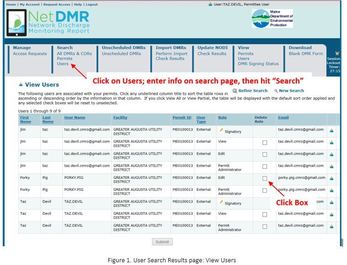
As a Permit Administrator, you can delete permit administrator/edit/view rights for a user who has access to your permits through the View Users page shown in Figure 1 by following these steps:
|
 1. Log into your CDX/NetDMR account.
2. Click on Users under the Search menu. Enter the name (full or partial) for the user of interest, and then hit search. Locate the user of interest on the User Search Results page (Figure 1) and click to create a check in the box under the Delete Role column of that row.
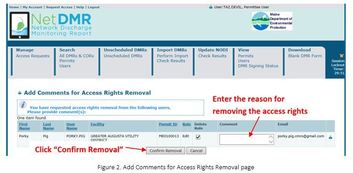
3. The Add Comments for Access Rights Removal page will appear (see Figure 2).
a. Enter the reason for removing the access rights into the Comments field (e.g., This employee is no longer working for this facility), then click on Confirm Removal to continue, or click Cancel to return to the View Users page.
|
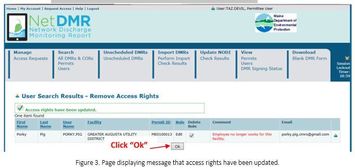 4. The confirmation page will be displayed (Figure 3) once the removal has been completed. Click on Ok to return to the View User Account Details page.
As always, if you have any questions regarding NetDMR call your inspector or contact Rebecca Beam – NetDMR Coordinator – at 207-287-9034 or rebecca.m.beam@maine.gov
|
Online Payment for Even-Numbered Certificate Holders Available October 2
If your operator certificate ends in an “even” number, no need to wait until March 1, 2018 to renew. After October 2 you can pay your renewal fee online by credit card. Just go to the NEIWPCC-JETCC website, www.Jetcc.org to enter payment information. And if you have received your 18 TCHs for the previous 2 years, then your certificate is renewed!
If you don’t use the internet, or want to renew by check, your renewal notification should be arriving by mail at the beginning of October. It will include a detailed training summary of your Training Contact Hours (TCHs) on file. If you have taken more classes, send the information to NEIWPCC–JETCC by email, mail, or fax to (207) 771-9028.
Still need training credits? Check out the calendar session of this newsletter. You can also get credit for online webinars or training seminars presented by your facility, such as lock-out/tag-out classes or equipment training by a vendor. Just send the information to NEIWPCC-JETCC, who will forward it to DEP for review & approval. It is always better to get approval before attending a course to make sure you get credit.
For odd-numbered certificate holders, look for an email notice from NEIWPCC-JETCC in January. If you have changed your email since last year, let them know by calling 207-253-8020 or emailing certification@neiwpcc-jetcc.org.
1. d.
2. c.
3. a.
4. d.
5. c.
6. d.
7. b.
8. d.
9. d.
10. b.
11. a.
12. c.
| 




