Fall, 2015
In this Issue:

Greetings -
It’s been
a little over a month since I was sworn in as the Department’s Acting
Commissioner and it has been quite an education for me.
In the time I’ve been here, I’ve had the opportunity to meet
a fair number of Department staff and I’ve learned a lot about what each of the
four Bureaus do. I won’t say I have
committed every name to memory yet, nor will I say I can yet recite every program
and activity of the Department – I’m trying though.
I am happy to say that I’ve made the rounds to all of the
DEP regional offices. On September 18th
Suzanne Miller was kind enough to take me around the Bangor Office and response
building, introducing me to regional staff. I followed that trip up
with a visit to Presque Isle Office on September 30th. With Nick Archer as my guide, I started that
day at 4:40 a.m. with a drive to the local TV studio for the Potato Pickers
Special (you can only imagine where it went from there). I completed the tour on October 6th with
a visit to the Portland Office, where Jim Dusch took me from office to office
to meet everyone there.
It's apparent from my brief introduction that the Department
is staffed with committed professionals.
As I made the rounds, I was struck with the sense of pride that so many
had in describing what it is that they do.
Whether it was explaining how Response covers the State around the clock
or describing how air monitoring equipment is routinely re-purposed to make
sure we are performing our mission (without breaking the budget), it was clear
to me that people here find their work to be meaningful and are proud of what
they do.
It was an energizing way to start out my tenure here and I look forward to learning more as we work together to carry out our charge.
|

Over the past few months, two members of our dedicated staff have passed; Scott Austin from the Bureau of Remediation and Waste Management and Lynn Cornfield from the Bureau of Air Quality Control will be sadly missed. We will remember their lasting influence and place in the DEP family. Our sincere condolences go out to their families, friends and co workers.
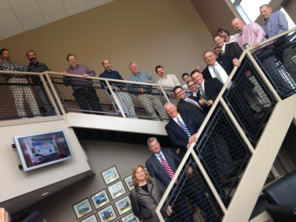
Governor Paul LePage, Commissioner Patricia Aho and the
Department of Environmental Protection recently announced the recipients of the
2015 Governor’s Award for Environmental Excellence. The awards, which are
administered by the Maine DEP, recognize businesses, nonprofit organizations,
and the public entities for their extraordinary efforts to protect and improve
Maine’s environment.
The honorees are:
Small Business
Category
Paris Autobarn, South Paris, Maine
Medium Business
Category
INCON, Saco, Maine
Large Business
Category
Ecomaine and their public sector partners; the U.S. Drug
Enforcement Administration, Counter Drug Task Forum (CDTF) members, Maine
Sheriffs’ Association, and the Cumberland County and York County Sheriffs’
Offices.
Community, Public
Sector or Nonprofit Category
The Presque Isle Landfill Design and Build Project is a collaborative
team project consisting of CES, Sargent Corporation, the City of Presque Isle, with
assistance from DEP staff.
More information is available on Maine DEP’s website.
Congratulations to this year’s award recipients!
|
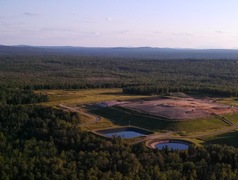
This project required the design, permit approval, and
construction of a landfill cover system for the closure of 9.2 acres of Phase 1
of the Presque Isle municipal landfill and the modification of the existing
landfill gas collection system. The
existing interim cap over Phase 1 had infiltration issues and the existing
leachate collection system was ineffective.
There was a deadline for receiving 75% matching funds from DEP for the
closure costs, which the traditional design, permit, and construction time
frames would have had difficulty meeting.
Due to the time and budget constraints, coupled with the environmental
issues at the facility, the City, their engineering consulting firm of CES, and
the DEP began discussions of creative ways to successfully close out Phase
1. Out of these discussions, the concept
of using a Design-Build contracting approach was born. Sargent Corporation was selected through a
competitive process to complete the project team as the contractor.
CES and Sargent Corporation formed a joint venture to
undertake design, permitting, and construction for closure of Phase 1 in what
is known as a Design-Build approach.
Whereas a traditional project approach would have taken 2 years to reach
completion, using the Design-Build joint venture, the project was designed,
permitted, and constructed in 9 months.
Using the traditional project approach, the engineer’s initial estimate
for the project was $3.4 million. Using
the Design-Build approach, the actual complete cost (design, permitting, and
construction) was approximately $2.4 million.
This savings is attributable to the compressed project timeline as well
as the teamwork between the CES-Sargent Corporation joint venture, the City of
Presque Isle, and DEP staff members; Dave Burns, Dick Behr, Lou Pizzuti and
Cyndi Darling. Unique, innovative, yet environmentally
sound design and construction elements were identified by project team members
and implemented in the project.
|
The Clean Water State Revolving Fund (CWSRF) is administered by the Department and the Maine Municipal Bond Bank and provides low-interest subsidized loans for the construction of publicly owned wastewater treatment works implementation of nonpoint source management programs that help protect or improve water quality.
Starting with the CWSRF Federal Fiscal Year 2015 Intended Use Plan (IUP), the Department will provide an incentive to encourage municipalities and wastewater districts to develop a Climate Adaptation Plan (CAP) for their wastewater treatment system. The intent of the CAP is for loan recipients to assess the wastewater treatment system’s vulnerabilities to climate change and developing a plan for system resiliency.
The CAP should identify hazards associated with climate change, evaluate their impacts on critical assets, identify adaptation practices, and present recommendations that build resiliency to the critical assets. Some impacts to critical assets will develop slowly over time (sea level rise, air and water temperature changes, precipitation changes, etc.) and other impacts may happen suddenly (storms, tidal surge, ice jams, etc.).
Annually,the Department solicits project requests from the owners of municipal wastewater facilities to fund CAP’s. The amount of the incentive provided will be established annually during the development of the IUP and is dependent on the allotment of federal funds for the CWSRF program. This fiscal year the amount has been set at $20,000 per borrower for the development of these plans. Requests for this year’s CAP funding were solicited in September. In all, the Department received eight requests totaling $160,000 in principal forgiveness from communities that what to participate in this opportunity. Although this is more than the Department initially set aside for this program this year, we will be able to meet this demand, should all of the borrowers proceed with CAPs.
For more information about the Clean Water State Revolving Loan Fund visit the SRF website.
On October 1, 2015, the U.S. Environmental Protection Agency (EPA)
revised the National Ambient Air Quality Standards (NAAQS) for ground level
ozone from 75 parts per billion (ppb) to 70 ppb based on extensive scientific
evidence about ozone’s effects on public health and welfare. The ozone season
for Maine will continue to be from April 1 to September 30. The 2015
ozone season, which just ended, has not been fully QA’d (quality assured) but based on
preliminary data the highest design value in the state is 68 ppb.
Therefore, all regions of the state are meeting the revised ground-level ozone
NAAQS of 70 ppb.
The ozone season for Maine will continue to be from April 1 to September 30 and based on preliminary 2015 ozone season data, all regions of the state are meeting the revised ground-level ozone NAAQS of 70 ppb.
As part of our commitment to supporting and engaging our partners in environmental protection, DEP and our partners host many educational opportunities across Maine. For a complete list of training opportunities, visit the Maine DEP Training web page.
2015 Stream Smart Road Crossing Field Workshop (Phase II)
October 26, Wells
November 3, Houlton
November 17, Augusta
November 19, Old Town
Erosion Control Practices for Contractors
October 21, Kittery
October 23, Newport
October 28, Waterboro
November 12, Ellsworth
November 18, Damariscotta
November 24, Farmington
Shoreline Stabilization
December 10, Presque Isle
December 11, Brewer
December 15, Augusta
December 16, Portland
Additional Training Resources
Tank Smart Online Operator Training
Asbestos and Lead Training Opportunities
Code Enforcement Officer training calendar
Maine DOT Local Roads Program workshops
The effects of nutrient pollution in aquatic
environments have increased across the nation. Effects typically include increased
algae growth in the water column, which blocks light from reaching seagrasses. The algae dies and decays, causing a decline
in oxygen near the bottom that organisms need to breathe. As algae blooms worsen, the
impacts to the ecosystem can include extensive blooms of floating and
attached algae, loss of aquatic vegetation, lack of oxygen in bottom waters, changes
or destruction of biological communities, and fish kills.
Through the Clean Water Act, the US EPA created the National
Nutrient Criteria program in 1998 to form national and regional nutrient
programs. In 2004, the EPA
defined expectations for states to develop numeric nutrient criteria for
nitrogen and phosphorus, and required states to demonstrate progress toward
this goal. In addition, the DEP is required to evaluate potential water quality
impacts from nutrients and when necessary, to establish discharge limits in Maine Pollutant Discharge
Elimination System Permit/Waste Discharge Licenses to prevent violating water quality
standards.
In order to better understand potential point sources of nitrogen
pollution, in April 2015 the DEP requested information from 32 major
dischargers whose effluent either directly enters marine waters or just
upstream of Head of Tide. These facilities were asked to voluntarily collect
and process effluent samples during summer 2015 for nitrogen and phosphorus analysis at a DEP contracted lab. An
outstanding response resulted in 29 municipal and industrial wastewater
facilities, from Kittery to Calais, voluntarily sampling their effluent five
times over the summer.
Data received from this project will provide the DEP with better information
to determine the amount of nutrients entering marine waters, and to more
accurately inform the modeling that is part of waste discharge licenses. For more information, visit the DEP nutrient criteria webpage.

Congratulations and Best Wishes to our recent retiree:
Diana Perkins, Office Associate II, Supervisor, Central Maine Regional Office - 17 years of State service
A warm welcome to the newest members of our staff:
Mike O'Connor, Environmental Specialist III, Central Maine Regional Office - Land Division
Hannah Flanagan, Environmental Specialist II, Central Maine Regional Office - Land Division
Mike Loughlin, Environmental Specialist III, Eastern Maine Regional Office - Water Quality Management Division

Recently, Maine
DEP Deputy Commissioner, Heather Parent addressed the attendees at the EPA Brownfields
Grant announcement in Biddeford. The Brownfield program awarded Maine grantees
a total of $2,350,000 at the award ceremony held on September 23, 2015. EPA’s
Brownfields program provides grants and technical assistance to communities,
states, tribes, and other stakeholders, giving them the resources they need to
prevent, assess, safely clean up, and sustainably reuse brownfields. Cleaning
up and reinvesting in these properties protects the environment, reduces
blight, and takes development pressures off greenspaces and working lands.
EPA’s Land Revitalization program works with communities, states, non-profits
and other stakeholders to develop and test sustainable approaches for the reuse
of formerly contaminated properties.
Stay update and follow Maine DEP on twitter @maine_dep.
|
|





