Summer, 2015
In this Issue:
 Over the past several
months, we have been monitoring several pieces of legislation at both the State
and Federal level. Recently, the Maine legislature finished their work for this
session yet the fate of 65 bills remains in question at this time. The following
bills were passed by the legislature and will become law on October 15, 2015:
LD 580 – An Act to
Extend the Funding Period for Landfill Closure Costs
Under the current law,
DEP pays 75% of certain landfill closure costs incurred on or after July 1, 1994
and before December 31, 2015. This bill extends that time period to December
31, 2025.
LD 911 – An Act
Concerning the Review of Certain Projects under the Site Location of
Development Law
LD 911 creates several
new definitions relating to the scenic impact of a wind energy development; it
allows for the consideration of cumulative scenic impacts in the permitting of
wind energy developments; it also allows the Department of Environmental
Protection to require a visual impact assessment for wind energy developments
located within 15 miles of scenic resources of state or national significance
and mandates a visual impact assessment if a generating facility is located
within 15 miles of specific scenic resources of state or national significance.
LD 1366 – An Act to
Promote Recycling Program Integration and Efficiencies
This legislation
promotes a more comprehensive approach to recycling in Maine, by including
implementation of Maine’s beverage container redemption program within DEP’s
Sustainability Division and DEP’s materials management programs. The Department
is and will continue to coordinate implementation with the Department of
Agriculture, Conservation and Forestry, who in turn will continue to oversee
the portion of the law regarding food safety matters. We will manage product
code registrations, data analytics, and will provide assistance regarding
recyclables covered by the Bottle Bill with our other efforts to help
municipalities, regional districts, industry stakeholders and business improve their
recycling opportunities.
LD 1019 - An Act Making
Unified Appropriations and Allocations for the Expenditures of State
Government, General Fund and Other Funds and Changing Certain Provisions of the
Law Necessary to the Proper Operations of State Government for the Fiscal Years
Ending June 30, 2015, June 30, 2016 and June 30, 2017 (This bill became law on June 30, 2015)
As part of the state’s
biannual budget, the Land and Water Quality program was divided into two
separate bureaus. This proposed change was created to address the growing
volume of work that the land division has seen over the past several years. The
land bureau receives 2500-3000 permit applications every year, ranging from
small permit-by-rule applications, to large projects of statewide significance.
A number of these applications have to do with large, grid scale energy
projects such as; wind, hydropower and tidal energy. As we move forward, the
Bureau of Water Quality will continue under the direction of Mick Kuhns and the
newly created Bureau of Land Resources will be led by our newest bureau
director, Mark Bergeron.
Four of the 65 bills I
mentioned earlier are bills of Department interest and we will continue to
monitor their status pending a ruling by the Maine Supreme Judicial Court. They
are:
-
LD 727 – Oil Storage Tanks
-
LD 1040 – Youth Conservation
Corps
-
LD 1044 - PaintCare
-
LD 1303 – Fund Merger
My thanks to all of you
for your work in providing information to prepare testimony before legislative
committees, attending work sessions as well as fielding questions and requests
from other state agencies. Your collaborative effort is deeply appreciated.
In June, I was honored
to be named Chair of the Ozone Transport Commission (OTC) at the OTC Annual
Meeting in Princeton, NJ. The OTC is a multi-state organization created under
the Clean Air Act. They are responsible for advising EPA on transport issues and
for developing and implementing regional solutions to the ground-level ozone
problem in the Northeast and Mid-Atlantic regions.
OTC provides air
pollution assessment, technical support and a forum through which states can
work together to harmonize their pollution reduction strategies. OTC members
include: Connecticut, Delaware, the District of Columbia, Maine, Maryland,
Massachusetts, New Hampshire, New Jersey, New York, Pennsylvania, Rhode Island,
Vermont, and Virginia. This is the first time since 1993 that Maine has served
as Chair.
The long awaited arrival
of good weather also brought the announcement from four of our employees of
their decision to retire. I personally want to acknowledge George Seel, Fred
Lavallee, Gordon Fuller and Cathy Stulz for their contribution to this
agency and their years of service to the state. On behalf of everyone at DEP,
congratulations and best wishes; George, Fred, Gordon and Cathy!
I hope you all take some
time to enjoy summer in Maine!
|
 In an ongoing effort to increase readiness for State and private coordination in the event of a rail accident, Maine Department of Environmental Protection, railroads, and Public Safety Agencies participated in training and exercise to practice procedures and equipment used in response to an oil spill from rail tank cars. The training was held in Greenville, June 15 – 25, 2015.
Participating in the training and exercise included representatives from: Maine Department of Environmental Protection, Maine Emergency Management Agency, Central Maine and Quebec Railway, Eastern Maine Railway, Maine Northern Railway, Federal Rail Administration, US Environmental Protection Agency, National Oceanic and Atmospheric Administration, Greenville Fire Dept. Milo Fire Dept.
The Classroom-style training covered: Rail safety at rail facilities and at a wreck/derailment scene; the properties and hazards of crude oil; the use of mapped data for implementation of protection strategies for sensitive habitat for wildlife and fisheries; case studies of previous rail accidents involving oil; firefighting strategies for responding to crude oil fires; and Incident Command Structure and communications.
In addition to the classroom training, a two day exercise was held each week with participants working together to coordinate resources to respond to a simulated oil spill along the railroad adjacent to Moosehead Lake. Boats, containment boom, oil recovery equipment, and shoreline cleanup strategies were deployed and monitored.
|
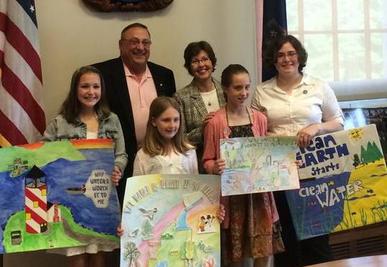 |
With bright, colorful posters in hand, the winners of the Maine
Clean Water Week Poster Contest attended a special ceremony at the State House
on June 5, 2015. Students representing 36 communities across the state
submitted over 550 posters for the competition.
Governor LePage and Commissioner Aho met to congratulate the
winners of this year’s contest and their families in the Governor’s
office. The students whose art work was
chosen received a cash prize of $100.00 from MEWEA. They are:
Grades 1-3: Freya
Qualls from North Berwick Elementary School
Grades 4-6: Lydia
Merrill from Chop Point School in Bath
Grades 7-8: Moriah
Hajduk from Winthrop Middle School
Grades 9-12: Elizabeth
Kane from Gorham High School
The
poster contest is sponsored annually by the Maine Water Environment Association.
The association consists of over 650 members of municipal and industrial operators,
consultants, students, and regulatory officials. MEWEA
represents over 95 wastewater treatment plants serving over 125 communities
throughout the state.
The
2016 calendar will be distributed in September with the top 12 posters
representing two additional students from each age group.
On July 28, the Maine DEP published an updated list of Chemicals of High Concern, pursuant to 38 M.R.S.A. § 1693-A(3) which directs the Commissioner to perform such a review at least every three years.
Supporting documentation published with the revised list of Chemicals of High Concern provides a detailed explanation of the revision process and both are available to the public on the Safer Chemicals Program webpage located here: http://www.maine.gov/dep/safechem/index.html
Stakeholders and interested parties are encouraged to submit written comments to kerri.malinowski@maine.gov regarding the updated Chemicals of High Concern list by 5:00 p.m. August 28, 2015.
|
Summer is a busy time of year for all of us. DEP staff and management receive a large number of requests to take part and present at various events during the summer months. One such event was held on July 9th, when E2Tech invited Commissioner Aho and our four bureau directors to present the “State of the Environment” at their summer conference. The group was asked to address emerging issues, innovation and outreach. The rare opportunity to hear from the Commissioner and all the directors drew a large crowd and gave attendees a chance to participate in an informative Question & Answer period at the end of the presentation. To view our presentation please visit E2Tech’s website at http://www.e2tech.org/Res/Documents/MAINEDEPJULY2015.pdf.
The Environmental & Energy Technology Council of Maine (E2Tech) seeks to build and expand the State’s environmental, energy, and clean technology sectors. E2Tech acts as a catalyst to stimulate growth in the State’s environmental, energy, and clean technology sectors by facilitating networking opportunities, serving as a clearinghouse for objective information, and leading efforts to promote the sector.
|
A number of the ponds and lakes in the Belgrade area have infestations of the Eurasian water milfoil (Myriophyllum spicatum), an aquatic invasive freshwater plant. The multi-stemmed/multi-leafed fast growing plant can form thick underwater stands of tangled stems and vast mats of vegetation at the water's surface, negatively impacting the bodies of water. Extensive efforts in recent years to control the invasive weed have included removing the plant and disposing of it. However, in early July, staff from the Department's Divisions of Sustainability and Solid Waste partnered with a local Sidney Farm (Kennebec Cheesery), and the Friends of Messalonskee, to conduct a trial to determine if milfoil can be deactivated through composting, and avoid landfilling the vegetation.
Three piles were constructed by the facility’s owner, Peter Koons, using his farm tractor, each consisting of a mix of three cubic yards of goat bedding from the farm and one cubic yard of collected milfoil. After just one week, pile temperatures reached optimal composting levels, and the piles will be turned on a regular basis to ensure proper composting. After a six-week active composting phase, material will be collected from the piles and taken to the DEP Lakes Program to see if milfoil can be re-grown from the composted material.
The vast majority of our air
pollution in Maine comes from out of state.
However, 45% of our pollution emissions come from
transportation, so we are partnering to target reductions in this area.
Maine DEP became an affiliate in
EPA's SmartWay Program in May 2015. DEP recognizes that a strong and
efficient transportation fleet is vital to Maine's environment and economy. We
encourage the freight transportation community to join us in our efforts to
reduce transportation emissions, save fuel, and lower costs. SmartWay is an innovative
partnership between the private sector, nonprofits and agencies like Maine DEP,
and USEPA.
The purpose of this voluntary
program is to help businesses move goods in the cleanest most efficient way
possible. Maine trucking companies, dealers, rail carriers, logistics companies
and commercial manufacturers and retailers who ship and receive products are
all eligible to join the program. The SmartWay logo sends a message to
your customers that you are moving goods in an environmentally responsible
manner.
Members of SmartWay will learn
about cost effective innovative technologies such as aerodynamic technologies (pdf), idle reduction technologies (pdf), low rolling resistance tires (pdf), Retrofit Technologies, and transportation energy and environmental benchmarking tools. Several Maine companies have
already been recognized with regional awards for their SmartWay
projects. Read more about these remarkable inspiring projects in the Maine
Success Stories links on our SmartWay webpage.
Over the coming months we will be
focusing our energies on a Maine version of SmartWay targeting smaller
transportation fleets. Stay tuned for an
Environmental Leader Transportation Program to recognize and encourage small
businesses to join the commitment to lower transportation emissions through
innovative programs that will actually save them money.

Congratulations and best wishes to our recent retirees:
Gordon
Fuller, VRAP - 38 years of state service
Fred Lavallee, Environmental Engineer, Services Manager - 40 years of state service
George Seel,
Tech Services Division Director - 36 years of state service
Cathy Stulz,
File Room Supervisor - 15 years of state service
A warm welcome to the newest members of our staff:
Leslie
Anderson, Innovation Director - Office of the Commissioner
Justin
French, Policy Director- Office of the Commissioner
Stacy Knapp,
Environmental Specialist III - Bureau of Air Quality
David Madore,
Communications Director - Office of the Commissioner
Nathan Robbins, Climate Change Specialist - Sustainability Division
As part of our commitment to supporting and engaging our partners in environmental protection, DEP and our partners host many educational opportunities across Maine. For a complete list of training opportunities, visit the Maine DEP Training web page.
Maine Compost School September Sessions
Additional Training Resources
Tank Smart Online Operator Training
Asbestos and Lead Training Opportunities
Code Enforcement Officer training calendar
Maine DOT Local Roads Program workshops
|
|
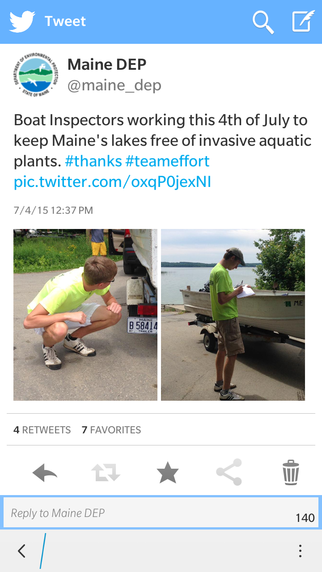
The objective of Maine’s Courtesy Boat Inspection Program is
to reduce the spread of invasive aquatic plants (IAP) by boats, trailers, and
equipment to Maine waters. Trained Courtesy Boat Inspectors discuss with
boaters the risk posed by IAP, show boaters how to inspect and remove
vegetation from boating and fishing equipment, and urge boaters to inspect
before and after every launch. As the name implies, these inspections are
voluntary – not mandatory. Inspectors may be paid staff or volunteers with
a lake association. The Maine Department of Environmental Protection
contracts with Lakes Environmental Association in Bridgton to train volunteers,
organize inspections, and administer a small grant program to help lake
associations run successful inspection programs.
Join us on Twitter @maine_dep and stay up to date!
|
|