|
In this issue:
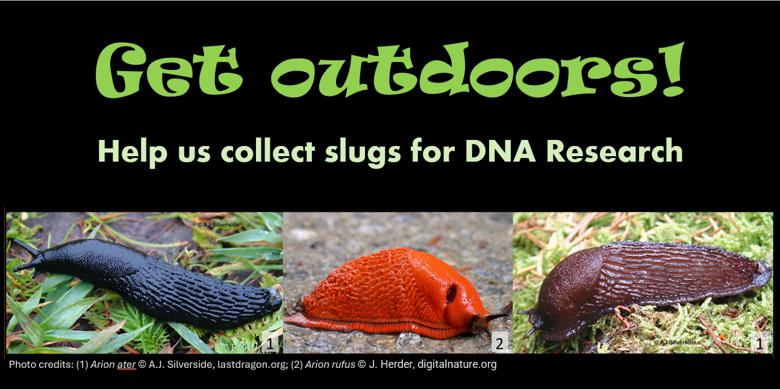
Lately, more and more states are reporting observations of snails and slugs that are not native to the U.S. This is not a surprise, given the large volumes of goods, people, and plant material that travel the country and the globe on a daily basis. Here in Maine, we have our own little community of non-native slugs. They are large, black, and slimy and seem to be living in harmony with residents and visitors of Vinalhaven. These were identified as Arion ater, a European species only thought to be in the Pacific Northwest. Fast forward a few years and another community of slugs was found inhabiting a nursery. These slugs are large, brown, and slimy and were identified as Arion ater ater, a subspecies of Arion ater. Neither community of slugs seems to be causing problems, but the USDA would love to figure out how these communities may be related to each other and to other slugs found in other states.
The Department is collaborating with the USDA to collect and submit Arion type slugs from different locations in Maine for DNA testing. The knowledge gained from this testing would not only help researchers identify the origin of these slugs but also help them understand how long they may have been here and how they could have spread. Genetic testing can also improve the identification of closely related slug species that are difficult to distinguish based solely on appearance, particularly when individuals are young.
We will be collecting and submitting slugs from the two known locations, but we would love to know if there are more out there. If you have noticed any large slugs on your property, please contact us. We will come by and collect them. Also, if you are encountering these slugs, do not handle them without gloves. Many slugs are known to carry parasitic nematodes which could cause serious health effects.
All seed potatoes planted or sold in Maine must meet Maine’s seed potato certification standards. Selling and planting only certified seed potatoes helps protect Maine’s potato industry by ensuring the planting stock is free of, or meets tolerance requirements, for certain potato diseases that can reduce potato crop yields and quality.
To verify any seed potatoes that were grown in Maine are certified seed potatoes, look for Maine Certified Seed Potato tag on the packaging. The Maine certified seed potato program also publishes a list of growers that crops have met the seed certification requirements on their website.
If you purchase certified seed potatoes from out of state to sell or plant in Maine there are additional requirements that must be followed. These requirements include, but are not limited to, obtaining an import permit from the Maine Seed Certification Program and arranging an inspection of the potatoes upon arrival. The Maine Seed Certification Program recently published a bulletin outlining all the requirements to import seed potatoes to Maine.
A note from the Horticulture Program: We thought we’d try something new starting in this edition of the MELeaf and begin a series of short articles highlighting an invasive plant on the Do Not Sell List and some alternatives to try planting instead. Thanks to Gary Fish, State Horticulturist, for this first installment of the new Invasive Plant Spotlight.
How many times have you been asked if you have any burning bush (Euonymus alatus) for sale? How do you usually reply to that question? Have you ever seen the plant invading Maine forests?
I have encountered it for years in the Central Maine area where I frequently hike. It is especially easy to spot in the fall as the plant takes on its namesake red to pink “burning” fall color. Often reaching heights of 10 to 15 feet tall, burning bush can cover the entire forest floor. Burning bush is easily spread by birds and has been banned from sale or import in Maine since 2018. We have recently seen in the horticulture trade press, and you may have been asked about, a newer variety Euonymus Fire Ball Seedless™ Burning Bush. This variety is also not legal to sell or import into Maine. All cultivars and hybrids of banned species are also banned unless an exemption is requested and granted for that cultivar or hybrid. All exemption requests are reviewed by a diverse stakeholder panel. DACF has not received any request to exempt Euonymus Fire Ball Seedless™ Burning Bush.
There are many native and non-invasive plants you can recommend to a customer as an alternative to planting burning bush.
For bright red fall color, these are some great plants to offer:
- Red & black chokeberry,
- highbush blueberry,
- fragrant sumac,
- redvein enkianthus, and
- Virginia sweetspire.
For other brilliant fall colors, you can offer:
- Summersweet,
- Northern spicebush,
- fothergilla,
- bush honeysuckle (Diervilla sp.),
- witchhazel, and
- Carolina allspice
More Information on Maine's Invasive Plant Do Not Sell List
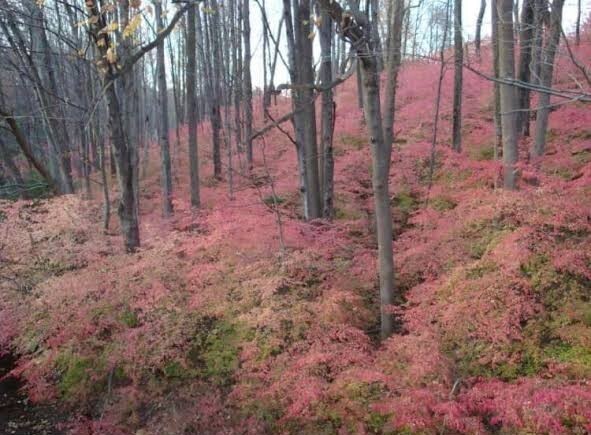 This photo shows what happens when burning bush invades a forest.
Spotted lanternfly (SLF) is a large planthopper that has been in the U.S. since 2014, when it was first found in Pennsylvania. It has since spread to about 20 states. It is not known to be established in Maine.
The spotted lanternfly has proven to be a serious pest of grapevines and other high-value crops such as hops and maple. SLF injures woody plants by piercing the wood and sucking out sap. It exudes honeydew, a sticky sugary substance that attracts yellow jackets and sooty mold. Its preferred host, tree-of-heaven (Ailanthus altissima), is loaded with spotted lanternfly adults this time of year. Luckily for Maine, tree-of-heaven is not commonly found here. But SLF can feed on other plants and may be spotted on grapevines, black walnut and maples right now. In states south of us, adults are starting to lay egg masses.
We are not aware of any overwintering populations of spotted lanternfly in Maine, but you may see adults and egg masses, which can hitchhike long distances. We are particularly concerned during egg-laying season (October-December) as eggs are laid on a variety of surfaces including nursery stock, vehicles, trailers, lawn furniture, etc. SLF egg masses will overwinter hatching in the spring. All nursery stock, vehicle or other outdoor items coming from any state east of the Mississippi should be checked carefully for eggs and adults.
If you suspect you have seen spotted lanternfly in Maine, take lots of photos, note the location, and report it.
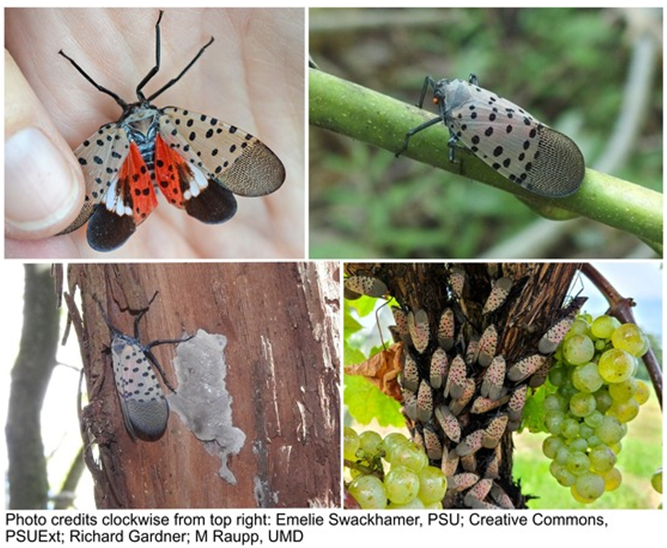 Spotted lanternfly adults. An egg mass is shown in the picture on the lower left.
The hot and dry 2026 growing season put watering practices at nurseries to the test, and for some, illuminated needs for improvement of irrigation systems. While most common plant pests had normal to low populations, perhaps due to these conditions over the last several years, others thrived on stressed plants. The following were some of the more common or noteworthy finds recorded by inspectors this summer.
Damage to Aster Family Flowers
Do you ever notice flower heads of aster family plants such as sunflowers, echinacea or rudbeckia that are disfigured or turning black? Inspectors usually find sunflower moth (Homoeosoma electella) caterpillars to be the culprit. Look for the presence of black frass (insect poop) or webbing on top of the flower heads and flowers going by too fast. Its presence can be confirmed by opening the center of the flower head to find larvae feeding inside. The Coastal Maine Botanical Gardens has also noted these caterpillars causing issues on some of their echinacea.
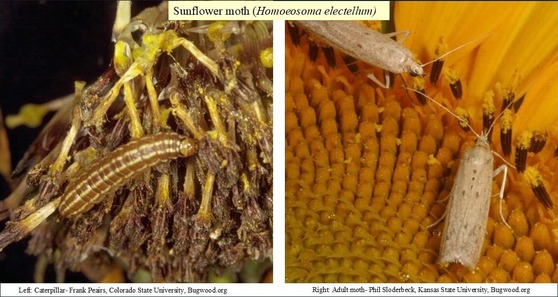 Left: Sunflower moth caterpillar. Right: Adult sunflower moths.
If you see damage on flowers of Heliopsis helianthoides (false sunflower), inspect the plant for orange and black insects known as false milkweed bug (Lygaeus turcicus) which feeds on developing and mature seeds. This insect can be difficult to distinguish from its close relatives, the small and the large milkweed bugs which feed primarily on seedpods and seeds of Asclepias spp. Like monarch butterflies, these species have vibrant coloration to deter predators, for a good reason. All these orange and black insects extract toxic chemicals called cardenolides from their primary hosts. The false milkweed bug is also a look-alike for spotted lanternfly.
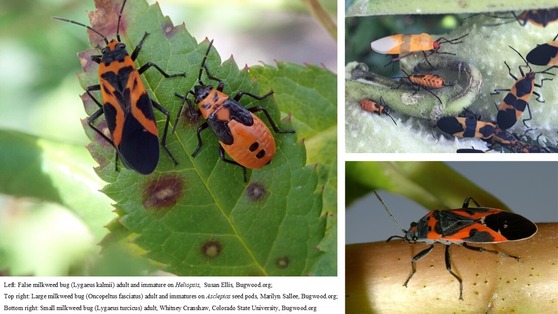 Left: The false milkweed bug. Top Right: The large milkweed bug. Bottom Right: The small milkweed bug.
Lace Bugs
Lace bugs are well known as pests causing permanent damage to the foliage of broadleaved evergreens such as Rhododendrons, Azalea and Pieris. However, the last few years inspectors have observed an increase of these insects on deciduous trees including serviceberry, willow, sycamore, elm, cherry and Japanese tree lilac. Due to feeding through a piercing sucking mouthpart, lace bug symptoms start as yellow to white stippling on the top of the leaf and can progress to more severe infestations with leaf silvering or bleaching. Signs of the insect can be found on the underside of the leaf, including brownish-black excrement spots, sooty mold, white cast skins, and insects with flat lacelike translucent wings.
Elongate Hemlock Scale
Elongate Hemlock Scale (EHS, Fiorinia externa) is considered a pest of concern in Maine, as it can cause significant damage to evergreen tree species in forests and landscapes. Despite its common name, inspectors most often find EHS on Canaan, Fraser, balsam and concolor fir trees that have been imported from mid-Atlantic states where this insect is more prevalent. In Maine, EHS is established in southern and coastal areas. Nurseries where EHS has been found tend to have reoccurring populations, either from continued introduction on nursery stock or infestation of fir and hemlock trees in the surrounding forest.
It is crucial to inspect incoming host trees carefully:
- Inspect the innermost foliage on the tree for yellow spots on needle tops and elongated oval scales on the undersides.
- Look for whitish or grayish branches caused by the waxy flocculence the insect produces.
- Look for thinning foliage and defoliation that progressed from the center to of the tree out.
Control any infestations quickly before nursery stock is moved or sold, and before crawlers are unintentionally moved on clothing, animals and equipment to the surrounding environment.
The Maine Forest Service has good pictures of elongate hemlock scale and the damage it causes on their website.
Honeylocust Borer
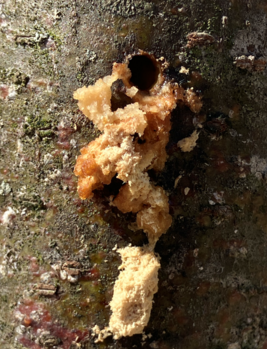
An obvious borer hole caused by the honeylocust borer (Agrilus difficulis) was found in a balled and burlapped honeylocust (Gleditsia triacanthos) tree at a nursery last month. This insect is native to the eastern US and primarily infests honeylocust trees that are under stress. Larva feed on phloem, etching serpentine galleries under the bark (much like its well-known look-alike emerald ash borer, Agrilus planipennis), possibly leading to canopy dieback but rarely tree death. Adults emerge from the tree, leaving oval to D-shaped exit holes with frass and wood shavings. Sap oozing from the tree could indicate the presence of honeylocust borer.
A honeylocust borer exit hole with frass below.
Gummosis
Occasionally, inspectors come across trees, often cherries or other fruit trees, that look like they are blowing thick sticky amber colored bubbles from their trunk or branches. This overproduction of sap called gummosis is a defense mechanism indicating that the tree is responding to stress. Discovery of Gummosis requires additional inspection to determine the cause of stress, which could be damage from insects such as borers, fungal or bacterial diseases, mechanical damage, herbicide or weather-related injuries. Removal of the “gum” is not recommended as it could cause additional injury to the bark. Instead, work to prevent further injuries to the tree, promote the health of the plant, and control pests that are causing the stress.
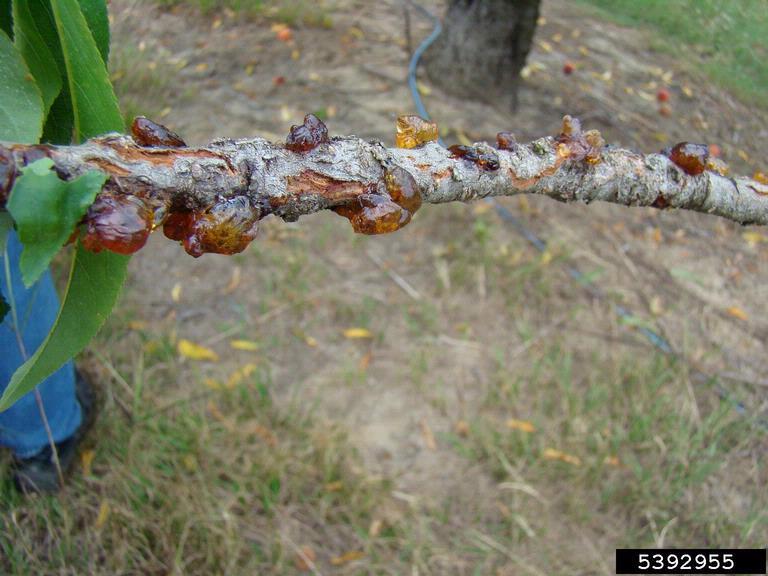 Gummosis on a peach branch. Photo credit: Rebekah D. Wallace, University of Georgia, www.bugwood.org
|