|
Drought conditions have worsened statewide since July. Roughly 60% of the state is under moderate drought (D1), similar to the amount of areas affected by drought experienced statewide at the end of last August. Drought is severe (D2) along the Midcoast, from Scarborough through Mount Desert Island, which encompasses nearly 14% of the state. Drought conditions are expected to persist into the fall season. Previous El Niño years have brought above-normal precipitation, which may improve drought conditions in the winter season.
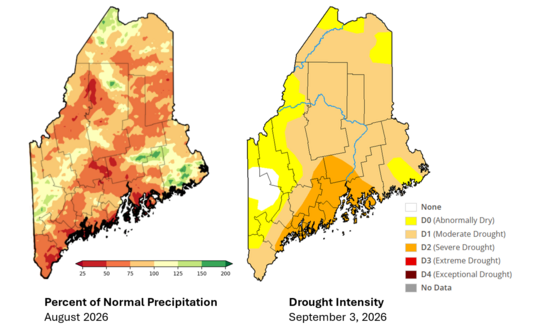 Image: (left) The percent of normal precipitation in August 2026 compared to the average precipitation normals for the same month from 1991-2020. Percentages below 100 indicate a deficit in rainfall for most of the state; (right) Drought conditions for every county continued to worsen in August into September 2026.
August was drier than normal across most of the state, with rainfall averaging only 50-75% of normal. Throughout the meteorological summer (June through August), rainfall totals were below normal, with the Midcoast receiving only 20-50% of normal. Overall, it would take approximately 7-14 inches of steady, light rain to end the current drought conditions over the next 1-2 months (National Weather Service 2026). Temperatures in August were 2-4°F above normal across most counties, which was similar to August 2025. In September, the Climate Prediction Center forecasts above-normal precipitation in southern Maine, and equal chances of above- or below-normal precipitation and temperature.
Beech Leaf Disease (Litylenchus crenatae mccannii)
Annual assessment of Maine’s beech leaf disease (BLD) long-term monitoring plots for 2026 was completed near the end of August. Similar plots are established in other Northeastern states to monitor the progress and impacts of BLD in the region. Maine’s BLD long-term monitoring plots were established immediately after confirming the disease-causing nematode in Waldo County in 2021. Since then, the disease has been found in all 16 counties and over 400 towns in Maine. This year, a Waldo County plot that originally had 13 beech trees had only 2 surviving beech trees – In our Knox County plot, where BLD was also confirmed in 2021, no beech tree had lower than 25% crown dieback. On a brighter note, some of our plots in other parts of the state showed slower disease progression than expected. We have not found any trees that appear to be resistant to BLD thus far. No resistant trees have been reported throughout the range of this fast-moving disease.
Drought Impacts to Trees
Many parts of Maine have not been getting adequate amounts of rain for healthy tree growth this summer. Extended periods of insufficient rain can cause physiological disruptions that cause significant tree stress. Consecutive years of stress due to prolonged inadequate moisture can lead to root and crown dieback. Tree health can be further worsened by secondary forest pests: stressed trees can develop greater susceptibility to infection by disease pests and insect pests can become attracted to stressed trees lacking resources for defense.
Drought stress can initiate senescence seen as early fall foliage coloration, yellowing foliage (chlorosis), wilting/desiccation of foliage and premature defoliation. These symptoms can be confused with those of disease and insect issues, so it is important to determine the reason for symptoms before management actions are undertaken. For example, a discoloring elm tree could be a sign of Dutch elm disease, but also a sign of environmental stress. While the outcome of Dutch elm disease is mortality, an early senescing elm could leaf out normally and look healthy next spring.
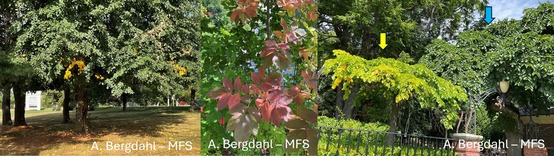 Images (left to right): Little-leaf linden showing senescing, yellowing foliage and leaf drop; White ash prematurely showing its characteristic light-purple fall coloration; A Camperdown elm showing yellowing of foliage likely due to drought (yellow arrow). The Camperdown elm to the left (blue arrow) does not show the same symptoms. This tree likely benefitted from its less-exposed growing site and growing next to a roofline that would have provided extra water during rains.
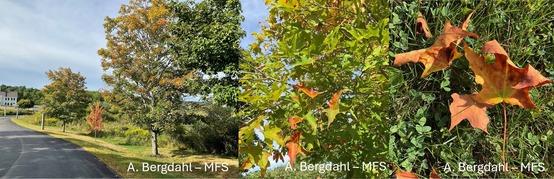 Images (left to right): Planted maple cultivars showing symptoms of early senescence such as early fall coloration; leaf desiccation; premature defoliation in the absence of other obvious biotic/abiotic stressors, suggesting drought stress.
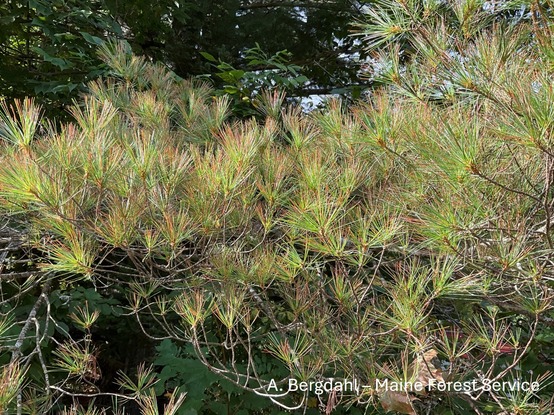 Image: Conifers may show drought stress as browning at the tips of needles or browning of older age-class needles. The eastern white pine pictured here lost many of its older needles in spring due to white pine needle damage, so impacts to older needles are not as apparent as the browning of current-year needle tips.
Giant Tar Spot of Maple (Rhytisma acerinum)
Norway maple (Acer platanoides) is the only species impacted by giant tar spot of maple. This includes red-leaved, variegated, and other varieties of Norway maple. Since Norway maple is no longer permitted to be sold in Maine due to its invasive habit, the disease is commonly seen persisting on shade trees planted in yards and urban areas before the species ban and in unkept areas colonized by the prolifically seeding Norway maple.
Leaves infected by spores stay mostly without symptoms until later in summer, when yellow spots appear, followed by small black spots (fungal lesions) that coalesce, forming conspicuous large black spots.
This year the impacts of giant tar spot infection and drought have combined leading to severe symptoms and heavy defoliation in many trees in several towns. Most reports and sightings have come from the major population areas around Portland, Bangor, and Augusta. Severe defoliation may cause some crown dieback in the worst infected and defoliated trees, but giant tar spot infection is unlikely to have greater impacts on tree health. This is because the disease impacts leaves later in the growing season when trees have already stored ample energy for next year’s growth.
The fungus that causes giant tar spot will overwinter in this year’s infected leaves and infective spores will be ejected next spring during wet periods. This emphasizes the importance of cleaning up leaves in fall to reduce symptoms of this disease in the following season. Composting leaves is effective, if they are covered with other material to prevent spore release in spring. Leaf cleanup is often ineffective/impractical in urban areas where the disease persists on many trees in unmanaged areas and properties.
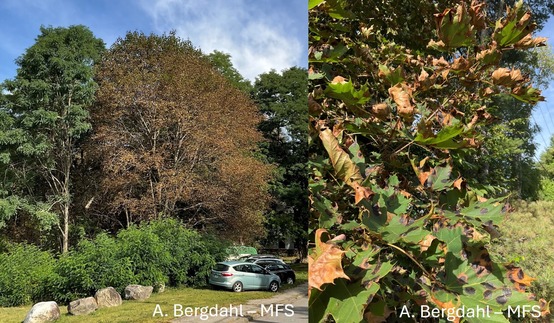 Images (left to right): A whole Norway maple tree showing severe symptoms of a combination of drought and giant tar spot.
Northern Tooth Fungus (Climacodon septentrionalis)
Northern tooth is a white shelf fungus that fruits in late summer/early fall. Fruiting is a mycology term for mushroom/decay conk formation for the purpose of spore production and dispersal for new infections. Decay fungi can only produce these resource-intensive reproductive structures when the mycelia of the fungus (the mostly non-visible fungal strands responsible for decay and spread within a tree) gain sufficient energy via the decay process. Thus, the presence of a decay conk like that pictured below is often an indication of advanced decay within a tree. A northern tooth decay conk can produce many billions of spores on its tooth-like, porous spore-producing surfaces on the lower side of each shelf-like fungal growth. Naturally caused or human-caused tree wounds are required for infection.
Most often found on maples (Acer spp.), the northern tooth fungus can infect and decay other hardwood species leading to a spongy white internal rot. Trees may become brittle in areas where decay has advanced, leading to branch breaks or even main stem failure. However, there are plenty of examples of trees infected with this or other decay fungi that remain intact and standing for many years.
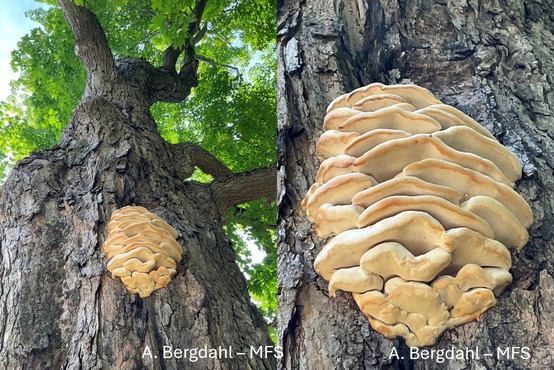 Images (left to right): A northern tooth fungus conk on the main stem of an old roadside sugar maple; A close-up of the fungal structure showing the off-white coloration and pore-like underside that is typical of this wood-decaying fungal species.
The Importance of Fall Watering for Trees
As temperatures drop and trees begin to senesce, it is easy to forget the importance of continuing to water your trees. Watering trees in fall is important because although aboveground growth slows this time of year, tree roots will continue to grow until soils reach near-freezing temperatures . Fall watering can also prevent the occurrence of winter burn in conifers – a condition that develops in spring when temperatures warm and tree foliage begins photosynthesis. As part of this process leaf pores must open for gas exchange also causing water loss. If replacement moisture is not accessible at this time a water deficit may develop. In the least serious cases, the resulting desiccation, reddening and death of tissues causes aesthetic impacts. In more serious cases, trees can be damaged severely or die. This situation is less likely if soils and tree tissues enter winter fully hydrated, so keep watering your trees into fall unless natural rain is sufficient to keep soils moist.
Balsam Woolly Adelgid (Adelges piceae)
This is a good time of year to assess balsam woolly adelgid (BWA) populations in your woodlots. This invasive insect was first found in North America in 1908 in Brunswick, Maine. It has since spread throughout Maine; however damaging populations were historically limited to the southern portions of the state. In North America, BWA causes damage to true firs (Abies spp).
For some trees, the history of BWA infestation will be obvious due to the gnarled, knobby branch nodes and shortened branches caused by the tree’s reaction to the adelgid’s feeding. This can lead to trees with flattened tops, fiddle shaped tops, narrowed spires and other deviations from the typical pointed top we associate with balsam fir. Now, in central Aroostook County, fir is visible from Route 11 north to Masardis on ridgetops, which display these characteristics.
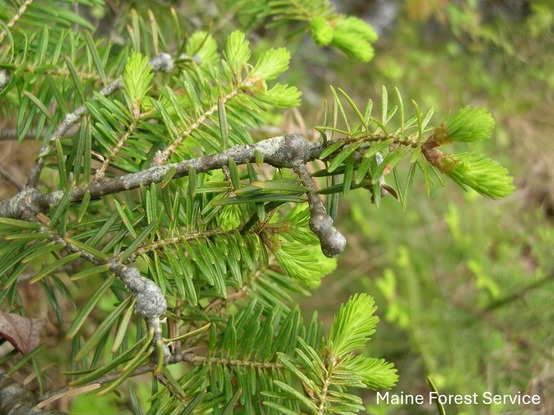 Image: Gouty branch nodes affected by balsam woolly adelgid.
For trees with limited damage visible in the branches and crowns, late summer provides an opportunity to scout for the waxy material that gives BWA and several other adelgid species the “woolly” part of their common names. The white wisps are well-defined on healthy BWA at this time of year. Heavy populations were observed on the trailside balsam firs at Aroostook State Park in Presque Isle late in August. A prior observation of heavy trunk-phase populations occurred in Presque Isle in February on the Northern Maine Community Trails.
This episode of high populations will cause drought stress in the impacted trees due to cellular changes in the tree around the BWA mouthpart insertion sites. The tissues produced are very poor at conducting water and very dense. If you’ve ever cored a balsam fir in a part of the bole that has feeding damage from adelgid, you will know it. On a species that normally cores like butter, your increment borer will run into a barrier that feels like rock. These BWA-induced rings, termed Rotholtz or redwood, are visible in tree cores, sanded tree cookies, and sawn lumber. In the case of fir trees that experience sudden mortality following drought, looking for Rotholtz can provide clues about whether prior BWA damage contributed to that mortality when other evidence of BWA is not present.
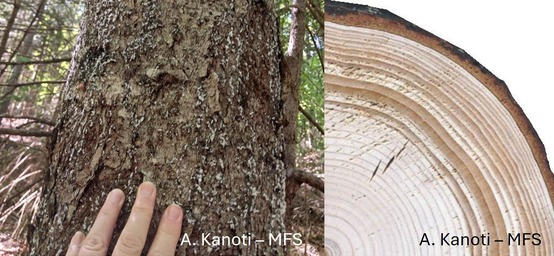 Images: (Left) Heavy populations of balsam woolly adelgid on the stem of a fir tree on the South Peak Trail in Aroostook State Park; (right) dark red rings are Rotholtz, a result of cellular changes caused by BWA mouthpart insertion, tree cross section from Atkinson, ME, 2004.
Managers in Northern Aroostook County and other far-northern parts of the state that were historically “exempt” from worrying about BWA damage should be on the lookout for this pest. In areas where BWA is present above trace levels on boles or at population levels high enough to cause crown deformity, consider this another reason to find a way to manage fir under short rotations and to urge stand composition towards species such as spruce and others that are not hosts to this insect whenever possible.
Browntail Moth (Euproctis chrysorrhoea)
Early-instar browntail moth caterpillars have emerged from their egg masses and have begun feeding on host plants. These small caterpillars feed primarily on leaf surfaces, referred to as skeletonization, which results in late summer leaf discoloration used by MFS during aerial surveys to identify areas with high BTM populations. Damage caused by browntail moth caterpillars this late in the growing season is generally not a serious health issue for trees. In addition to feeding, these caterpillars are beginning to construct their winter webs by creating silken pathways on a few leaves at the tips of a branch. These webs are very small and can be difficult to notice until leaf-off later this fall.
We have been getting many reports of large webs in trees, raising concern that these may be browntail moth winter webs. Large webs (>10 inches) in trees in late summer are most likely from fall webworm caterpillars, not browntail moth caterpillars. These native caterpillars and their webs are not a concern for trees or humans; instead, they are a great food source for birds and help support other beneficial insects in our forests. Unlike browntail moth winter webs, fall webworm webs will start to break down by winter. Read more about the difference between browntail moth webs and fall webworm webs in our latest browntail moth update.
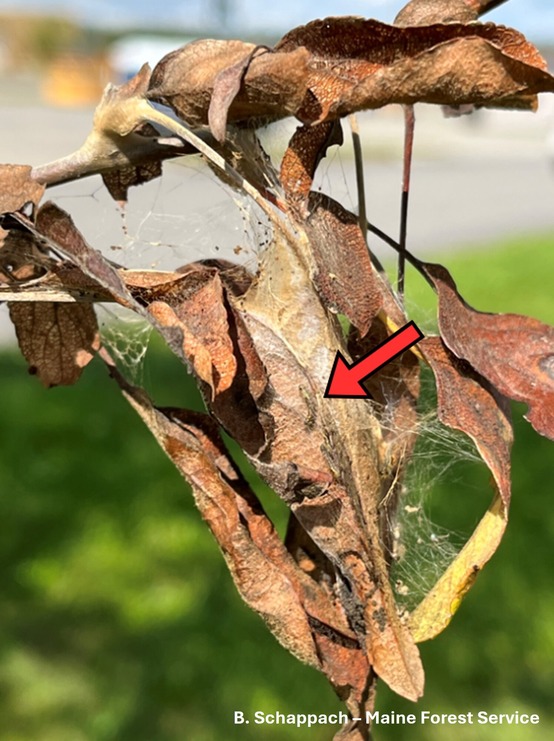 Image: The red arrow is pointing to young browntail moth caterpillars constructing their winter web in early September.
Cecropia moth (Hyalophora cecropia)
In late summer we run across a wide variety of different caterpillar species that wander in search of a safe place to spin a cocoon and pupate. Most of these species spend the winter as pupae and emerge in the spring as adult moths or butterflies. One such species we recently observed was the caterpillar of one of our native silk moths, the cecropia moth. It is our largest native moth and is sometimes mistaken for a bat around lights at night. The caterpillars are quite large as well, with a bright green body and prominent knobs that are pale blue, yellow and orange on the top and side of the body, arranged in rows.
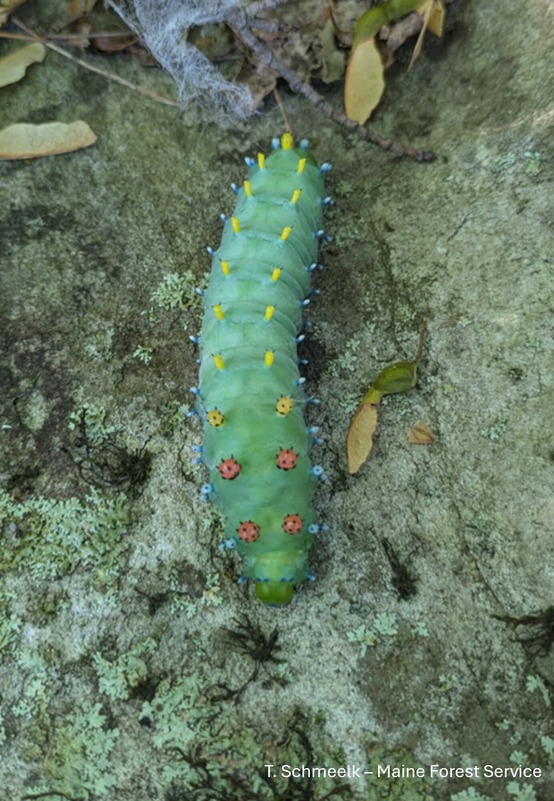 Image: Cecopia moth caterpillar crawling along the ground, Liberty ME.
The caterpillars can be found in May through October in most of their range. The larvae consume the leaves of a wide variety of shrubs and trees from vastly different plant families, including alder, apple, ash, beech, birch, boxelder, cherry, dogwood, elm, gooseberry, maple, plum, poplar, white oak, and willow. Cecropia moths are not as common as they once were due to a number of factors, which include pathogens, habitat loss, light pollution, pesticides, and an introduced parasitoid fly that was released in the late 1800s to combat spongy moth. Another factor thought to contribute to the decline of this species in some parts of its range is the movement and introduction of individuals by well-meaning people from various parts of its range in an effort to increase genetic diversity. This practice can cause more harm than good by spreading pathogens and degrading natural gene pools.
Hemlock Woolly Adelgid (Adelges tsugae)
This is just a brief reminder that hemlock woolly adelgid (HWA) is now in the period of lowest risk of spread. From now until March 1 is a good time to do work in your hemlocks without worry of spreading eggs or mobile crawlers of HWA. The crawlers from this past summer settled onto a hemlock host tree and are now in aestivation (summer hibernation). Later in the autumn, they will start to feed and grow, but risk of spread will remain low until they reach maturity and start to lay eggs in the late winter/early spring.
Oak Twig Pruner (Anelaphus parallelus)
When the end of oak branches dangle from trees in late August, you may wonder what caused this phenomenon, called “flagging.” Upon closer inspection, you may find that these branch flags are the handiwork of the oak twig pruner, a native beetle whose damage becomes more obvious in late summer. Oak twig pruner larvae spend their first-year feeding and developing inside oak twigs, where they overwinter and resume feeding in the following spring. Throughout the spring and summer of their second year, they hollow out the twigs they inhabit, leaving a thin layer of bark so the twigs break and eventually fall to the ground. The fallen twigs may still have green leaves, but they can also turn brown before they fall. The larva inside may pack the oval-shaped opening at the cut end of the twig with a frass plug to keep out predators. The larvae remain inside the fallen twigs and pupate in the autumn.
Although fallen branchlets may be alarming, oak twig pruners are not a significant threat to tree health. To reduce the severity of damage on ornamental oak trees, pick up the fallen branchlets soon after they’ve fallen and dispose of them to reduce populations.
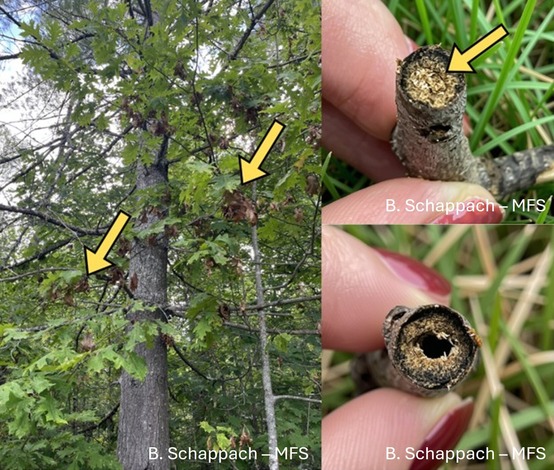 Images: (left) Red oak tree with multiple brown branch “flags”; (top right) Yellow arrow points to an oval-shaped frass plug at the severed end of a fallen oak branchlet; (bottom right) Fallen oak branchlet with frass plug removed to reveal twig mining made by oak twig pruner.
Spongy Moth (Lymantria dispar)
In 2019, the internal quarantine on spongy moth in Maine was lifted, and the entire state became subject to the federal spongy moth quarantine. The spongy moth has made inroads in northern Maine in recent years, where people may not be accustomed to its signs or to responding to its presence.
This time of year, adults are just wrapping up activities, including laying eggs that will overwinter. Egg laying will soon come to an end. In low populations, scraping egg masses can be effective in mitigating damage from spongy moth. Scrape the masses into a container and either soak them in hot, soapy water or seal them in a bag and dispose of them. In this 2021 video, before the common name for this insect was changed, MFS provides tips on finding and discarding spongy moth egg masses.
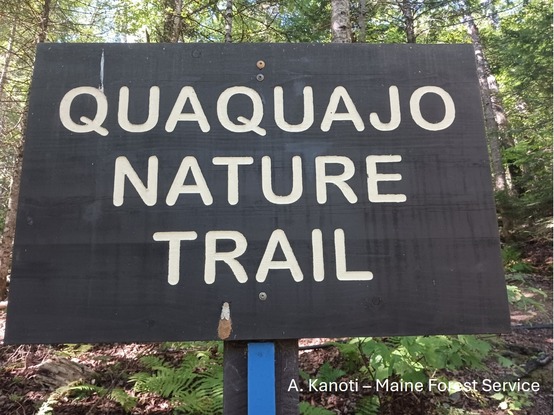 Image: Female spongy moth depositing eggs on a sign (look below the “R” in “TRAIL”) in Aroostook State Park, Aug 28, 2026.
Spotted Lanternfly (Lycorma delicatula)
Following last month’s coverage of spotted lanternfly (SLF) in our conditions report, the New Hampshire Department of Agriculture, Markets, and Food (NHDAMF) recently reported on their first field detection of adult SLF in Salem, NH. While the few adult SLF recovered do not necessarily constitute an established population and follow-up survey will be required, this is a timely reminder to remain vigilant as this invasive pest spreads northwards towards Maine. SLF is already established in 19 other states, including nearby Massachusetts.
The preferred host plant of SLF is tree-of-heaven, Ailanthus altissima, an invasive species that is also spreading northwards and can already be found in southern Maine. SLF is infrequently intercepted in Maine, which to date has mostly come from warehouses finding dead adult SLF Coming from states with heavy SLF infestations. Most concerning for Maine is this insect’s ability to cling to vehicles and be transported over great distances (SLF even caught a ride to Maine on a cruise ship in 2023). They also lay their egg masses on almost any substrate, which are extremely well-camouflaged and often appear as nothing more than a subtle streak of dried mud. If you suspect you’ve found a SLF in Maine, please take a picture and report it.
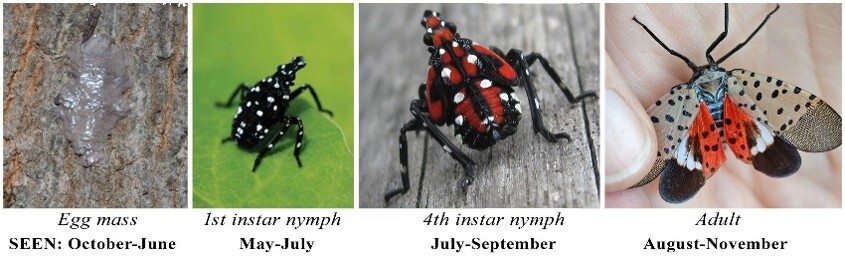 Image: Spotted lanternfly life stages include (from left to right) eggs, nymphs and adults. Older red, black and white nymphs, adults and eggs are likely to be found this time of year. (Maine DACF CAPS)
Spruce Beetle (Dendroctonus rufipennis)
Spruce beetle (Dendroctonus rufipennis) is a native bark beetle in Maine that primarily targets mature and overmature spruce. An opportunistic species, the aptly named spruce beetle is known to attack white and red spruce in various stages of decline. This decline can result from any number of insect, disease, or abiotic stressors that weaken a tree enough for the beetle to gain a foothold. These factors can include sudden events such as blowdowns or gradual stressors such as last year's drought. Historically, insect defoliation from pests such as spruce budworm has been a major contributor to this stress, though much of the recent spruce beetle activity has been further south along the coast where spruce budworm activity is fortunately minimal.
There have been outbreaks of spruce beetle along the coast in the past, including one in the 1990s when more than 90% of Downeast spruce greater than 15 inches in diameter were killed. While not all these trees were experiencing the same stress, once beetle populations reach a high enough threshold, even healthy trees can become susceptible to attack. It is thought that a combination of limited stand management and the shallow soil profiles common along the Maine coast contributed to this outbreak. Later, in 2007, mature spruce that had survived the 1947 fire in Bar Harbor were also attacked. In this case, spruce beetles were found in red and white pine as well, though damage remained minimal in these hosts because the trees were able to successfully pitch out the attacking beetles.
“Pitch tubes” consisting of resin and frass are a common sign of spruce beetle attacks. Adult beetles bore through the bark to reach the cambium, where they create vertical galleries beneath the bark and lay their eggs. Once hatched, the larvae create their own galleries radiating outward from the parent gallery, which can eventually girdle the tree. Larval activity can also be associated with bark loss as woodpeckers feed on the nutritious grubs beneath the bark. As damage to the tree's vascular tissue progresses, foliage will begin to turn brown from the top of the tree downward. Under heavy beetle pressure, tree death can occur within a single season.
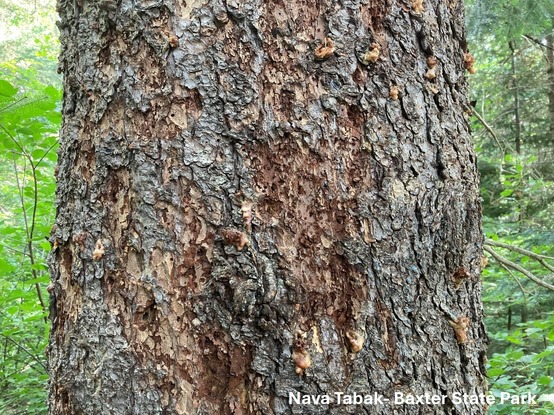 Image: Trees affected by spruce beetle will often exhibit pitch tubes and bark damage from woodpeckers.
When an infested tree is identified, removal is typically the best management option. Larvae can continue developing in felled trees, however, so bark from the main bole should be chipped or burned before May, when adults emerge to seek new host trees. For those concerned with prevention, maintaining tree vigor is the most important management strategy. Providing supplemental water to high-value spruce during periods of drought may help make trees less susceptible to attack.
Spruce Budworm (Choristoneua fumiferana)
Spruce budworm pheromone traps across Maine were removed throughout August and our recently compiled results show elevated moth captures in 2026 when compared to 2027. BioSIM flight models used to predict SBW movement across the region indicated an active 2026 flight season and there were several nights where the model predicted moths dispersed into Maine and northern New Hampshire, Vermont, and New York. The map below shows an example of predicted SBW moth movement on the night of July 3, 2026.
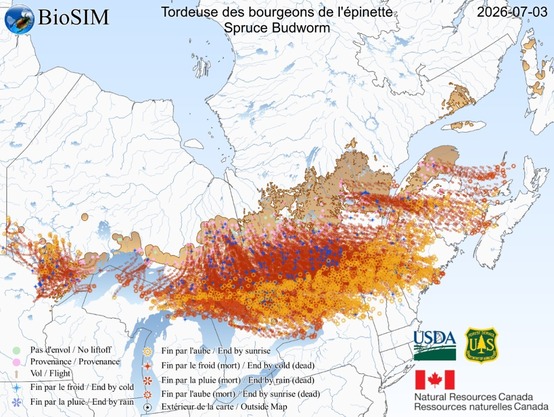 Image: BioSIM map of spruce budworm dispersal on July 3, 2026.
Not surprisingly, our pheromone trap data reflect these flight models, and significantly more moths were captured this season compared to last. While trap captures in northern Aroostook County were mostly as expected, we had two standout locations in Big Twenty Twp and Fort Kent where traps captured an average of over 500 moths. Less expected were higher trap captures in places like northern Oxford, Franklin, and Somerset Counties that historically capture very few moths each season.
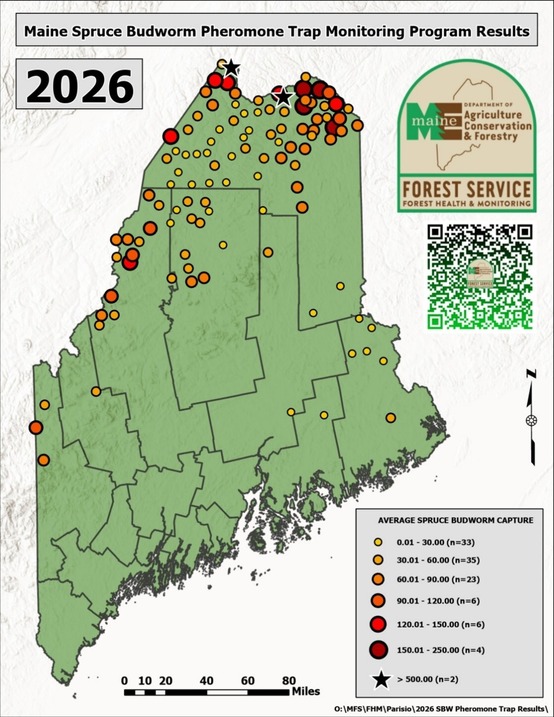 Image: Map of 2026 spruce budworm statewide pheromone trap network results.
Now that pheromone trap data are completed, Maine will move onto more intensive larval (L2) sampling over the fall and winter seasons. These pheromone trap network results have helped prioritize where L2 samples are collected first and which samples will be processed first at the UMaine SBW Lab in Orono. While high pheromone traps in an area do not guarantee high larval populations in the same area, it does provide useful guidance on how to approach these intensive statewide sampling efforts. Once overwintering larval densities are determined, these results will, in turn, guide management decisions for 2027, as Maine expects to enter its third season of cooperative Early Intervention Strategy (EIS) treatments in Aroostook County.
Insects in Firewood - We will say it again, if you store your winter’s worth of firewood inside the house, expect insects to come in with the wood. Most of these hitchhikers are just annoying, but there is the potential to bring in powderpost beetles or other wood boring insects that could infest the beams, floorboards, furniture etc. in your house. It is better to store wood outside under cover and bring a week’s worth in at a time.
Now through early October: Ash Protection Collaboration Across Waponahkik (APCAW) collaborators are seeking assistance in ash seed collection efforts throughout western, southern and central Maine. If you want to be involved, reach out to apcaw-group@maine.edu or view the APCAW event calendar.
Now through October 23: Comments Open for Risk Mitigation Measures for Red Pine Scale.
To participate:
- Review the draft Risk Management Document
- Submit your comments and feedback to forestry-foresterie@inspection.gc.ca by October 23.
Tuesday, September 22, 9:00 AM to 4:30 PM: MESAF Penobscot Experimental Forest Tour, Bradley, ME
Join the Maine Division of SAF on the PEF’s Diamond Anniversary (1950-2025) to discuss lessons learned in silviculture and operations – along with wildlife habitat and economic implications – from long-term U.S. Forest Service and University of Maine research in northern conifers and hardwoods in central Maine.
Registration is required
Wednesday, September 23, 3:00 PM to 5:00 PM, Planning in the Wild: Invasive Species Workshop, Hidden Valley Nature Center, 131 Egypt Road, Jefferson
Join the Hidden Valley Nature Center and Lincoln County Regional Planning Commission for an informative walk and talk workshop at Hidden Valley. The Department of Agriculture Conservation and Forestry, Maine Natural Areas Program, and Maine Forest Service will lead this program on common terrestrial invasive species and how to deal with them on your property. Registration requested.
Thursday, September 24, 6:00 PM to 7:00 PM, Spruce Budworm Treatment Information Session, UMFK, Fort Kent
Join the Maine Forest Service and University of Maine at Fort Kent staff involved in the project for a free educational event to learn more about spruce budworm, monitoring, and this year's efforts and results from the Early Intervention Strategy management.
This event is free, but registration is required. The session will be canceled in the event of low registration.
Friday, September 25 through Sunday, September 27: Common Ground Fair, Unity
Maine Forest Service will be at Common Ground Fair; visit with us in the Low Impact Forestry Area. Tom Schmeelk will be a guest speaker for Maine Woodland Owners on Friday and Colleen Teerling will speak with Ash Protection Across the Wabanakik on Sunday.
Monday, November 16 through Friday, November 20, 5:30 PM to 7:30 PM: Maine Forest Service: Landowner 101. Bucksport, ME
This class is through RSU 25 Adult and Community Education. The weeklong Landowner 101 course will cover topics and information to help guide woodland stewards through the sustainable management of their forest. One session will focus on common forest insects and diseases affecting the Midcoast and Downeast. This class is free, but registration is required.
If you require an accommodation or service to participate, please contact us at dacf@maine.gov or (207) 287-3200 at least 5 days prior to the event.
Conditions Report No. 4, 2026
On-line
Department of Agriculture Conservation & Forestry, Maine Forest Service – Forest Health and Monitoring
Contributors: Aaron Bergdahl, Amy Emery, Allison Kanoti, Gabe LeMay, Mike Parisio, Brittany Schappach, Tom Schmeelk, Colleen Teerling, and Andy Whitman.
|