|
Maine Forest Service continues to monitor for emerald ash borer (EAB) using purple prism traps (PPTs). Field staff deployed 161 PPTs in May prior to the adult emergence period in Maine. Given the extent of emerald ash borer infestation in Maine, these PPT locations are focused within areas of Maine’s EAB quarantine zone where EAB has not been confirmed and areas outside of the quarantine where we expect EAB will show up due to human activity. Once peak EAB emergence has passed, PPTs are inspected for adult beetles in July and a new lure is added for the remainder of the monitoring season. PPTs checked this past July led to two important detections. First, an adult beetle recovered from a PPT in Bristol marked the first known detection for Lincoln County. Second, and more surprisingly, an adult beetle was recovered from a PPT in Jackman. Unfortunately, Jackman is well outside the existing EAB quarantine area in Maine. Given the great distance from the next closest EAB population and Jackman’s popularity for tourism and outdoor recreation, we suspect this detection is linked to the transportation of infested firewood in violation of Maine’s quarantine laws. The detection in Jackman adds to a growing list of emerald ash borer populations in Maine that are most likely linked to the movement of infested firewood—arriving in areas where wood flow is largely out of the area due to harvest with the exception of recreational and home-heating firewood. The quarantine will be expanded in response to the detection in Jackman and the new regulated area will be announced shortly.
The Jackman detection also illustrates the challenge that prompted the Department to propose deregulation of the emerald ash borer. As EAB continues to spread and new, geographically isolated infestations are detected, the effectiveness of the existing quarantine as a tool to slow its spread has diminished. DACF has therefore proposed removing Maine's current EAB regulations and is seeking public comment on the proposed rule changes:
August 18, 2026, 12:00 PM to 2:00 PM, at the Maine Potato Board Conference Room, 744 Main St #1, Presque Isle, ME 04769 and a simultaneous virtual option on Microsoft Teams
August 18, 2026, 5:00 PM to 7:00 PM, at the Maine Forest Service, Central Region Headquarters, 87 Forestry Way, Old Town, ME 04468 with a simultaneous virtual option on Microsoft Teams
We strongly encourage written comments from the public to aid in the decision-making process. The written comment deadline is August 28, 2026, at 5:00 PM. Comments can be emailed to gary.fish@maine.gov or sent via mail to Gary Fish, Maine Department of Agriculture, Conservation and Forestry, Plant Health Programs, 28 SHS, Augusta, ME 04333-0028.
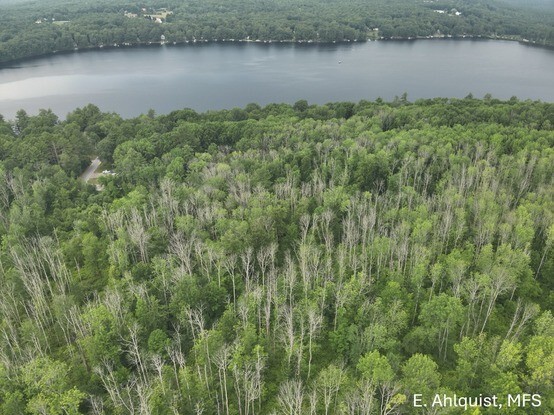 Image: A forest of ash tree skeletons killed by emerald ash borer observed during aerial survey in Poland, ME.
From Northwestern Now
As trees disappear from urban neighborhoods, lives may be lost with them.
In a new study, Northwestern University scientists tracked death rates and fluctuations in tree canopy cover across an 11-year period in Chicago. They found that areas experiencing greater losses in tree canopy — land covered by trees’ leafy crowns — also experienced higher mortality rates, particularly in the city’s hottest neighborhoods.
The findings, published in GeoHealth, suggest cities should prioritize protecting mature trees alongside planting new ones. Given the myriad health benefits associated with trees, tree maintenance has become even more crucial as human-caused climate change drives more extreme weather and intensifies heat risks in cities.
“Previous studies have mostly looked at how health outcomes are associated with static tree canopy coverage,” said Northwestern’s Daniel Horton, the study’s senior author. “These snapshot-style studies looked at mortality rates and the tree canopy at one moment in time. But cities and their tree canopies constantly change, so we looked at how the canopy and death rates change over the years. We found that as tree canopy decreases, mortality increases.”
|
From City Trees
Decatur, Georgia City Arborist and TRAQ-certified UCFS Member Kay Evanovich presented to the Georgia Arborist Association in 2024 on “The New Cancellations: Homeowners Insurance and Trees.” Decatur, pop. ~25,000 and 4 square miles/10.4 square km in size, is a college town just east of Atlanta. In 2023, Evanovich received an escalating number of calls from anxious Decatur homeowners who’d received letters from their home insurance companies. Often vaguely worded, the gist of the letters seemed to be insurance nonrenewal or threat of cancellation due to tree limbs overhanging roofs. These imperatives come after insurance companies principally use drone, fixedwing aircraft, and satellite imagery that is analyzed by AI to roughly identify where canopy overhangs roofs.
Webinar: Tools for Urban Forest Pest Preparedness. August 19, 2PM
2026 MMA Convention: 90th Anniversary Year. October 7-8, Augusta Civic Center
Partners in Community Forestry Conference. November 16-19, St. Louis, MO
Forester II (Forest Products Utilization & Marketing), Maine Forest Service
|