|
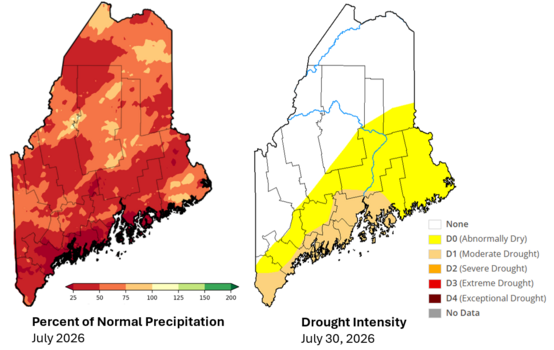
Image: (left) The percent of normal precipitation in July 2026 compared to the average precipitation normals for the same month from 1991-2020; (right) Drought expands to every county in July. Drought is expected to remain the same in August. Graphics from Northeast Regional Climate Center and U.S. Drought Monitor.
At the end of July, abnormal drought (D0) conditions in Maine expanded and now affect every county. Areas of severe drought (D2) in York County have improved to moderate drought (D1), but moderate drought has expanded along the Midcoast through Hancock County and as far north as the Bangor area. Spring 2026 provided much-needed relief from drought in many areas; however, with the reduced precipitation in June and July, much of the state is now quickly approaching drought conditions and impacts similar to those in September 2025.
July was one of the driest months on record for Maine; most areas in every county received only 25-50% of normal rainfall. As a result, there remains a roughly 6-10-inch statewide precipitation deficit compared to the normal water year (October 1 through September 30), which has led to low water tables in many areas (Northeast River Forecast Center 2026). Temperatures in June and July averaged about 1-3°F above normal, with some areas in Androscoggin, Cumberland, Franklin, and Kennebec experiencing temperatures 3-5°F above normal in June.
While El Niño has consistently affected some areas of the globe, its impact on temperatures and precipitation in the Northeast is variable (e.g., some El Niños have been dry, some wet, some slightly cooler, some slightly warmer, etc.), making future climate prediction challenging. In late July, the Climate Prediction Center forecasts above-normal precipitation for August. Temperatures in August have a 50% chance of being above or below normal (Climate Prediction Center 2026).
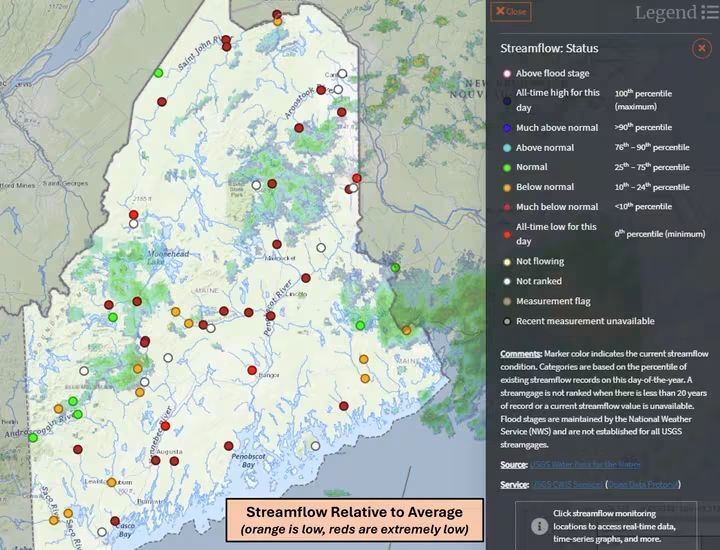
Image: Streamflow compared to average across Maine. Graphics from National Weather Service Caribou.
Annual aerial survey efforts for forest health issues are well underway for the season and surveyors have now covered most areas of the state from York to the northern reaches of Big Twenty Township. Surveyors are on the lookout for specific types of insect and disease damage known to be present at this time of the year and record any affected areas ‘on the fly’ using satellite-enabled digital sketch mapping software.
Oaks in particular in the Midcoast area experienced another year of extensive winter moth damage, ranging from light to severe defoliation. Damage was most concentrated between Bath and Bristol. Fortunately, browntail moth defoliation continues to decline in Midcoast areas following the peak of this outbreak in 2021.
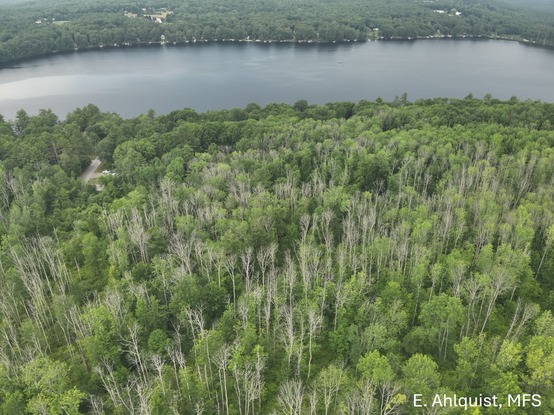
Southern Maine did reveal a few localized pockets of browntail moth defoliation, primarily in the same area on the western shores of Sebago Lake that was affected in 2025. Dieback and mortality of ash trees due to emerald ash borer were also observed throughout southern portions of the state, and the more recent infestations in Waterville and Newport are also now advanced enough to be highly visible via aerial survey. Further south, stands of discolored red pine are becoming a more frequent sight in southern Maine, as the highly damaging red pine scale continues to expand its footprint. Closer to the New Hampshire border, surveyors continue to document the lingering effects of the spongy moth outbreak that affected those areas for several years.
Image: A forest of ash tree skeletons killed by emerald ash borer observed during aerial survey in Poland, ME.
Downeast Maine is also experiencing the effects of red pine scale, which was detected in Acadia National Park in 2014 and has been radiating throughout the region. Beech leaf disease has also become increasingly visible from the air. Many beech trees have now progressed far enough through the disease that whole canopies are showing crinkled, distorted leaves. Stands of affected trees have been recorded across the southern half of the state, though damage is currently most severe along the Midcoast where beech leaf disease has existed the longest.
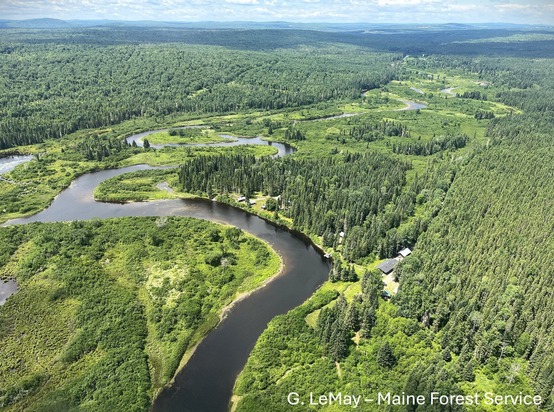
Image: An aerial survey of the northwoods near St Pamphile revealed remarkably little damage from spruce budworm in the area.
Further north, multiple flights have been conducted to evaluate the fate of spruce budworm in Aroostook County, following targeted aerial insecticide treatments conducted earlier this year and in 2025. Though substantial evidence of active populations is evident in untreated areas in the greater Fort Kent area and surrounding St. John Valley, very little spruce budworm activity was seen elsewhere, especially along the northwest border with Quebec where the bulk of aerial spray operations were conducted.
These observations help guide ground investigations, document changes in forest health over time, and inform management decisions across Maine. Though a significant portion of the state has already been covered, future aerial survey flights are planned later in the season to record other causes of forest damage, including the potential effects of last year’s drought. If you’re interested in seeing detailed maps of aerial survey data from the past, they are available in the Annual Summary Reports on the Maine Forest Service website.
Beech Leaf Disease (Litylenchus crenatae mccannii)
Beech leaf disease (BLD) continues to be found in new areas of Maine. Check the Maine Forest Service Invasive Species Dashboard for an up-to-date map of towns where BLD has been confirmed.
Treatment Trials
BLD treatment trials continue at several locations in Maine. For these trials, we are selecting beech trees that show high resistance to beech bark disease, indicated by smooth, canker-free bark. Macroinjections of Arbotect 20S (Thiabendazole Hypophosphite) were done for three smooth-barked beech trees at each 2026 site in late June (Bowdoin, Etna, Portland, Vassalboro). We now have injected a total of 30 trees at 10 sites from 2024, 2025 and 2026. The plan is to preserve these trees and their beech bark disease resistance genes by re-treating them on two- or three-year intervals.
An additional set of smooth-barked beech at each site have been selected for a bark drench application of Phiticide (Mono- and dibasic sodium, potassium, and ammonium phosphites) plus a Pentrabark adjuvant, as required by the Phiticide label. This bark drench treatment must be done twice each growing season with about one month in between treatments. Since this treatment must be done every year, we have revisited all trial sites twice this year for reapplication of the bark drench.
The trials have shown mixed results, with some trees responding quite well to one or both treatments. However, trees at some sites have not responded well. We can only speculate about reasons for this variability among trees and sites.
BLD Long-Term Monitoring Plots
BLD long-term monitoring plot work will begin in early August across nine sites in Maine. Sapling and seedling beech in the understory are in severe decline or already dead at most of these sites. Mature beech mortality due to factors associated with BLD was recorded for the first time in 2025 at sites in Knox and Waldo counties, where BLD was first confirmed in 2021. Observations from the 2026 plot work will be reported in the next Conditions Report.
A New BLD Treatment Option
Microinjection of Arborjet’s PHOSPHO-jet (mono- and di-potassium salts of phosphorous acid) has been trialed by Arborjet and has shown positive results. This treatment involves different equipment and lower volumes of mixed product compared to the macroinjection of Arbotect 20S, making application faster. Positive results of this treatment have been confirmed by an arborist in Maine. Information about this treatment can be found on the PHOSPHO-Jet factsheet.
Dutch Elm Disease (Ophiostoma ulmi, O. novo-ulmi)
Dutch elm disease (DED) is a vascular wilt pathogen that is fatal to elms. Infection by a vascular wilt pathogen disrupts water transport within an infected tree’s vascular system. This results in wilting and defoliation symptoms on infected parts of the tree. Once infected, there is no way to bring the tree back to health and the tree will die as the infection progresses. There are, however, possibilities to protect valuable elms from DED infection via root flare injections that must be done by a licensed commercial pesticide applicator.
DED is found throughout Maine and symptoms and signs of DED are currently visible among infected trees. Our office has fielded several calls about dying elms in recent weeks, prompting this brief disease overview. More information about DED can be found in the .
Images: (left to right) Early DED infection is often indicated by an infected branch of wilting, discolored leaves (referred to as a flagging branch); A green and healthy elm (green arrow) next to an elm that died in one year (brown arrow). Despite the ability of DED to spread to adjacent trees via root connections (root grafts), the healthy elm has remained so for the last two years.
Oak Wilt (Bretziella fagacearum)
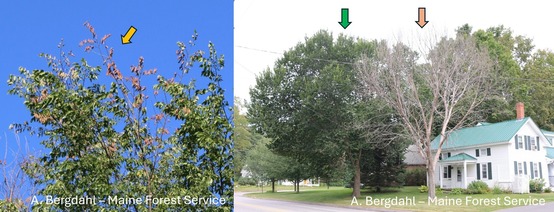
First, and very importantly, oak wilt (OW) has not been confirmed in Maine and the closest known location of the disease is in eastern New York State. This article serves to remind people to be vigilant regarding oak health and to report any instances of oak foliage wilting or oaks dropping leaves during the summer months – both potential symptoms of this disease that could threaten Maine’s oak resources. If you witness an oak tree dropping its leaves in summer, please report this to the Maine Forest Service or contact us at (207) 287-2431 or foresthealth@maine.gov.
OW is a vascular wilt pathogen, like DED mentioned earlier. Rapid discoloration, wilting and dropping of leaves are characteristic symptoms of this disease known to kill oak trees within as little as six weeks after infection. Once an oak is infected with OW, there are no therapeutic treatments to save the tree. There are, however, protective treatments that can be applied via root flare injection by a licensed commercial pesticide applicator.
OW can be transported longer distances by human movement of wood harboring the disease – emphasizing the importance of not moving firewood and other oak logs or wood products that have not been kiln dried or had their bark removed.
OW is spread over shorter distances primarily by sap-feeding beetles (Family Nitidulidae) attracted to freshly wounded oaks. This is why MFS recommends not pruning oaks from April to September, and if pruning must be done during this time, to seal wounds with latex paint or tree wound sealing products. OW can also spread underground via same-species root connections (root grafts). Refer to this MFS Oak Wilt Fact Sheet for more information about the disease.
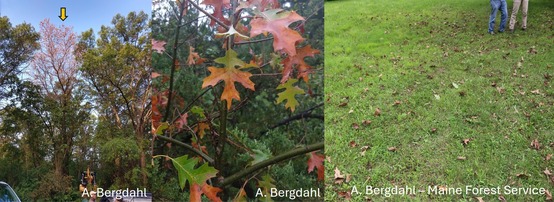 Images: (left to right) Orange arrow points to a recently dead oak in a Minnesota park; Discolored leaves of an oak an oak wilt-infected oak; Early-defoliated leaves of an oak wilt-infected oak tree in Pennsylvania.
Spruce and Fir Mortality
MFS staff have been receiving multiple reports from around Maine regarding sudden decline and mortality of spruce and fir trees. Many of these trees were reported to have died within a few weeks to a month. Some reports cited single trees in a yard setting, while others have reported groups of trees on field edges, in tree lines and along roadsides. This phenomenon has not been reported or observed in an interior forest setting.
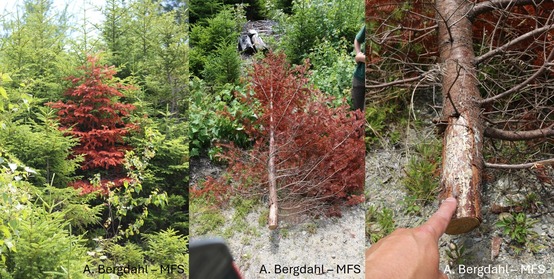
Images: A recently killed fir tree showing signs of attack by Armillaria root disease. Note the white fungal growth (mycelia) growing just under the bark.
Current and past inspections of similar occurrences by MFS staff have revealed a few consistent observations that are likely tied to stress events preceding symptoms. The growing season of 2025 was characterized by widespread drought conditions. It is believed that this led to weakened spruce and fir trees, predisposing them to attack by secondary agents of tree decline. Commonly, signs of insect and/or fungal attack are noticeable on closer observation of previously drought-stressed trees. Bark beetles specific to conifers are often attracted to mass-attack and breed in stressed trees. This is sometime preceded or followed by colonization of fungal root disease; often Armillaria root disease (Armillaria spp.), also known as shoestring rot. Some trees show evidence of attack by balsam woolly adelgid (Adelges piceae). Cellular changes caused by this insect’s attack can amplify drought impacts.
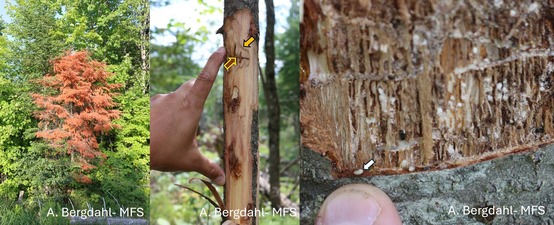 |
Images: Left to right: A rapidly killed fir tree; A dead fir tree with bark peeled back showing beetle galleries (brown arrow) and the margin of an expanding fungal infection possibly transferred to the tree by infesting beetles (orange arrow); Insect galleries revealed upon removal of bark of a recently dead spruce tree. The white arrow is pointing to a small beetle larva that was feeding and maturing under the bark.
Balsam Twig Aphid (Mindarus abietinus)
Balsam twig aphid is a native insect most commonly found on balsam fir. It has multiple generations per year; some asexual and some sexual. Some generations are winged while others are not. Some generations lay eggs and some give birth to live young. Because it is a native insect, there are many predators that help keep populations in check, and it rarely kills trees. However, at higher populations, it causes aesthetic damage, which is of concern to Christmas tree growers. Maintaining pollen-producing flowering plants near fir trees can help attract and maintain predators and parasitoids that can keep the aphid populations lower. When populations are high, pesticides may be needed if aesthetic damage cannot be tolerated.
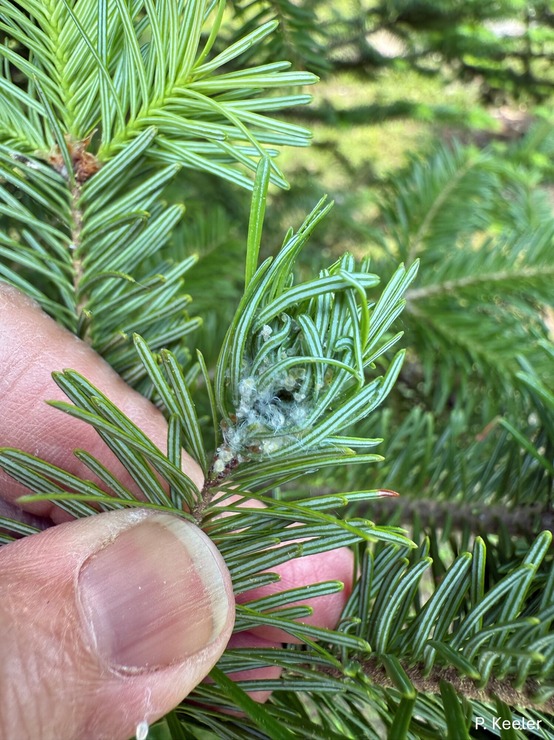
Balsam twig aphid is sometimes mistaken for hemlock woolly adelgid (HWA). Like HWA, it is a small sucking insect and often produces a white, wooly coating on its body (flocculence). However, HWA produces small, concentrated flocculence at the base of needles and does not distort needle shape. Balsam twig aphid creates a more diffuse flocculence and when populations are high enough, produces a very characteristic twisting and curling of needles. Furthermore, in North America HWA is always found on hemlock, and balsam twig aphid is usually found on balsam fir, although it also feeds on other firs and sometimes spruces.
Image: Balsam twig aphid produces a white substance around its body, causing it to be sometimes mistaken for hemlock woolly adelgid.
Browntail Moth (Euproctis chrysorrhoea)
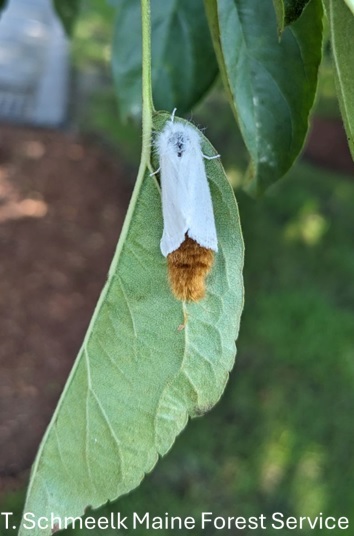
At this point in July, adult browntail moths have mated, the females have laid their egg masses on host foliage, and, having completed their life cycle, died. The next generation of caterpillars is developing inside these egg masses and will hatch in early August. The egg masses are laid on the underside of host tree leaves and are covered in a hairlike material that is exuded from the female when the eggs are laid. These are not the toxic hairs the caterpillars possess, but they serve as a mechanical barrier against predators and help prevent the eggs from drying out.
Image: Female browntail moth laying egg mass on the underside of host foliage.
When the caterpillars hatch from their egg mass later in August, they will feed communally and graze on the outer surface of the leaf, leaving behind the less nutritious, harder parts of the leaf. This feeding is called skeletonization and causes the leaf to die and turn a copper color. This damage can be used to identify areas with elevated browntail moth populations during late summer aerial surveys.
Emerald Ash Borer (Agrilus planipennis)
Maine Forest Service continues to monitor for emerald ash borer (EAB) using purple prism traps (PPTs). Field staff deployed 161 PPTs in May prior to the adult emergence period in Maine. Given the extent of emerald ash borer infestation in Maine, these PPT locations are focused within areas of Maine’s EAB quarantine zone where EAB has not been confirmed and areas outside of the quarantine where we expect EAB will show up due to human activity. Once peak EAB emergence has passed, PPTs are inspected for adult beetles in July and a new lure is added for the remainder of the monitoring season. PPTs checked this past July led to two important detections. First, an adult beetle recovered from a PPT in Bristol marked the first known detection for Lincoln County. Second, and more surprisingly, an adult beetle was recovered from a PPT in Jackman. Unfortunately, Jackman is well outside the existing EAB quarantine area in Maine. Given the great distance from the next closest EAB population and Jackman’s popularity for tourism and outdoor recreation, we suspect this detection is linked to the transportation of infested firewood in violation of Maine’s quarantine laws. The detection in Jackman adds to a growing list of emerald ash borer populations in Maine that are most likely linked to the movement of infested firewood—arriving in areas where wood flow is largely out of the area due to harvest with the exception of recreational and home-heating firewood. The quarantine will be expanded in response to the detection in Jackman and the new regulated area will be announced shortly.
The detection of EAB in Jackman comes at a time when the Department has proposed draft rules to deregulate the emerald ash borer, due to the continued spread of the insect. Maine Department of Agriculture, Conservation and Forestry will host two public hearings on the topic of removing Maine’s current EAB and European Larch Canker regulations:
August 18, 2026, 12:00 PM to 2:00 PM, at the Maine Potato Board Conference Room, 744 Main St #1, Presque Isle, ME 04769 and a simultaneous virtual option on Microsoft Teams
August 18, 2026, 5:00 PM to 7:00 PM, at the Maine Forest Service, Central Region Headquarters, 87 Forestry Way, Old Town, ME 04468 with a simultaneous virtual option on Microsoft Teams
We strongly encourage written comments from the public to aid in the decision-making process. The written comment deadline is August 28, 2026, at 5:00 PM. Comments can be emailed to gary.fish@maine.gov or sent via mail to Gary Fish, Maine Department of Agriculture, Conservation and Forestry, Plant Health Programs, 28 SHS, Augusta, ME 04333-0028.
Fall Webworm (Hyphantria cunea)
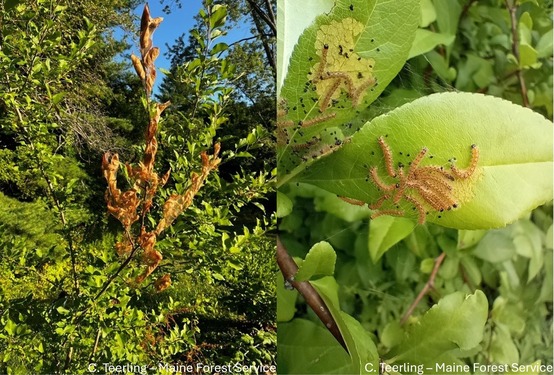
Every autumn, the Maine Forest Service gets calls about fall webworm, a native insect that creates webs in which it feeds gregariously. It has a wide host range of deciduous trees, and later in the autumn, the webs can become very large and unsightly. These webs can be alarming to those who don’t know what they are. Each year there are those convinced that if we don’t do something about this insect, there will be no green trees the following spring. Luckily, the caterpillars feed only on the leaves, and not next year’s buds, which have already been formed. Because the feeding is so late in the season, trees defoliated by this insect do not try to leaf out again. So, although the tree may lose a few weeks of photosynthesis from the damaged leaves, it is not harmed in any significant way.
Images: (left) Damage caused by fall webworm larvae to a tree branch; (right), small fall webworm tent on young apple tree.
Although it is called fall webworm, the caterpillars can hatch and begin feeding in July, creating small but very noticeable tents starting near the tips of the branches and moving toward the interior of the tree. Although the tree is not harmed, the webs can be very unsightly. At this time of year, it is easy to manage webs that are low enough to reach. Branches with webbing can be pruned, using sanitized snips. Be sure to prune to slightly below the brown, dead leaves, and remove some of the living leaves below them, as this is where the caterpillars are feeding. Alternatively, a forked stick or long pole with a nail driven perpendicular to the pole can be inserted into the web, and the web twisted out of the tree, removing most of the caterpillars. Finally, you can just look for the gregarious caterpillars on still-green leaves at the base of the web and remove those leaves. In all cases, you can transfer the removed material to another host that is not aesthetically important, allowing the caterpillars to develop relatively uninterrupted, or submerge it in a bucket of soapy water for a few hours, which will kill the caterpillars.
EDRR Invasive Species Alert - Be on the lookout for destructive tree-of-heaven
Biologists from the Maine Department of Agriculture, Conservation and Forestry are asking for the public’s help in locating and reducing the spread of severely invasive tree-of-heaven (Ailanthus altissima). Tree-of-heaven is native to Eastern Asia and was first introduced into the United States in the late 1700s as an ornamental and street tree for its hardiness. Tree-of-heaven is considered an Early Detection and Rapid Response (EDRR) species because it has only been sighted in a handful of locations in Maine (limited to York and Cumberland counties). Tree-of-heaven exhibits one of the highest rates of spread among U.S. tree species because of its prolific seed production and aggressive root system. Locating new populations of tree-of-heaven is urgent to support control and long-term monitoring of this species in Maine.
How can I recognize tree-of-heaven?
Tree-of-heaven looks very similar to our native staghorn sumac (Rhus typhina), so be sure to pay attention to the key traits listed below.
Key traits to identify tree-of-heaven
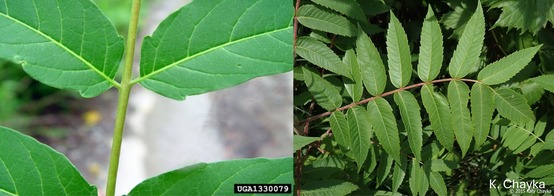
- The compound leaves are 1-4 feet long and made up of 10-40 oval shaped leaflets with smooth margins (sumac has serrated margins, see photos).
- The base of each leaflet is toothed and has round glands underneath.
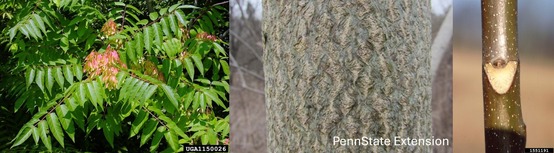
- Mature bark is smooth, grey or brown, and resembles the skin of a cantaloupe.
- The buds, leaves and twigs are arranged in an alternating pattern.
- The leaf scars are large and V- or heart-shaped.
- In late May-early June, small yellow-green flowers grow in clusters.
- In August-October, thousands of winged fruits called samaras are produced.
- Any part of the plant will give off a rancid peanut butter smell when crushed, giving it the nickname stinking sumac.
Image: smooth margins with toothed leaf bases of tree-of-heaven vs. serrated leaf margins of staghorn sumac.
Image: (left) Tree-of-heaven with samaras; (middle) tree-of-heaven bark and (right) stem with leaf scar.
If you would like more information or believe you have found tree-of-heaven, please send an email with photos and location to invasives.mnap@maine.gov, or map the location with photos by scanning the QR code (preferred). Also, visit iMapInvasives.org to see mapped locations, explore invasive species near you, and set up email alerts for your area or species of concern. Please visit our website www.maine.gov/dacf/mnap/ under the Invasive Species tab to view our invasive plant field guide for identification tips, and to sign up for a free iMapInvasives account.
Why is tree-of-heaven of concern?
Tree-of-heaven is an aggressively spreading deciduous tree that is extremely tolerant of poor soils, drought, and pollution. It can grow in pavement cracks, causing damage to streets, sewers, and building foundations. It produces hundreds of thousands of seeds per year and can also grow via root sprouting, colonizing large areas quickly and crowding out native plants. Additionally, the powerful allelopathic chemicals it produces negatively affect the growth of native species and increase the abundance of other non-native species. This process results in reductions to beneficial bacterial colonies in the soil, and stunted growth of native plants growing under the canopy of tree-of-heaven. Even after the removal of tree-of-heaven, it may take multiple years for native plants to recover.
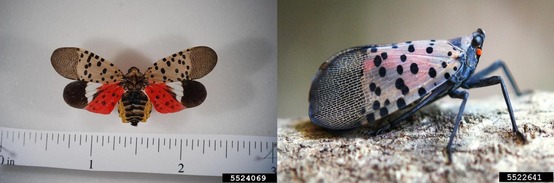
Images: Spotted lanternfly adults.
Spotted lanternfly amplifies tree-of-heaven’s potential impacts
Tree-of-heaven is also the preferred host tree of spotted lanternfly (Lycorma delicatula, SLF), a highly invasive sapsucking insect that feeds on over 100 different plant species. Although this insect strongly prefers tree-of-heaven, once this insect has an established population it is likely to feed on economically important woody plant species like grape, hops, maples and walnuts. SLF rarely kills its host, however, feeding harms the plant. Damage may include leaf wilting, branch dieback, and sooty mold growth. As the health of the host decreases, the increased vulnerability makes the plant more susceptible to other stressors, such as drought-stress and disease, which, in combination, can overwhelm and kill the host. Furthermore, SLF can have detrimental effects on local agricultural and hardwood production. For example, surveys of agriculture and forest industry professionals combined with economic modeling predicted a potential economic impact of $324 million loss in Pennsylvania each year due to this pest (Harper et al. 2019). Given SLF's strong preference for tree-of-heaven, managing or minimizing tree-of-heaven populations in Maine may be an important strategy for reducing the likelihood of SLF establishment and its associated impacts on agriculture and forests.
 |
Report tree of heaven by scanning this QR code.
Fir-Fern Rust (caused by Uredinopsis mirabilis): Many balsam fir trees in Christmas tree plantations are now exhibiting symptoms of fir-fern rust, a disease which alternates infections between balsam fir and certain fern species, especially sensitive fem. Conditions this past spring were ideal for infection of fir, and the causal pathogen seemed to successfully infect fir at greater distances from fern host plants than usual. Most infections on fir generally occur within about 50 feet of fern host plants, but moderate infections have been noted at much greater distances this year.
Monday, July 20, through Friday, August 28 at 5:00 PM, Public comment is open on the proposed repeal of the emerald ash borer and European larch canker state quarantine rules. Written comments can be emailed to gary.fish@maine.gov or sent through postal mail to Gary Fish, ME DACF, Plant Health, 28 SHS, Augusta, ME 04333-0028.
Friday, August 14, 10:00 AM to 2:00 PM, MESAF Summer Field Tour – Spruce Budworm Panel & Field Tour. Fort Kent, ME. Cost: $30 for MESAF members and $40 for non-members. Registration required.
Tuesday, August 18, 12:00 PM to 2:00 PM, Public hearing on the proposed repeal of the emerald ash borer and European larch canker state quarantine rules. Maine Potato Board Conference Room, 744 Main St #1, Presque Isle, ME and Microsoft Teams.
Tuesday, August 18, 5:00 PM to 7:00 PM, Public hearing on the proposed repeal of the emerald ash borer and European larch canker state quarantine rules. Maine Forest Service, Central Region Headquarters, 87 Forestry Way, Old Town, ME, and Microsoft Teams.
Tuesday, September 1, 9:00 AM to 12:00 PM, SAP-NE and APCAW Public Ash Seed Collection Training. Old Town, ME. Registration required.
If you require an accommodation or service to participate, please contact us at dacf@maine.gov or (207) 287-3200 at least 5 days prior to the event.
Conditions Report No. 3, 2026
Online
Department of Agriculture Conservation & Forestry, Maine Forest Service – Forest Health and Monitoring
Contributors: Aaron Bergdahl, Amy Emery, Chad Hammer, Allison Kanoti, Gabe LeMay, Mike Parisio, Brittany Schappach, Tom Schmeelk, Colleen Teerling, and Andy Whitman.
|