In This Edition:
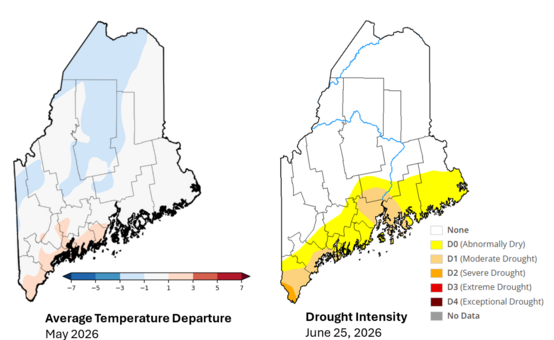
Image: The average difference in temperature in May 2026 compared to the average normal temperatures for the same month from 1991-2020 (left). Drought persists in several counties in June; however, conditions continue to improve and are expected to resolve completely in some areas (right).
Temperatures across the state were nearly average in May at about 50.8°F; only 0.3°F above average. Toward the end of the month, some northern areas were under frost advisories and freeze warnings, resulting in a handful of frost-damage reports from the public. Precipitation totaled 4.64 inches, which is above average compared to the May climate normals from 1991 to 2020. Seasonal temperature and precipitation are predicted to be above normal through August (Climate Prediction Center 2026). Past El Niño events have brought slightly more precipitation whiplash, or periods of severe drought following heavy flooding or vice versa, to Maine compared to non-El Niño years. Some forecasting models predict this year’s El Niño to be the strongest since 1850 (National Weather Center, Berkeley Earth 2026).
Statewide, drought intensity has continued to improve. In early May, about 27% of the state faced severe drought (D2). By the end of June, this had decreased to less than 1%, with the remaining areas improving to moderate (D1) or abnormally dry (D0) conditions.
Anthracnose foliar diseases
The consistent periodic rains in early summer have favored the spread of some leaf diseases caused by fungi in several genera, collectively referred to anthracnose diseases. Anthracnose diseases damage leaf tissue and some species cause cankers that can harbor the disease over the winter and lead to infections the following spring. Anthracnose diseases can cause severe, whole-tree defoliation, but they often simply cause leaf lesions, leaf deformity, and mild defoliation. Although the dead portions of leaves, spots, and deformities caused by anthracnose diseases are eye-catching and look serious, they are seldom major threats to tree health. Management is recommended only in serious situations and when tree aesthetics are of primary concern. Pruning dead wood and cankered branches/twigs during the dormant months can reduce overwintering sources of infections. Fall leaf clean-up and proper disposal, such as composting or landfilling, may also limit disease development in spring. Fungicides can be applied before budbreak and during leaf expansion to limit anthracnose diseases. Since there are many different anthracnose-type fungi with varying life cycles, it is critical to correctly identify the causal fungus prior to attempting management.
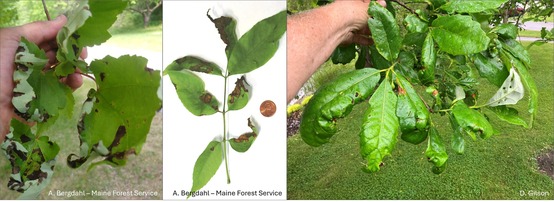 |
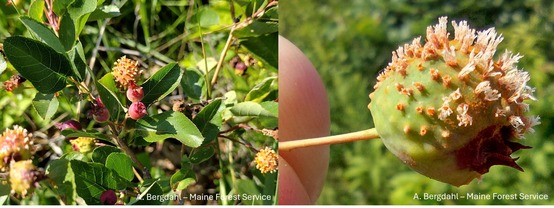
Images: (Left to right) Symptoms of maple anthracnose, ash anthracnose, and oak anthracnose.
Beech Leaf Disease (Litylenchus crenatae mccannii)
Beech leaf disease (BLD) continues to spread in Maine, but only nine new towns have been reported so far this year (reports from known infested areas continue). We believe this lower number of reports is because the public has become more familiar with the disease and it is spreading to less-inhabited areas of Maine, where surveys and public reports are less common. Since BLD was first detected in Maine in 2021, the total number of towns with detected BLD infestations is 404.
The Maine Forest Service (MFS) continues to trial tools for BLD management. We are mostly targeting beech bark disease-resistant trees (aka smooth-barked beech) in hopes of protecting these rare trees and the rare resistance genes they contain. Basal bark drenches of polyphosphite chemicals labeled for managing beech decline and macroinjections of Thiabendazole (Arbotect 20S) are the two main tools under trial. This year we treated beech trees on sites in Bowdoin, Etna, Portland and Vassalboro. We have also assessed all the trees treated by both methods in previous years – results have been mixed. Trees on some sites have responded to these treatments very well, while others not so well. The reasons for this are unclear. Check our website for more information about BLD and modes of management. You can also check the Maine Forest Service Forest Pest Dashboard for current BLD detections and the detections of other high-profile forest health pests in Maine.
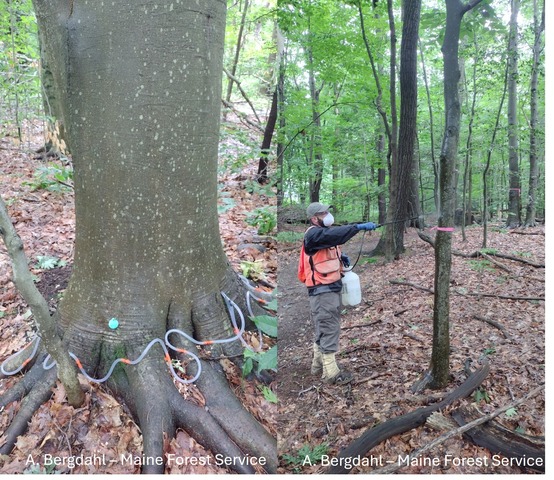 |
Images: (Left to right) A large, smooth-barked and beech bark disease-resistant beech tree in Portland being treated with a macroinjection of Arbotect 20S; Basal bark drench application of a polyphosphite product to a beech bark disease-resistant beech tree.
Gymnosporangium Rust of Serviceberry
On a recent trip to Midcoast Maine, on top of Mount Battie, a Gymnosporangium rust specific to Serviceberry (Amelanchier spp.) was noticed. A report of this disease was also received recently by MFS via our forest pest reporting system. This is not a serious or common disease, but is reported here as a feature of interest.
There are several fungal species in the genus Gymnosporangium that cause symptoms in hosts in both junipers (Juniperus spp.) and the Rose family (including apples, hawthorn, quince, etc.). Gymnosporangium rust fungi require host species in both of these groups to complete their complicated, five-spore-type life cycle and cause disease. A more common and commercially significant Gymnosporangium rust is confusingly named cedar-apple rust involving junipers (and less often, cedars) and apples.
Images: (left) Berries from an Amelanchier spp. bush infected by Gymnosporangium rust next to smooth, uninfected berries; (right) A close-up image of a berry with spore-producing structures (aecia).
White Pine Needle Damage Complex
A disease complex called white pine needle damage (WPND) has been impacting white pines in Maine for nearly two decades. WPND is referred to as a disease complex because it can involve one or more of the following white pine needle pathogens: brown spot needle blight (Mycosphaerella dearnessii); Bifusella linearis; Dooks needle blight (Lophophacidium dooksii); Septorioides strobi. Infection by these fungi results in the same sequence of symptoms beginning with yellowish bands on needles at points of infection, followed by needle/crown discoloration (yellow to orange), and early summer needle drop. As infected needles drop, the crown discoloration symptom subsides leaving thin-looking branches only holding current-year needles, and thus, thin looking crowns. This is especially seen in the bottom portions of the crown where disease symptoms are more prevalent. Reports from the field describe lower overall severity of WPND symptoms across Maine, with spots of severe symptoms occurring here and there throughout the white pine resource. The reason for this year’s overall lower disease severity is not clear and is a welcome positive development in the health of Maine’s white pines. Please feel free to check the MFS Fact sheet on WPND for more detailed information about the disease complex.
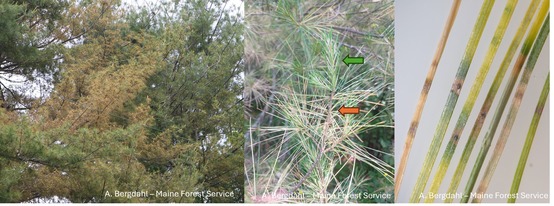 |
Images: (Left to right) Needles affected by WPND fungi in a white pine crown turning orange; A closer look at a white pine branch showing last year’s symptomatic needles (orange arrow) and the current year’s asymptomatic growth (green arrow); An even closer look at needle discoloration, needle banding symptoms and small black dots which are fungal fruiting structures of brown spot needle blight that will spread spores when they fully mature and break through the needle surface.
Possibly Bare-Patched Oak Leafroller (Pseudexentera spoliana (cressoniana))
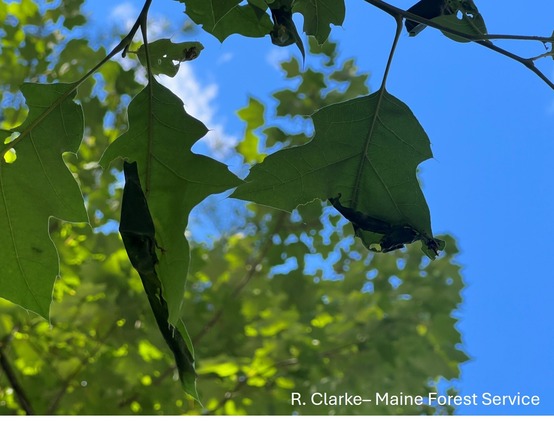
Leaf rolling damage was observed this June in Bangor, Greenbush, Old Town and Veazie, being particularly noticeable on roadside trees. Damage consisted of leaves rolled from the tip towards the twig, with feeding occurring within the rolled leaf tissue. Symptoms were observed throughout the crowns of affected trees and appeared restricted to oak hosts.
Although no specimens were collected, the pattern of injury and host association are consistent with bare-patched oak leafroller. Adults emerge very early in the spring to lay eggs on developing oak buds. Larvae then emerge to feed, first on buds and later on leaves, from within their rolled leaf shelters. They typically cease feeding by June, at which point they drop to the soil for pupation until the following spring.
Image: The bare-patched oak leafroller primarily affects red oak, where larvae feed from within leaves that have been rolled into protective shelters.
The bare-patched oak leafroller is occasionally a significant defoliator in Maine. Over 9,000 acres of defoliation were documented in 2012, centered around the town of Cherryfield. Additional activity in coastal Washington and Hancock counties continued in the years that followed, contributing to some oak mortality in 2016. Beyond Maine’s borders, this moth is also known in Atlantic Canada for a pattern of repeated defoliation events occurring throughout the late twentieth century, at one point impacting over 56,000 acres of forest in 1988. For the time being in Maine, the suspected bare-patched oak leafroller damage appears to be in a limited area, though future aerial surveys could provide a better understanding of the situation.
Browntail Moth (Euproctis chrysorrhoea)
Throughout June, we received reports of diseased browntail moth caterpillars in Bangor, Bridgton, Brewer, Naples, New Gloucester, Old Town, and Turner. Pathogens can help reduce browntail moth populations in localized areas, but will not eradicate populations, nor prevent them from escalating in the future.
Browntail moth caterpillars not impacted by the pathogens reached their full size and constructed “pupal packets” in their host trees. These structures protect the caterpillars from predators and weather conditions as they develop into adult moths. On July 1, an observation record for an adult browntail moth was reported on iNaturalist in Lewiston; this is the first report we have recorded this year. Browntail moths will continue to emerge from their pupal packets and be present through July as winged adults, capable of flight.
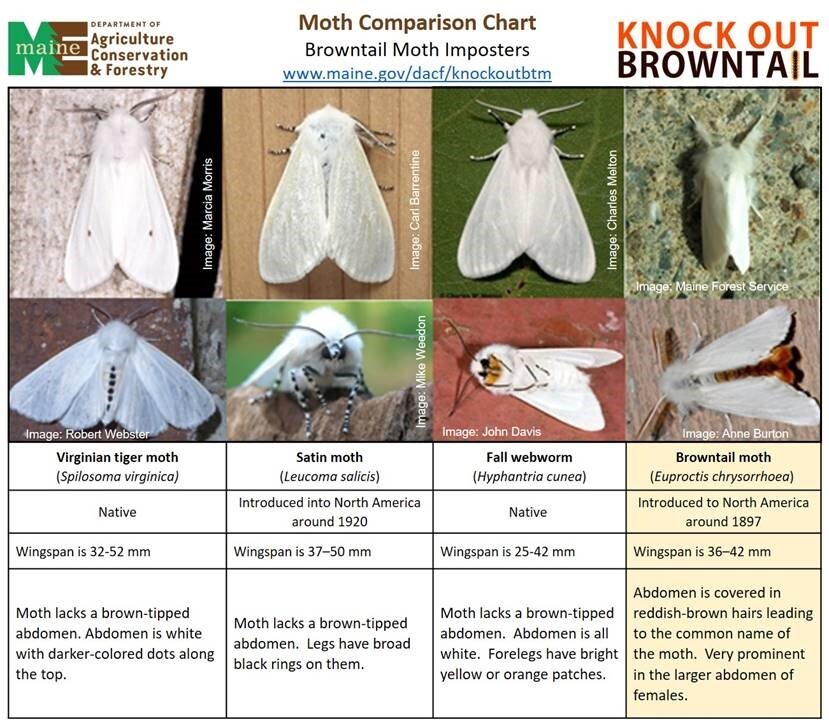
There are some common white moth species active during the browntail moth flight season. Adult browntail moths have white wings, white legs, and a reddish-brown abdomen, or “tail.” Sometimes, adults will have a small, black dot on each forewing. Although adult browntail moths can look hairy, they do not have the toxic hairs found in their caterpillar life stage. However, it is important to avoid touching the adult moths, as they may pick up residual rash-causing caterpillar hairs when emerging from their pupal packets.
Image: Moth comparison chart of the most common browntail moth “imposters” that you might see during flight season.
In July, browntail moth adults fly in search of a mate. To deter browntail moths from laying eggs in your backyard trees, turn off outdoor lights in July through early August. If you cannot turn off outdoor lights, consider using lightbulbs with a yellow hue, as this bulb color is the least attractive to browntail moths according to the latest research from the Mech Lab at UMaine Orono. Read more about this in the Mech Lab’s bulletin on their research on browntail moth’s attraction to artificial light. Additionally, our recent browntail moth update has a segment on “How to keep populations low around your house”.
Emerald Ash Borer (Agrilus planipennis)
At the end of June, adult emerald ash borer emergence approached its peak in southern Maine and was well underway in northernmost Maine, with emergence continuing throughout the summer months. Prior to emergence, the MFS installed 161 purple prism traps (PPTs) in key areas of Maine where EAB has not yet been detected. Once peak emergence has passed, MFS staff will revisit all these traps mid-season to check for adult beetles and replace the chemical attractant lure on each trap. Traps will remain in place until the end of flight season and will be removed in October. In addition to PPTs, MFS and cooperators have installed 29 girdled trap trees (GTTs) throughout the state to be processed throughout the fall and winter months. Aside from detecting new EAB infestations, these GTTs also serve as a tool to evaluate sites for future biological control releases, since the biological control agents used to help manage EAB populations cannot exist without viable EAB populations to serve as hosts.
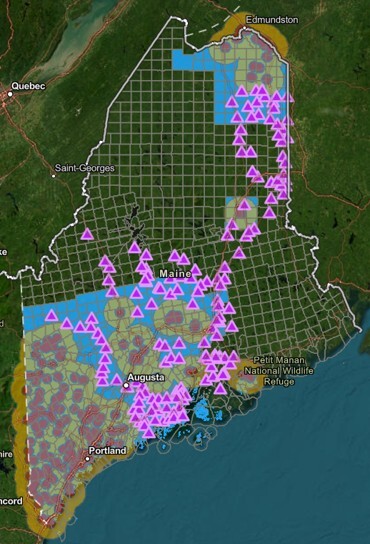 |
Image: Map of 2026 purple prism trap locations in Maine in relation to emerald ash borer quarantine areas and locations where emerald ash borer is already established.
Spongy Moth (Lymantria dispar)
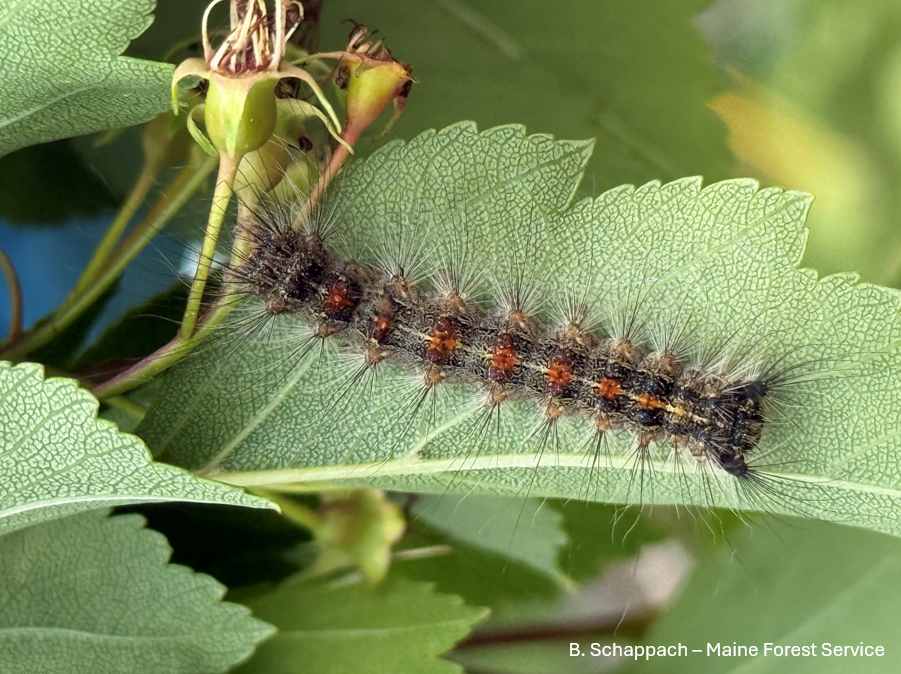
We have received a few reports of spongy moth caterpillars in Hancock, Lincoln, Penobscot, and Waldo counties this month. In early July, spongy moth caterpillars are roughly 2-2.5 inches long, approaching their full size. Spongy moth caterpillars have a distinct knob on each side of their heads, with five pairs of blue spots followed by six pairs of red spots down their backs. In areas with high infestation, trees can seemingly be defoliated overnight – especially because spongy moth caterpillars feed on their preferred host trees, oak, poplar, and birch, at night. On occasion, spongy moth caterpillars can also be found chewing on all conifer species, except fir.
Although the caterpillar treatment window has passed, local spongy moth populations can still be reduced by removing their egg masses. In late July and August, look for quarter-sized, buff-colored egg masses on tree trunks and branches or outdoor structures such as house siding, porches, or outdoor furniture. Scrape off the egg masses into a container of soapy water and leave for a few days before disposing of them. Spongy moth populations have remained low in the past few years, with the last outbreak occurring in 2021 and 2022, with over 50,000 acres of damage recorded both years. Last year, our aerial surveys recorded 1,546 acres of outbreak-related mortality in Oxford County.
Image: Fourth instar spongy moth caterpillar in June. Behind the knob-like structures, the current markings will develop into five distinct pairs of blue spots followed by six distinct pairs of red spots as the larvae grow to their fifth and sixth instars.
Spruce Budworm (Choristoneura fumiferana) Early Intervention Strategy Project
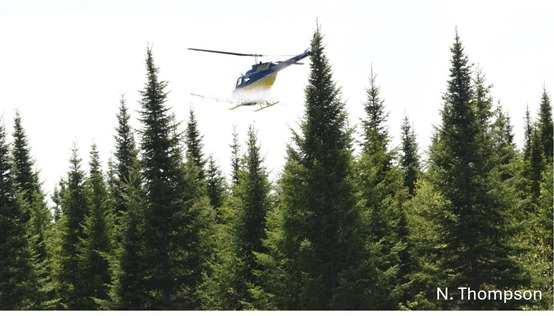
The MFS, along with partners in the Maine Budworm Response Coalition, cooperating state agency staff, the Spruce Budworm Lab at the University of Maine, Orono, Dr. Neil Thompson of the University of Maine at Fort Kent, and contractor JBI Helicopters, successfully completed the 2026 Early Intervention Strategy (EIS) treatments for spruce budworm on June 8, 2026. During the project, 63,609 acres were treated with Mimic 2LV and 1,296 with Foray 76B, for a total of 64,905 project acres.
The 2026 project involved commercial timberlands, state lands and private woodlots. For operations, the treatment area was divided into five distinct zones of roughly equal acreage, spanning from Saint Pamphile in the west to Madawaska Lake in the east. Zone 5, centered primarily around the greater Fort Kent area, consisted primarily of smaller woodlots and was coordinated by MFS. In this program, 38 landowners voluntarily enrolled 127 small woodlots for treatment in 6 towns.
Up to and immediately prior to treatment, bud development of spruce and fir host trees was monitored carefully each day to determine that the proper stages were reached to ensure on-target application, allowing the program to open in all zones on June 3.
Insecticide applications began on June 3, with favorable weather throughout the project area and the treatment day (5:00 AM through 8:00 PM). 29,263 acres of spruce-fir and mixed-woods forests were treated with Mimic 2LV.
Thursday, June 4, provided a small window suitable for treatment. Helicopters got started while the winds were ideal for treatment, and operations shut down for the day in all zones by 10:15 AM, before the winds reached the high end of the operable limits. During this short treatment window, 7,378 acres of forest were treated with Mimic 2LV, and 201 acres with Foray 76B. Two small woodlots were treated with Foray 76B on June 4 as well.
Friday, June 5, provided a full day with favorable conditions for treatment. Zone 5 access control staff had swept spray blocks and were in position by 4:30 AM and worked well into the evening to allow the patchwork of small landowner lots to be treated across a five-town area. 25,809 acres of forest were treated with Mimic 2LV, and 885 acres with Foray 76B. Treatments on four of the five zones were concluded. All remaining small landowner blocks in Zone 5 were treated on June 5, which left three small landowner woodlots to treat in Zone 4.
Image: Helicopter with spray boom treating mature balsam fir forest where SBW populations were determined to reach the Early Intervention Strategy threshold through sampling of overwintering (L2) larvae.
The weekend of June 6 and 7 did not have weather conditions suitable for application. MFS staff worked to ensure signs were properly posted in Zone 5 and did not block newly opened ATV trails and removed signs in areas where more than 48 hours had passed since treatment.
On Monday, June 8, treatment in the project area concluded with a 5:00 AM start and 8:55 AM finish. 1,159 acres of forest were treated with Mimic 2LV and 210 with Foray 76B.
|
Ownership Type
|
Mimic
|
Foray
|
Combined Acres
|
|
Public Lands
|
1,578
|
70
|
1,647
|
|
Small Landowner
|
1,661
|
995
|
2,656
|
|
Large Landowner
|
60,370
|
231
|
60,601
|
|
TOTAL
|
63,609
|
1,296
|
64,905
|
This is a short, simplified summary of operations for a lengthy, complex project that has involved hours of careful planning, beginning at the close of the 2025 treatment season. The MFS truly appreciates the time and effort of all staff involved in designing and implementing the small-landowner EIS treatment project, as well as all cooperators who helped implement the larger treatment program.
Wasp Mantidfly (Climaciella brunnea)
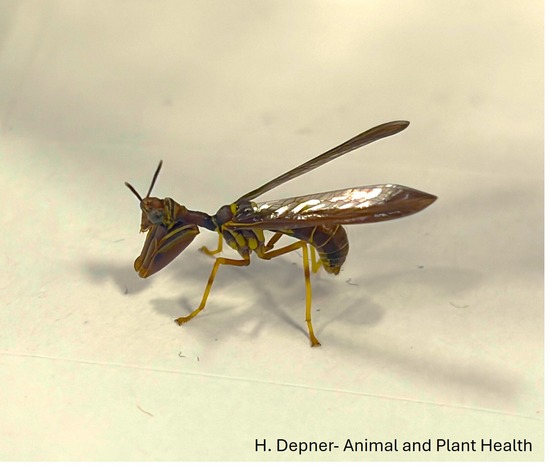
One of Maine’s less commonly seen insects showed up at the lab this month. Looking like a sci-fi hybrid of a praying mantis and a paper wasp, the wasp mantidfly is not related to either, but is part of the lacewing order (Neuroptera). They are ambush predators and will wait for prey, which they grab and hold, mantis-like, with their specialized forelegs. Mantidflies do not have a stinger, but when disturbed they will curl their abdomen in a way that looks like a wasp preparing to sting.
Image: The wasp mantidfly looks like both a praying mantis and a paper wasp but is related to neither.
Winter Moth (Operophtera brumata)
Elevated winter moth populations continue to cause defoliation in the Midcoast region, with many reports coming from Woolwich, Bristol, Edgecomb, and Brunswick. Visible roadside defoliation along the I-295 corridor in Brunswick has been noticeably severe. While aerial survey flights will follow, ground survey was also performed this year in the Midcoast to capture the geographic footprint of the damage area before the trees produce another set of leaves.
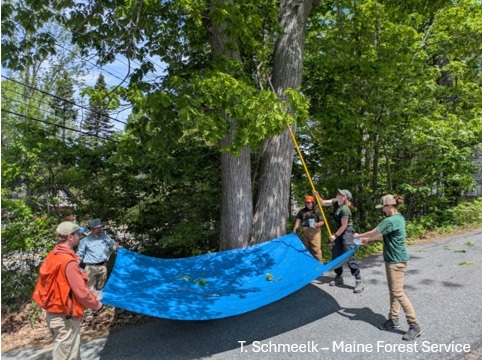
On May 27 and 28, the MFS hosted forest health staff from Connecticut, Rhode Island, and our long-time collaborators from the University of Massachusetts at Amherst for winter moth biological control collections. This mobilization was made possible by the Northeastern Forest Fire Protection Compact Forest Health Working Team to bolster the number of winter moth caterpillars collected and, in turn, the number of the Cyzenis albicans available to support winter moth biocontrol programs. During the mobilization, 6596 caterpillars were collected. Additional collections were made with MFS staff in Bristol and Thomaston, with Charlene Donahue (MFS retiree) making a collection on Vinalhaven to determine biocontrol establishment from a release in the 2010s.
Image: Winter moth caterpillar collection during the two-day mobilization.
“Sawyer Beetles: are now very active especially in softwood areas with dead or dying trees or in wood yards. These large (1/2”-1 1/4" long), slender black to grey or brownish, often mottled beetles with long "feelers" (antennae) can be seen clambering over softwood in search of a mate or a place to lay eggs. Eggs are laid in the bark of weakened or freshly cut softwoods where they will hatch and the whitish grubs or roundheaded borers begin their boring. Once wood is infested, control is difficult. Much worm-riddled wood has been rendered unmerchantable by larvae of this complex of 4 species. The easiest methods of control involve a complex wood-handling procedure. Prompt debarking will render wood unsuitable for egg laying. Winter processing would also aid in reducing the problem.”
Tuesday, July 7, 2:30 PM and 3:30 PM, Ash Injection Demonstration. Rumford, ME. Join USDA APHIS researcher Dr. Phillip Lewis for a demonstration of insecticide injection techniques to protect ash trees from the emerald ash borer. These sessions will share helpful tips and tricks for those with some injection experience, as well as the basics for beginners. Space is limited; fill out the registration form to reserve a space and receive program details.
Wednesday, July 15, 5:00 PM, Update on local forest pests, Bremen, ME. Hosted by Bremen Conservation Commission and held at the Bremen town office. This program will discuss the invasive pests attacking trees in the area - which trees are most seriously afflicted, the pests involved, any potential remedies or preventive measures, and recommendations for replanting if significant numbers of trees are lost.
Wednesday, July 29, 9:30 AM, Emerald Ash Borer Workshop, Madison, ME. The Maine DACF and Somerset Woods Trustees are hosting a workshop to update public tree and forest managers and public works staff along with interested community members on the known status of emerald ash borer in Maine, local and state management efforts, municipal support opportunities, and will include plenty of time for Q&A. Register online for this event.
If you require an accommodation or service to participate, please contact us at dacf@maine.gov or (207) 287-3200 at least 5 days prior to the event.
Conditions Report No. 2, 2026
View on-line
Department of Agriculture Conservation & Forestry, Maine Forest Service – Forest Health and Monitoring
Contributors: Aaron Bergdahl, Amy Emery, Allison Kanoti, Gabe LeMay, Mike Parisio, Brittany Schappach, Tom Schmeelk, and Andy Whitman.
|