Browntail Moth Update #7: June 25, 2026
Browntail moth caterpillars are no longer active at any of our monitoring sites. Instead, the caterpillars that did not succumb to the virus or fungus will remain in their pupal packets until they emerge as adult flying moths in early July. We have not yet observed adult browntail moths in the field or received any public reports.
Although adult browntail moths have hairs on their abdomens, these hairs are not the toxic hairs found in the caterpillar stage. However, it is important to avoid touching the adult moths, as they may pick up residual caterpillar hairs when emerging from their pupal packets, which could cause a rash.
Can you correctly identify an adult browntail moth?
Although we haven’t seen any adult browntail moths yet, we have had field observations and reports of white moths that look similar to browntail. Adult browntail moths have white wings, fuzzy white legs, and a reddish-brown abdomen, or “tail.” Sometimes, adults will have a single black dot on each forewing.
In the northeast, we have a huge diversity of white moths that are active at the same time as browntail moth, which can make identifying browntail moths challenging. Use the moth comparison chart below to help you identify some of the white moths you may see during the browntail moth flight season.
Outdoor lights are highly attractive to browntail moth adults. It is recommended to turn off outdoor lights at night from now through early August to avoid attracting browntail moths. Making your property less attractive to adult browntail moths may reduce the amount of browntail moths flying and mating in your trees, therefore reducing the amount of browntail moth eggs (and future caterpillars!).
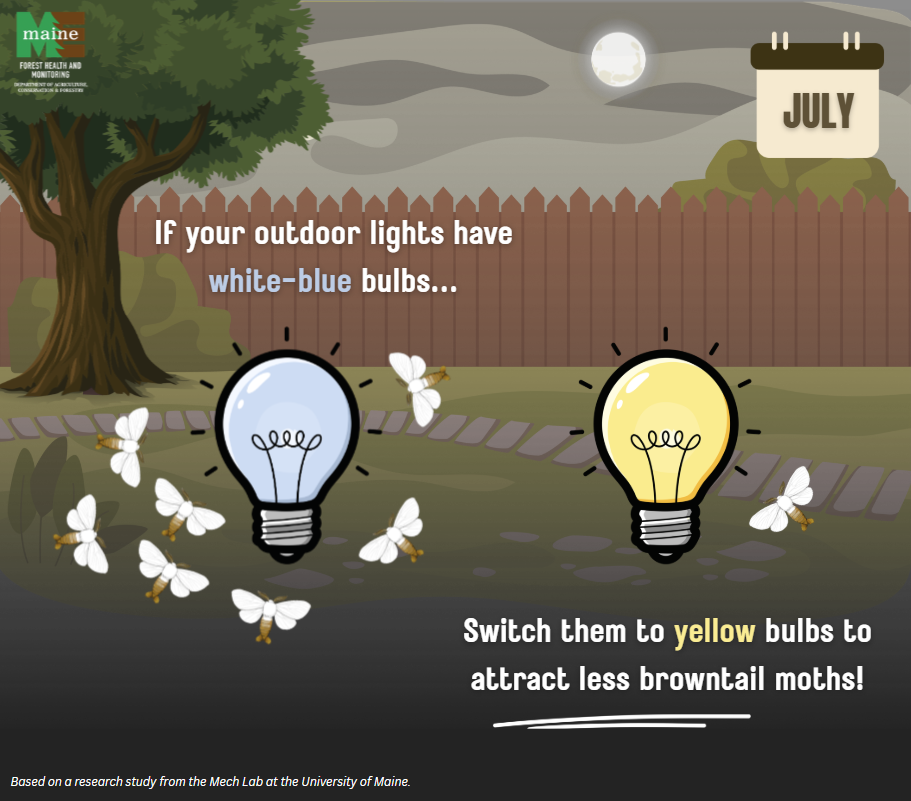
If you can't turn your outdoor lights off at night, consider swapping the outdoor bulb color from white-blue to yellow to attract fewer browntail moth adults according to research from the Mech Lab at UMaine Orono.
This July, remember:
- Turn off non-essential outdoor lights at night.
- Yellow bug lightbulbs are sold at many hardware stores and can be a good option if lights need to stay on outside.
- Avoid using lightbulbs on the UV side (cool white-blue hues), such as mercury vapor, metal halide, and some LED bulbs.
Recommendation based on research study from the Mech Lab at the University of Maine.
FAQ: How can I get rid of browntail moth adults?
If you have many browntail moth adults resting on areas near your home, you can remove them using a wet/dry vacuum. Just fill the base with a few inches of soapy water and ensure your wet/dry vacuum has a HEPA filter installed. Vacuum the moths and let them sit in the soapy water for a couple days before disposing.
Avoid using bug-zappers, light traps, lanterns, or other devices that use light to kill browntail moths. These devices will attract more browntail moths to your backyard with no guarantee that they will be killed and these devices may kill insects that help control browntail moths.
Find more information on browntail moth life cycle, management, human and animal health concerns, and more on our FAQ page.
|