|
In this Issue:
Box Tree Moth
Box tree moth (BxTM) is continuing to spread despite state and federal quarantines. Since 2021, it has been found in 10 states as well as in all eastern Canadian provinces, including New Brunswick near the Maine border. Currently, BxTM is not known to be in Maine.
Box tree moth caterpillars can quickly defoliate boxwood plants leading to rapid decline and death. This insect can easily move in nursery stock, as eggs and overwintering caterpillars that are difficult to detect. It is important for plant sellers and their customers to be familiar with this pest and how to inspect boxwood plants. The USDA created a video to help with box tree moth identification and host inspection. Check Your Boxwoods for Box Tree Moth Video.
If you suspect box tree moth on any incoming boxwood shipments, please email pictures to horticulture@maine.gov.
More information on box tree moth from USDA
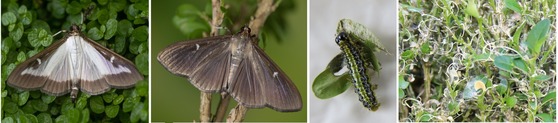 Photo credits (left to right): Ian Redding, box tree moth adult – light morph; Juergen Kottmann, adult – dark morph; Mujezinovic Osman, Faculty of Forestry, bugwood.org, mature caterpillar and feeding damage (“peeling”); Ferenc Lakatos, University of Sopron, bugwood.org, heavy defoliation showing midribs of leaves left behind.
Spotted Lanternfly
Spotted lanternfly (SLF) is also continuing to spread in the U.S. It is still not known to be established in Maine, although we periodically receive reports of adult lanternflies. Based on the timing of these observances, we believe these reports are the result of insects hitchhiking on vehicles coming from infested areas in other states.
The spotted lanternfly can lay eggs on nursery stock and various other materials that move from state to state. These egg masses are cryptic and long-lived as they are the overwintering stage of the insect. To help prevent introductions of SLF in Maine, check incoming plants, outdoor goods and vehicles carefully for egg masses and other life stages of SLF.
The spotted lanternfly has a strong association with the tree-of-heaven (Ailanthus altissima), which may make it difficult to establish in Maine. We are currently trying to identify locations of tree-of-heaven (TOH) in Maine to help assess this risk. In addition to keeping your eyes out for spotted lanternfly, please let us know if you see or are aware of any locations where tree-of-heaven is growing.
Email horticulture@maine.gov with images and locations of TOH or SLF.
As always, thank you for continued cooperation with keeping Maine’s plant life healthy.
More information about SLF
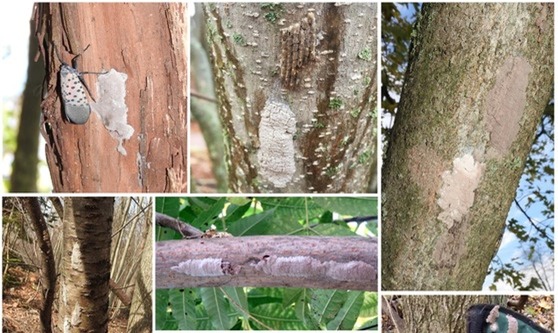 Spotted lanternfly egg masses. Photo credits (clockwise from top left): Richard Gardner, Emelie Swackhamer, Richard Gardner, Liz Willow, Richard Gardner, Kenneth R. Law (center); Bugwood.org.
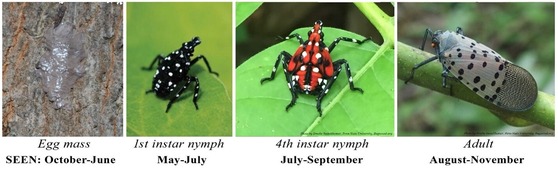 Spotted lanternfly life stages. Photo credits (left to right): Pennsylvania Department of Agriculture, Bugwood.org, Emelie Swackhamer
The Maine Greenhouse Best Practices Workshop planning committee is seeking a greenhouse, nursery, botanical garden, or other horticultural facility interested in hosting our 2026 workshop.
This annual event brings together greenhouse growers, nursery professionals, Extension specialists, state agency staff, industry representatives, and agricultural service providers for a full day of education, networking, and hands-on learning focused on greenhouse production and integrated pest management (IPM).
Benefits of Hosting
Hosting organizations receive:
- Recognition as the workshop host site in all promotional materials.
- An opportunity to showcase their facility, production practices, and innovations to greenhouse professionals from across Maine.
- Complimentary registration for host staff attending the workshop.
- Additional pesticide applicator recertification credits for staff participating as presenters, in addition to the credits earned for attending the workshop.
- Opportunities to connect with industry partners, educators, and fellow growers.
What Hosts Typically Provide
The planning committee works closely with the host throughout the process and handles most of the workshop logistics, registration, outreach, and agenda development.
Host responsibilities generally include:
- Providing a meeting space for approximately 30–50 attendees (if needed, we will arrange rental chairs, tables, etc. We just need a space that can be dark enough to see presentations projected on a screen).
- Offering access to greenhouse or production areas for a guided tour and hands-on educational activities.
- Assisting with basic day-of logistics and facility coordination.
- Identifying staff who are willing to participate in tours, demonstrations, or discussion sessions.
Past workshops have included greenhouse tours, hands-on scouting activities, biological control demonstrations, equipment showcases, disease and pest management training, and grower-to-grower discussions.
Interested in Hosting?
We are particularly interested in facilities that can provide opportunities for attendees to see greenhouse production systems, pest management practices, irrigation systems, propagation areas, native plant production, specialty crops, or other unique horticultural operations.
If you are interested in learning more about hosting the 2026 Greenhouse Best Practices Workshop, please contact:
Hillary Peterson IPM Specialist & Entomologist
Maine Department of Agriculture, Conservation and Forestry
hillary.peterson@maine.gov
University of Maine Cooperative Extension (UMCE) is working on a comprehensive update to Bulletin 2500, our native plants for home landscapes resource. The revised version will focus on plants native to New England and will include bloom times, tips for matching plants to site conditions, and information about invasive plants.
The updated plant list of over 170 species will be available online, with an emphasis on plants that are either readily available in the nursery trade or commonly found growing wild in Maine landscapes. A shorter printed version is also in the works, focused on plants more readily available in the nursery trade.
The resource is designed for two audiences: homeowners actively looking to add native plants to their landscape and those who want to recognize and appreciate what may already be growing in their yard. It will also include guidance on light and moisture conditions, edibility notes and how to approach rewilding a space gradually and thoughtfully.
UMCE will share more details, including a link to the updated resource, as the project comes together. In the meantime, reach out to Kate Garland with questions or to be among the first to know when it is available: katherine.garland@maine.edu, 207.942.7396
Post Rugosa Rose Signs
If you sell rugosa rose, please remember that you must post signs around all R. rugosa plants, regardless of variety, indicating that the plants can be invasive in some habitats. The Horticulture Program has a supply of free signs printed on weather resistant paper that are available to order using the outreach materials request form.
Now is also a good time to check your inventory to ensure that you do not have any plants for sale that are on the Invasive Plant Do Not Sell List. Remember, the ban on the sale of these plants includes all varieties, cultivars and hybrids of the listed species, and that some plants may be labeled under alternate scientific names. The Invasive Plant Guide for Maine Horticultural Businesses lists many of the alternate scientific names and common varieties. If you don’t already have a copy, order one for free using the outreach materials request form.
Compliance Agreements Needed to Ship Out-of-State
Anyone shipping plant material out of state must have a signed compliance agreement on file with the Horticulture Program. Compliance agreements are specific to each business and include the requirements the business must follow to comply with the destination state's plant health regulations for the species that are shipped and allows the business to send plants using a Maine Nursery Stock Certificate. Compliance agreements cost $60 for businesses that have a nursery license and $106 for businesses that ship plant products that do not require nursery licensing. To start the process of obtaining a compliance agreement fill out an application for shipping plants.
Spring of 2026 has provided Maine with up and down temperatures and lots of intermittent rain and sun, keeping growers on their toes.
Inspectors have found common greenhouse pest pressure to be low overall. Small infestations of aphids were seen on Alcea, Cuphea, Dahlia, Gazania, Geranium, Ipomoea, Portulaca, Zinnia, Avocado, cauliflower, pepper, and Tarragon. Thrips have been found on Asclepias, daylily, Gerbera, Ipomoea, marigold, Rudbeckia, Verbena, cucumber, and eggplant. Low infestation levels of aphids, spider mites and mealy bugs were found on various tropical/house plants. Lily leaf beetle larvae and adults have already been observed on Lillium, and pear leaf blister mites on fruiting pear trees.
Plant disease pressure has also been manageable. Botrytis was found on some of its favorite hosts: Begonia, Geranium, Impatiens and Zinnia. Powdery mildew was seen on sage, sunflower and Sedum, and Pythium root rot on snapdragon and lavender. Dahlia continues to often be found with virus symptoms, and mottling and mosaic virus symptoms were seen on Dicentra.
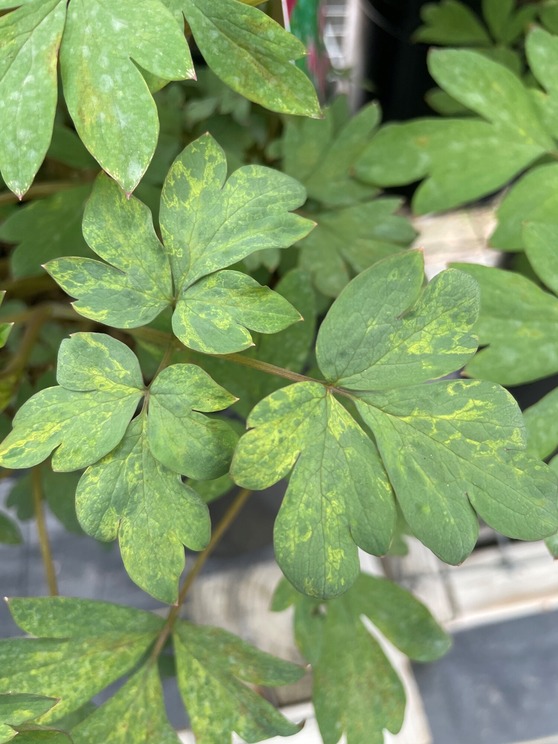 Mosaic virus symptoms on Dicentra
Japanese Maple Scale
An inquiry was received this spring from a nursery regarding a shipment of crabapple trees from a mid-Atlantic state that arrived with a white substance on the bark, found primarily under a fabric trunk wrap. Upon further investigation, the culprit was identified as Japanese maple scale (Lopholeucaspis japonica). This armored scale is native to Asia and has been found in the eastern US for more than a decade on a variety of woody ornamental hosts such as Japanese and red maples, crabapple, Cotoneaster, dogwood, Euonymus, holly, privet and Zelkova. Adults have a purple body with a reddish-brown exoskeleton, which is covered with an additional 1-2mm long grayish-white waxy protective coating, giving it an oystershell appearance. Heavy infestations can lead to stem and branch dieback; pesticide treatments are often recommended for control.
More information on Japanese Maple Scale
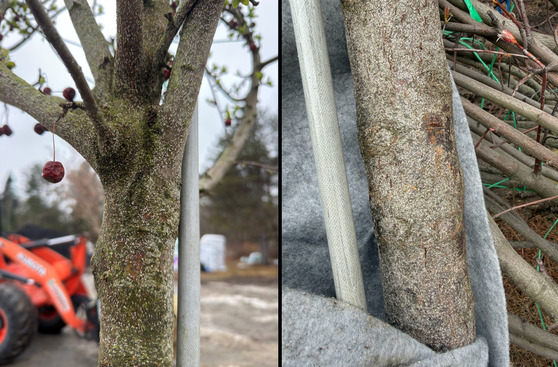 A heavy infestation of Japanese maple scale on crabapples.
Leafhoppers
Most leafhoppers do not overwinter outdoors in Maine, but tend to migrate from southern states, usually following the jet stream northeast with late spring storms. Inspectors were surprised to find leafhoppers damaging perennial Salvia and Asclepias plants at separate greenhouse businesses in early May. In both cases, the plants had overwintered inside cold frames, and we suspect that the leafhoppers survived in those sheltered locations. These finds also raised concern as inspectors have been on the lookout for the two-spot cotton leafhopper (Amrasca biguttula), a new species to the US from Asia. Two-spot cotton leaf hopper was first found in Puerto Rico in 2023 and has since spread to many southern states. While cotton is not generally grown in Maine, damage to other hosts including cucurbit and solanaceous crops, grape and hibiscus can be severe and include leaf yellowing, margin necrosis, leaf curl and distortion resulting in reduced plant vigor. Leafhoppers move quickly; approaching slowly is critical to look for the distinctive two dark spots on the wings.
More Information on Two-Spot Cotton Leafhopper
|