|
Drought
Maine entered the winter season with moderate drought (D1) conditions across all counties, with some counties in severe (D2) and extreme (D3) drought. Recent rainfall this spring has improved drought conditions in northern and eastern Maine; both areas have moved out of severe drought and into abnormally dry (D0) or no drought conditions. Regions of southern Maine are experiencing below-average precipitation, and severe drought conditions have persisted into this spring. In NOAA’s U.S. Drought Seasonal Outlook map, drought conditions in the next few months are expected to improve in most of Maine, except areas in southern York County, where they are expected to persist through the summer.
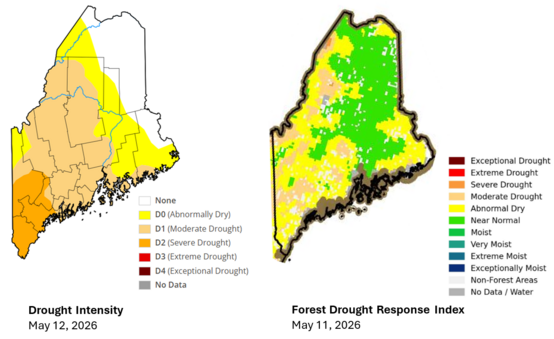 |
Image: (Left) Drought persists in every county in May; however, conditions are improving and are expected to resolve completely in some areas; (Right) The Forest Drought Response Index uses different metrics to report drought conditions in Maine’s forests, where woodlands are currently experiencing lower drought severity than indicated by the general drought index.
The Forest Drought Response Index (ForDRI) is a new monitoring tool that considers data from multiple environmental variables to identify forest drought stress: groundwater, soil moisture, evaporative demand, and vegetation health. Despite some areas of Maine experiencing drought, the ForDRI reports that Maine’s forests are experiencing less severe drought.
Winter Summary
The Northeast region experienced the coldest winter season (December–February) since the 2014–2015 season, averaging roughly 3.3°F below climate normals across multiple states. In Maine, winter temperatures were generally 1–5°F below normal in every county except Aroostook, where they were closer to average. Statewide, leaf-out in May occurred later than normal, likely influenced by a colder-than-average winter.
Precipitation this winter was 25–50% below average for central and southern Maine, with areas in Aroostook County experiencing up to 75% below average precipitation. This winter season was the driest on record for Houlton, and Caribou had a 17.2-inch deficit in snowfall compared to 1991–2020 climate normals. Although Bangor had above-average snowfall totals courtesy of a few high-snow-total storms, precipitation was still 3.21 inches below normal.
In contrast to below-average winter precipitation, March and April precipitation has been near or above normal across much of the state, except in southern Maine, where it has been below normal. The forecast for the next three months predicts slightly above-average temperatures and equal chances of below-, near-, or above-normal precipitation across Maine (NOAA 2026).
Browntail Moth (Euproctis chrysorrhoea)
Browntail caterpillars were slow to emerge from their winter webs this year, likely a result of the colder-than-average winter season and late host leaf-out. We did not document their emergence until April 29, about two weeks later than normal. This marks the latest date of emergence since weekly monitoring began five years ago.
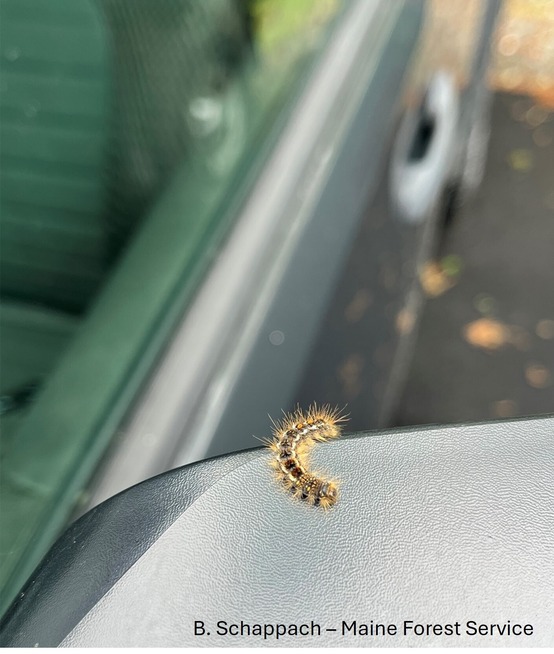
In mid-May, browntail caterpillars are mostly third instar (lacking their characteristic broken white stripes on the back), but warmer sites with more developed host trees have caterpillars in their fourth instar. Once the caterpillars are this large, they spend less time together and more time wandering in search of new food sources. This is often when people first realize they have a browntail moth infestation.
Image: Fourth instar browntail moth caterpillar crawling on a car's side mirror in a parking lot.
If you notice browntail moth caterpillars crawling on your house, car, garage, or other outdoor spaces, you can dislodge them by:
- Using the jet mode on your garden hose and/or
- Vacuum them up with a wet-dry vacuum. Ensure the vacuum has a HEPA filter installed to prevent their toxic hairs from exiting the vacuum and giving you a rash. Furthermore, fill the bottom of the wet-dry vacuum with a few inches of soapy water so that when they are vacuumed, the caterpillars fall into the water and die.
Generally, insecticide treatments should take effect before the end of May to be most effective. Treatments applied later than this do not reduce damage to trees or prevent the buildup of toxic hairs in the environment and are not recommended. Read more in our browntail moth FAQs.
Browntail moth populations are expected to remain low this year, except in a few areas with higher populations, including Androscoggin, Cumberland, Hancock, and Oxford Counties. Aerial and winter web survey maps, browntail developmental updates, and other helpful information can be found on our browntail moth webpage.
Fall cankerworm (Alsophila pometaria)
Fall cankerworm is one of our native geometrid moth caterpillars in the same family as the non-native winter moth. The populations of this species occasionally surge, with outbreaks occurring for two to four years. 2025 was the first year of noticeably higher fall cankerworm levels in the northeast, so we are expecting populations to be elevated this year. Due to the current outbreak of winter moth in Midcoast Maine, some of the damage from these two species may overlap and obscure the true scope of the fall cankerworm damage.
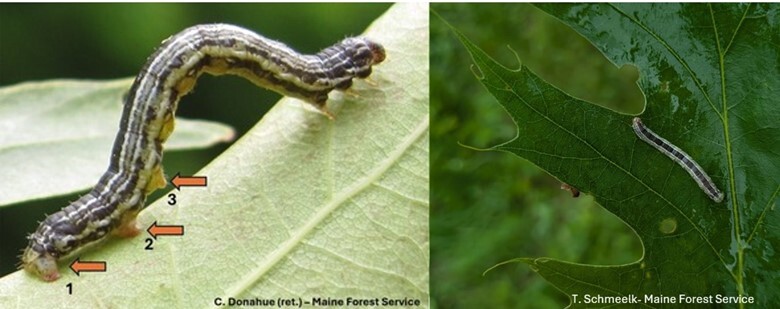
The caterpillars of fall cankerworm have a wide host range and feed on many deciduous trees, including elm (Ulmus spp.), ash (Fraxinus spp.), maple (Acer spp.), oak (Quercus spp.), members of the rose family, walnut (Juglans spp.), and willow (Salix spp.). As the cankerworms mature, they devour all but the midrib and veins of the leaves. Fully grown cankerworms are about one-inch long and vary in color from light green to brownish green, with a darker stripe running down the middle of the back and a white stripe along each side. They have three pairs of fleshy legs called prolegs near the end of the abdomen, whereas most other lookalikes have only two. The most interior pair of prolegs is reduced compared to the other two.
Management of this species generally isn’t warranted, as it has its own suite of native predators and parasitoids that help control outbreaks, including two Scelionidae wasps which parasitize the eggs.
Images: (Left) Prolegs are indicated at arrows. Proleg at 3 is reduced compared to those at 1 and 2; (Right) Fall cankerworm caterpillar on an oak leaf.
Hemlock Woolly Adelgid, (Adelges tsugae)
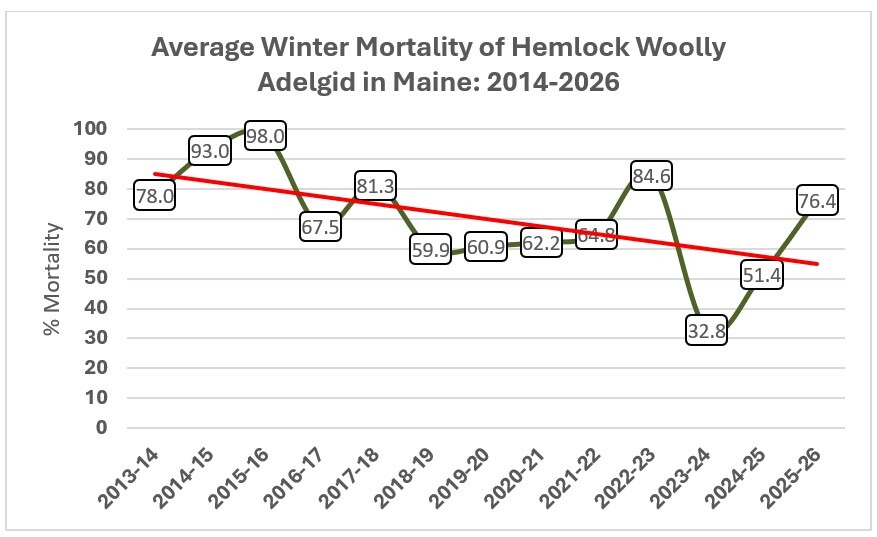
Every year, toward the end of winter, Maine Forest Service entomologists collect hemlock woolly adelgid (HWA) samples from sites throughout its range to see what percentage has died over the winter. Winter mortality of HWA is the major factor controlling HWA population growth, and over the past 13 years has ranged from 98% to 32.8%. This past winter, mortality was measured at nine sites and ranged from 61.5 to 91.6%, averaging 76.4%.
If you look at the trend over the past 13 years, winter mortality rates appear to be declining. This is partly because winters in Maine are not as consistently cold as they used to be, and research has shown that HWA in colder climates are also adapting and becoming more cold-resistant.
Image: Average winter mortality of hemlock woolly adelgid from 2014–2026.
Emerald Ash Borer (Agrilus planipennis)
New Location and Quarantine Update
In April 2026, a logger reported an ash tree with woodpecker damage in Benedicta to a Maine Forest Service district forester, which was then passed on to the Division of Forest Health and Monitoring. Initial photos of the infested tree appeared consistent with emerald ash borer (EAB), which was later confirmed in the field by peeling the bark and verifying the presence of EAB larvae.
This was a particularly difficult find to stomach, given its location. Maine has regulated EAB since it was first found in Maine in 2018 using quarantine rules to prevent the spread of EAB through movement of regulated ash plant material potentially carrying EAB larvae, especially firewood. This newest infestation is isolated by some 70 miles in any direction, meaning it is very likely the result of human movement of infested ash material outside of existing quarantine boundaries. Ash wood generally does not move into Benedicta, unless it is firewood.
The towns surrounding Benedicta have been added to Maine’s existing EAB quarantine area. At the same time, the quarantine area has been expended around Solon. While Solon was inside the quarantine area when EAB was discovered, its position on the quarantine boundary means EAB may be present at low populations outside the quarantine zone in that area.
Here is the complete list of towns being added to Maine’s EAB quarantine area in April 2026:
Aroostook County: Benedicta, North Yarmouth Academy Grant Twp, Sherman, Silver Ridge Twp, T1 R5 WELS, T2 R4 WELS, T3 R4 WELS, Upper Molunkus Twp
Penobscot County: Herseytown Twp, Staceyville, T1 R6 WELS
Franklin County: Carabassett Valley, Dallas Plt, Freeman Twp, Kingfield, Mount Abram Twp, Redington Twp, Salem Twp
Somerset County: Bingham, Concord Twp, Embden, Highland Plt, Lexington Twp, Mayfield Twp, Moscow, New Portland, Pleasant Ridge Plt
Piscataquis County: Kingsbury Plt
Biocontrol
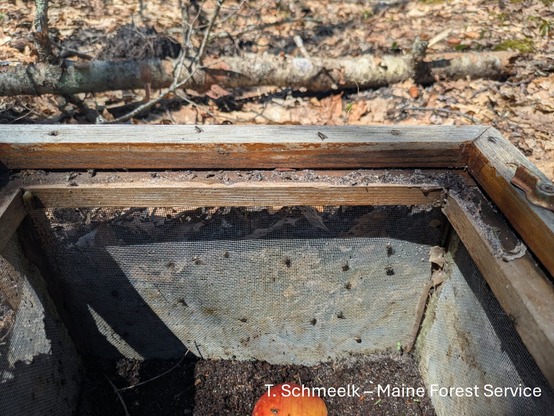
There are multiple ways to monitor for the parasitoids released to help manage EAB. In Maine, we have found the most effective way to detect parasitic wasps is to fell trees, peeling some of them, and placing branches and pieces of the upper boles in large rearing barrels for up to a year. This allows any parasitoids in EAB eggs or larvae to complete their development and emerge. Of the ten sites where we have monitored for parasitoid recovery, we have found one or both of Spathius galinae or Tetrastichus planipennisi (both parasitoids of EAB larvae) at five sites. The tiny egg parasitoid, Oobius agrili, is very difficult to detect and has not yet been found in Maine. Seven Tetrastichus and 36 Spathius were recovered from trees felled and placed in rearing barrels in 2024. Thirty-five of the Spathius were found in four trees at a single site. In addition to the released parasitoids, a native parasitic wasp in the genus Atanycolus was also found at multiple sites and was particularly numerous at one site, with five EAB found parasitized by this wasp. Although this wasp will attack EAB, because it is a generalist, it cannot provide sufficient control. However, it can add to the effect of the released parasitoid species. All but one of the released wasps recovered over the past five years have been in southern locations. In northern Maine, EAB requires two years to complete its life cycle, which may make it more difficult for the parasitoids to establish.
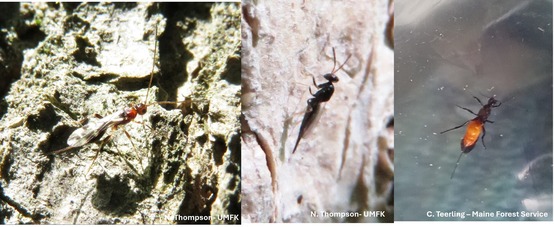 |
Image: Spathius galinae (left) and Tetrastichus planipennisi (center), parasitoids of larval emerald ash borer; (right) Atanycolus sp, a native parasitoid.
Treating Ash Trees for Emerald Ash Borer
As EAB continues to spread into new parts of Maine, many landowners are beginning to explore chemical treatment options to protect the ash trees on their property.
Spring is generally considered the ideal time for treatment with emamectin benzoate, an active ingredient shown to be highly effective at mitigating EAB impacts. When administered correctly by a licensed pesticide applicator, a single treatment can protect a tree for approximately three years. While treatments can be applied throughout much of the growing season, spring applications have consistently been shown to provide the best results.
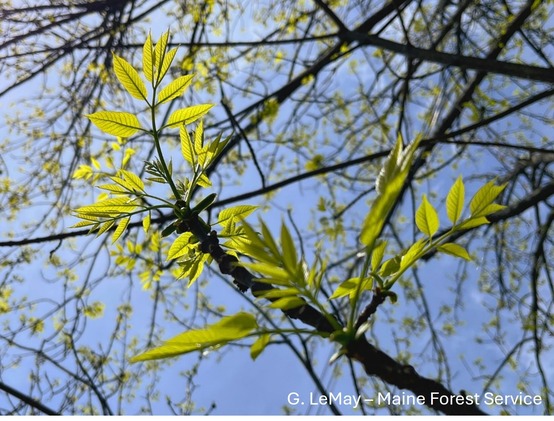
Image: Ash trees are beginning to leaf out across Maine.
Emamectin benzoate works systemically, meaning the insecticide moves throughout the tree’s vascular system where it can affect EAB larvae feeding beneath the bark and adults eating the leaves. Therefore, treatments are most effective once leaves are fully expanded and the tree is actively transporting water to the canopy. Depending on where you are in the state, ash trees may not leaf out until the end of May and into June. Much like a shy party guest, ash trees are among the last to arrive and one of the first to exit the growing season.
Once those leaves do appear, it is worth taking a close look at the health of the tree’s crown before committing to insecticide treatment. Within the first couple years of attack, EAB feeding can cause thinning foliage and even the death of individual branches. While treatments can help trees with moderate damage recover over time, those that have already lost more than half of their canopy are generally considered too heavily impacted to respond well to chemical intervention.
Decisions about whether to protect a tree also depend on individual priorities. Factors such as tree size, location, and aesthetic value all play a role, but for many landowners, treatment can be considerably more cost effective than removing and replacing a mature tree. Online tools such as Purdue’s Emerald Ash Borer Cost Calculator can help estimate treatment and removal costs over time.
Even if a tree is not yet showing signs of EAB infestation, treatments can also be conducted preemptively. Healthy ash trees located within roughly 10 miles of a known EAB detection are often good candidates for protection. Those interested in understanding their local risk can explore the Maine Forest Service Invasive Species Dashboard to see where EAB has been detected across the landscape. A guide on insecticide options for managing EAB is also available, which provides more information on the subject. As EAB continues to spread across Maine, early decision-making can greatly improve the likelihood that high-value ash trees remain healthy and in the landscape for years to come.
Southern Pine Beetle (Dendroctonus frontalis)
Each year, Maine Forest Service staff, along with cooperators including the National Park Service and The Nature Conservancy, run a network of more than 20 traps covering Maine’s coastal and inland pine barrens habitat. Although the traps did not capture many beetles over the course of the season, there were some positive southern pine beetle (SPB) trap catches. The four specimens that were captured were from three different sites; of those two had no prior detections of SPB. One specimen was captured at the Waterboro pine barrens where the first detections of SPB in Maine were made in 2021. Two specimens were from Kennebunk Plains Preserve and one specimen from Ferry Beach State Park. With these low trap catches, there is a very low chance of finding infested trees, but survey efforts are underway.
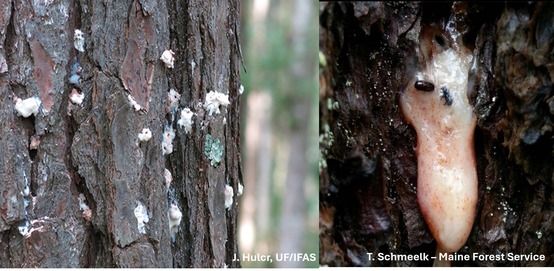
If you happen to be out in one of these coastal or inland pine barrens, look for pines that are declining or that look like they have declined. Signs of SPB infestation include trees with yellowing canopies or that are turning orange/red. One of the other major indicators of an SPB infestation is pitch tubes which look like popcorn (see image below) along the trunk of the tree; mostly head height and above. Our native red- and black turpentine beetles also create pitch tubes but are generally confined to below head height.
Image: (Left) Southern pine beetle pitch tubes on the trunk of a pitch pine; (right) close up of a fresh pitch tube with two southern pine beetles trapped within.
Spruce Budworm (Choristoneura fumiferana)
Spruce budworm activity continues in northern Aroostook County as the Maine Budworm Response Coalition gears up for another busy season of aerial spray operations in late May 2026. Given the success of last year’s treatment program, the number of acres intended for treatment in 2026 is considerably lower than in 2025. In total, just over 240,000 forested acres were treated for spruce budworm in northern Maine in 2025 using the Early Intervention Strategy (EIS) pioneered in New Brunswick and elsewhere in Atlantic Canada. By comparison, less than 70,000 forested acres requiring treatment are planned for the 2026 season. In addition to industrial timberlands, the 2026 program will also include around 2,600 acres located on properties enrolled in the program by interested small woodlot owners and determined to be eligible for treatment based on the presence of active SBW populations and the appropriate forest type and condition. We will have much more to report on next month, but in the meantime, the 2025 Spruce Budworm Annual Review & Outlook Report has recently been released and can serve as a good primer, providing an overview of how we arrived at this point, headed into the 2026 season.
Winter Moth (Operophtera brumata)
On May 4, our most recent biocontrol establishment effort took place in Georgetown, Maine. Last fall, a screened emergence cage was placed in the ground to overwinter the 800 fly pupae that were collected from some of our previous release sites in Maine in June 2025. These flies’ progeny will provide some relief to Westport Island, Georgetown and the surrounding area, which have been impacted by intense defoliation from winter moth caterpillars over the past few years. A multi-state mobilization effort to collect more biocontrol flies from our previous release sites is being planned. This mobilization will help our biocontrol program here in Maine and in Rhode Island, where winter moth populations seem to be building again.
Image: Cyzenis albicans flies emerge from the cage that was placed in the ground last fall in Georgetown, ME
Beech Leaf Disease (Litylenchus crenatae mccannii)
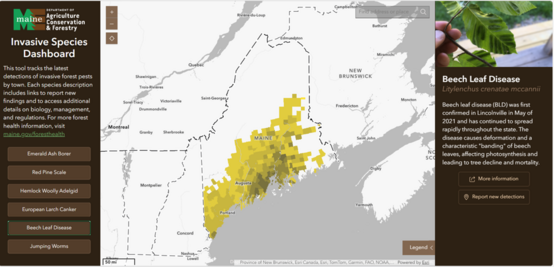
Beech leaf disease (BLD) is now found throughout a large portion of Maine, and we expect to find the disease in new areas in 2026 after leaf expansion reveals the banding and crinkling leaf symptoms characteristic of BLD. Now you can keep track of where BLD has been confirmed, in real time, by checking the Maine Forest Service invasive species dashboard. Here you can also view the current distribution of other high-profile forest pests in Maine.
Image: A screenshot of the publicly available Maine Forest Service Invasive Species Dashboard.
MFS efforts to trial BLD management methods continue in 2026. The current methods we are evaluating are basal bark drenches of polyphosphite products and macroinjections of Arbotect 20S (active ingredient, Thiabendazole). We are still looking for suitable sites where beech bark disease-resistant beech trees (clean beech/smooth-barked beech) can be found (see examples of resistant and non-resistant trees below). By protecting beech bark disease-resistant trees from BLD, we are preserving their rare genetics for the future. A minimum trial site requirement is presence of at least three clean beech trees that are about 10 inches in diameter or above, and willingness to join MFS BLD management trial efforts. An ideal site would have good road or trail access for easier transport of the water, pesticides and equipment used in the trials. Please reach out to aaron.bergdahl@maine.gov with site information and questions. BLD treatments will begin in late June.
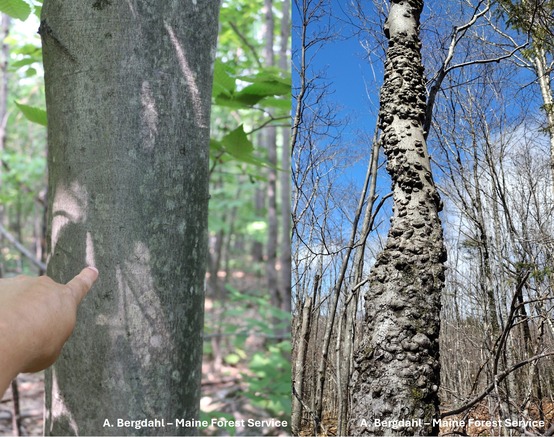 |
Images: A beech bark disease resistant beech tree exemplified by smooth bark (left); A beech tree that is highly susceptible to beech bark disease (right).
Roadside Orange Trees
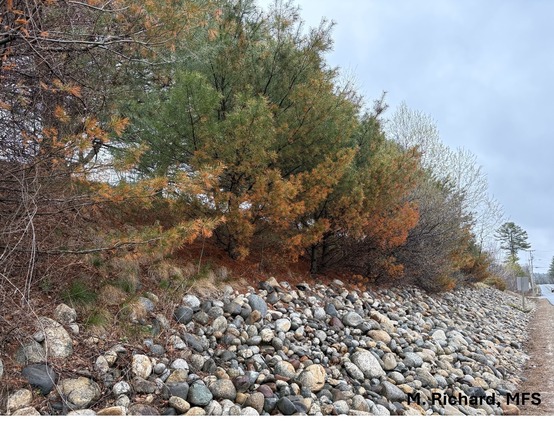
If the title of this article didn’t catch your attention, maybe curiously orangish pine trees have caught your eye this spring along roads and field edges. Salt damage and winter burn (desiccation of foliage due to high solarization in late winter) can be common among most species of conifers (evergreens) growing near paved roads and exposed areas in spring in Maine. This year, white pines have been particularly symptomatic. On closer observation, we have not identified any biological agents responsible for this and believe the symptoms are due to physiological impacts of salt and/or foliage desiccation. The exact combination of factors that have led to this symptom being more prevalent in white pine is unclear. We suspect that most of these trees will recover from this discoloration.
Image: Eastern white pine trees showing signs of winter damage/salt damage near a road in western Maine. In this case, a combination of salt exposure and heat reflectance from the stones may be to blame.
White Pine Blister Rust (Cronartium ribicola)
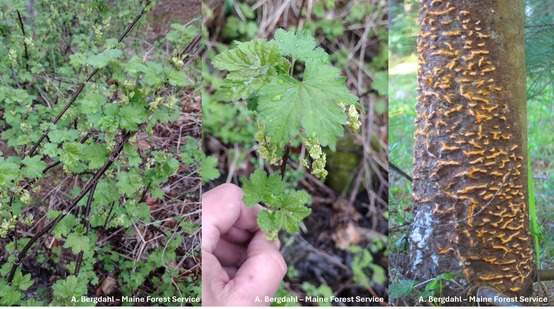
Plants in the genus Ribes (currants, gooseberries, and their hybrids such as “jostaberries”) are alternate hosts for the fungus that causes white pine blister rust, a devastating disease of white pine. Now is a great time to locate and manage (destroy) these woody shrubs, as they are among the first to leaf out in spring. Ribes spp. plants are adaptable and can be found in the forest understory, along rock walls and field edges. These plants are quite a bit less common in Maine compared to other Northeastern states due to a previous long-term effort here to eradicate them.
Images: Ribes plants are alternate hosts for the fungus that causes white pine blister rust.
Ribes plants are subject to a quarantine in Maine and their sale and cultivation are banned throughout most of the state. European black currants are banned throughout the entire state of Maine. More information about White Pine Blister Rust and the quarantine is found on our website. For official quarantine regulations language, see the Secretary of State Office’s website on rules, 01 669 Chapter 1). Please contact MFS Forest Health and Monitoring with any questions about white pine blister rust or current currant (Ribes spp.) restrictions.
Yellow-Bellied Sapsucker (Sphyrapicus varius)
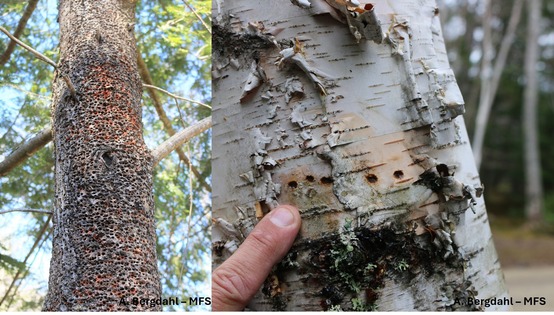
Yellow-bellied sapsuckers are birds that range throughout much of North America. They cause varying levels of tree damage as they excavate neat rows of holes in tree bark to drink exuding sap and feed on insects attracted to the tree wounds. The holes they make are larger and shallower than those typically made by insects and they are formed in neat rows by the bird. Further, this damage is not associated with boring sawdust or frass typically seen with wood-boring insects. Trees often heal over these shallow holes, but these wounds can sometimes serve as openings for infection by decay fungi or other pathogens.
Sapsuckers spend winters in southern areas of North America, even ranging into Central and South America. Some migrate through Maine while heading for summer nesting areas further north and some nest in Maine. Thus, you may only notice fresh sapsucker wounds in spring and fall when the birds are migrating through your area.
There are various creative ways people try to deter sapsucker feeding activity, including hanging old reflective compact disks from trees and wrapping parts of trees in burlap. If these don’t work, and your frustration with sapsuckers leads to you thinking about more sinister solutions, be advised that sapsuckers are protected by the Migratory Bird Treaty Act. Luckily most trees are resilient to sapsucker damage and few experience limb dieback or mortality.
Images: A hemlock tree with thousands of sapsucker holes extending much of the tree’s main stem (the tree’s crown remained green and full) (left); A few sapsucker holes in a birch tree (right).
EDRR Alert: Status Update of Stiltgrass in Maine
Japanese stiltgrass (Microstegium vimineum) has been confirmed in five counties in Maine (York, Lincoln, Sagadahoc, Kennebec, and Hancock). Stiltgrass is a severely invasive, annual grass originating from southern Asia. Originally introduced to Tennessee in 1919, stiltgrass has seen unbridled spread across the eastern United States over the past century. In Maine, stiltgrass is still considered an early detection/rapid response (EDRR) species. EDRR species are recent invaders, meaning they can still potentially be eradicated from the state. Therefore, biologists from the Maine Department of Agriculture, Conservation and Forestry (DACF) are asking for the public’s help in locating and reducing the spread of this severely invasive grass.
Background
Stiltgrass was first detected in 2020 (in York and Sagadahoc Counties), but additional efforts surveying new areas and alerting the public of this high-priority species resulted in the discovery and confirmation of four additional populations in 2025 (South Berwick, Westport Island, West Gardiner, and Blue Hill). These new areas are disconcerting, as previous infestations were limited to southern Maine, these new discoveries extend the distribution of stiltgrass into the Mid-coast region and Central Maine. In addition to this range expansion, a newly discovered population in York went undetected for several years and is relatively large, spanning twenty parcels of private land, along roadsides and also spreading into undeveloped forests via ATV trails. Other new populations detected in 2025 are thought to have been introduced in the past few years as hitchhiking seeds in nursery pots.
Stiltgrass is an herbaceous, annual grass that produces new plants only by seed, which are viable for 3–5 years. In areas stiltgrass has been found in Maine, it is primarily growing in yards, along roads, ATV/hiking/biking trails, old skid trails, wetlands and streams. Therefore, it is primarily spread via vehicle traffic, recreational activities (hiking and ATVs), and flowing water. As a prolific seed producer, stiltgrass easily invades natural areas and outcompetes many of our native groundcover species. Stiltgrass is also highly allelopathic, meaning it releases organic compounds into the soil that degrades the health of the soil and inhibits the growth of other plant species. As the growing season ends, stiltgrass stems dry out, leaving a thick layer of dry thatch along the forest floor. This introduces a severe wildfire risk to any invaded areas. Due to the countless negative impacts that stiltgrass poses on Maine’s natural areas, identifying stiltgrass populations and managing its spread is among the highest priorities for invasive species management in the state.
Identification
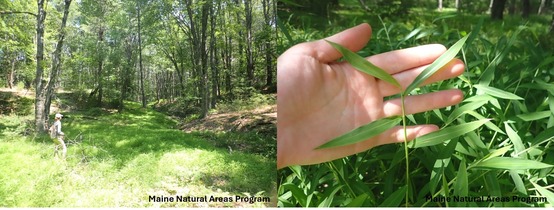
There are several characteristics that can be used to identify stiltgrass and distinguish this species from our native grasses in Maine. The most reliable identifying characteristic for stiltgrass can be found on its pale green, alternate leaves. On the upper surface of stiltgrass leaves is a recognizable silvery midrib (central vein running along the length of the leaf). This silver midrib is unique to stiltgrass and is not found on any of Maine’s native grasses. Additionally, the texture of stiltgrass leaves is extremely smooth or silky. Nearly all of Maine’s native grasses possess a sticky or grippy texture when passing the leaves between your fingers.
Stiltgrass can also be distinguished from native grasses using its growth form. Mature plants produce aerial roots, or “stilt roots” (the namesake for this species), at lower nodes along the stem that help to prop up the plant. This trait is unique to stiltgrass. Additionally, stiltgrass tends to branch out close to the ground, producing several main stems that may appear to have a sprawling growth habit. This trait is extremely uncommon among Maine’s native grass species.
Images: (Left) Stiltgrass has formed a large, dense infestations in a forest in Georgetown; (Right) Stiltgrass leaves alternate along the stem and have a silvery midrib.
Stiltgrass in Maine
Newly identified populations will all undergo initial management during the 2026 growing season, while management will continue for older sites. However, the search for stiltgrass is not over. Identifying populations of stiltgrass before they are well established is the key to slowing the spread of this severely invasive species, protecting our natural areas, and ultimately eradicating this species from the state of Maine. Newly detected stiltgrass should be removed to prevent it from damaging Maine’s treasured forests and wetlands. DACF will offer support and guidance to affected landowners. If you would like more information or believe you have found Japanese stiltgrass, please visit our website www.maine.gov/dacf/mnap/ under the Invasive Species tab to view our invasive plant field guide for identification tips and to sign-up for a free iMapInvasives account. If you think you have discovered a stiltgrass population, please email invasives.mnap@maine.gov with pictures of identifying characteristics and specific location details.
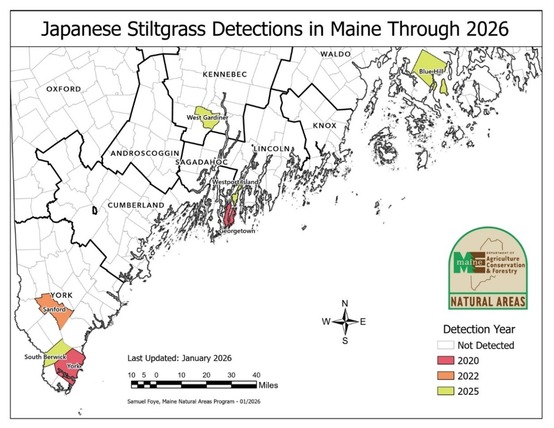 |
Image: Japanese stiltgrass locations in Maine.
Senior Entomology Technician Wayne Searles retires at the end of May after serving the state for more than 45 years. We are extremely grateful for his steady presence and the wealth of knowledge he has shared with those of us who joined FHM later. As supervisor Aaron Bergdahl stated, “It’s hard to imagine the MFS IDM Team without Wayne. He joined the Maine Forest Service in 1981 and has since worked on just about every forest health project: white pine blister rust control, spruce budworm, the 98’ ice storm impacts, phytophthora stream baiting, hemlock woolly adelgid, spongy moth, winter moth, browntail moth, white pine needle damage, Caliciopsis canker, European larch canker, light trap program, beech leaf disease, emerald ash borer, insect trapping of various kinds…”, and more. “Over the years he has worked with so many people, seen so much and done an enormous amount of important work: Wayne has truly made an impact on Maine’s forest health and its community.”
“All who know or who have worked with Wayne can attest to his excellent positive attitude and camaraderie, his knack for engaging the public, his deep historical and technical knowledge of Maine forest health, and his amazing ability to ‘get there from here’ – sometimes using some very creative routes (I believe he has the Maine Gazetteer memorized!). The MFS community is indeed grateful for the years he has spent here. He will be missed AND fondly remembered!”
Entomology technician Cindy Bellavance has finished up her time at Maine Forest Service and we are pleased to announce she is headed to North Carolina State University to pursue a Master’s Degree in Forestry, with a research project focused on the armored scale pests Cryptomeria scale and elongate hemlock scale. We will miss Cindy’s warm presence and wish her many “Happy Mondays” ahead.
Reg Clarke began as our summer intern in late May, based out of our Old Town office. Reg graduated in May from the University of Maine in Orono with a Bachelor of Science in Forestry. Reg comes to the position with a strong academic record and impressive depth of relevant field experience. Given the recent departure of two of our field staff, we expect to lean heavily on his abilities this coming season.
Arbor Week Activities: Six communities; Portland, South Portland, Kennebunkport, Westbrook, Farmington, and Yarmouth were awarded Tree City USA honors in a ceremony held on May 17 at the Pine Tree State Arboretum. A central driveway which will eventually lead to the arboretum visitors center was dedicated as Tree City Lane. Officials and school children from each community participated in the planting of trees along the drive. Our congratulations are extended to these towns and the people who made the awards possible.
Conditions Report No. 1, 2026
On-line: https://www.maine.gov/dacf/mfs/publications/condition_reports.html
Department of Agriculture Conservation & Forestry, Maine Forest Service – Forest Health and Monitoring
Contributors: Aaron Bergdahl, Amy Emery, Chad Hammer, Gabe LeMay, Mike Parisio, Brittany Schappach, Tom Schmeelk, Colleen Teerling, and Andy Whitman.
|